⭐ Must-see · Avlabari, Elia Hill, 2 km from central Tbilisi
Holy Trinity Cathedral (Sameba)
By the Tralover editorial team · Fact-checked · How we research
A golden cross above the city, built in our own time
🎧 Listen to this guide · about 5 min
Pop your earphones in and we'll walk you round.
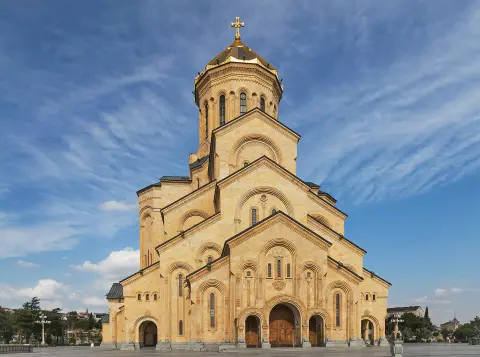
Look up from almost anywhere in Tbilisi and you will see it: a tall stone church with a golden dome, crowning the hill across the river. This is Tsminda Sameba, the Holy Trinity Cathedral. It is new, finished only in 2004, yet it is built in the old Georgian way, with steep gables, tall drums and fine stone carving. Climb the steps through the gardens and let it rise above you. Inside, candles flicker, incense drifts, and voices sing the liturgy in close harmony. Whether you come as a pilgrim or simply as a curious traveller, this is where you feel the faith of modern Georgia.
The story of Holy Trinity Cathedral (Sameba)
The idea for a great new cathedral came in 1989, as the Soviet Union was weakening and Georgia was turning back to its church. An international design contest was held. The first round produced no winner, and in the end the design of the architect Archil Mindiashvili was chosen.
The foundation stone was laid on 23 November 1995, the feast of St George. Building went on through hard years of economic crisis, funded largely by donations. Exactly nine years later, on 23 November 2004, Catholicos-Patriarch Ilia II consecrated the cathedral.
The site was not empty. Part of the hill held Khojavank, an old Armenian cemetery, and during construction graves were disturbed. This remains a painful memory for Tbilisi's Armenian community, and it is worth knowing as you walk the grounds. Today the cathedral is the seat of the Georgian Orthodox Church and the setting for its most important services.
The setting
The cathedral stands on Elia Hill in Avlabari, above the left bank of the Mtkvari. It measures about 70 metres long and 65 metres wide, and rises 86 metres to the top of its gilded cross. The plan is a cross inside a square, the classic form of Georgian church building, topped by a high central drum and dome. The walls are faced with pale stone and carved around the windows and doors. Around it lie terraced gardens, ponds, a separate bell tower and smaller chapels. Below ground there are further chapels used for services.
Why it matters
Sameba is a symbol of Georgia's religious revival after seven decades of Soviet rule. The Orthodox Church is the most trusted institution for many Georgians, and this cathedral is its public face. Major feast days fill the grounds with thousands of worshippers, and the midnight Easter service here is a national event. For visitors it is also a lesson in the Georgian church style, built at full scale with modern means, and a place to see the living faith of the country up close.
Your walk-through
The stops a guide would take you to, in order.
-
1
The main gate and garden steps
Enter from the street and climb slowly through the gardens. The cathedral grows taller with each step. Notice how the building rises in tiers, from the wide base to the gables, the drum and finally the dome. That stepped outline is the signature of Georgian churches, from medieval mountain chapels to this modern giant.
-
2
The west facade
Stop in front of the main facade and look at the carving around the windows and doors. Interlaced crosses, vines and geometric bands echo patterns from churches built a thousand years ago. Then look all the way up. The cross at the very top is 7.5 metres tall on its own, and the whole building reaches 86 metres.
-
3
The interior
Step inside. Women should cover their heads, and everyone should speak softly. The space is vast and lofty, lit by candles and high windows. Icons glow on the screen in front of the altar. If a service is on, stand to one side and listen. Georgian church singing uses several voices in close harmony, and it is haunting.
-
4
The bell tower
Walk out to the separate bell tower in the grounds. Georgian churches often have a freestanding belfry like this. On feast days the bells ring out across Avlabari and down to the river. From here you get a fine view of the cathedral side on, which shows its true size best.
-
5
The terrace view
Finish at the edge of the grounds, looking west. Across the valley, Narikala Fortress runs along the ridge, with the Mother of Georgia beside it. Below lie the domes of the baths and the old town. You now have the city's old and new symbols facing each other across the river.
Things you might not know
- The foundation stone was laid on 23 November 1995 and the cathedral was consecrated on the same date in 2004.
- The cathedral rises 86 metres to the top of its cross, which alone is 7.5 metres tall.
- Part of the site was once Khojavank, an Armenian cemetery.
Researched November 2026 from: en.wikipedia.org, georgia.travel. Fees and hours change, so check on the day.