⭐ Must-see · San Marco
St Mark's Basilica
By the Tralover editorial team · Fact-checked · How we research
A church of gold, built for a stolen saint
🎧 Listen to this guide · about 6 min
Pop your earphones in and we'll walk you round.
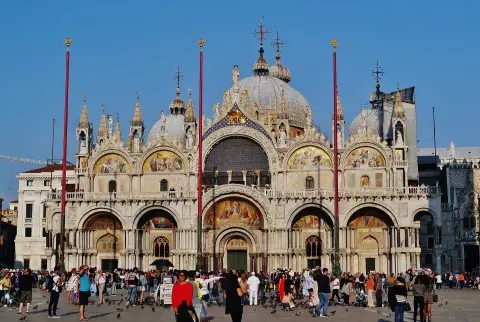
Welcome to the heart of Venice. Stand here in the piazza for a moment and just look. Five domes, rounded arches, marble from every corner of the old Mediterranean, and mosaics that catch the sun like fire. This is St Mark's Basilica, and it does not look like a western church at all. It looks east, toward Constantinople, because that is where Venice traded, fought and dreamed. Inside, the light drops low and the gold takes over. The floor ripples where the ground has settled over centuries. Take your time. Let your eyes adjust. This building was made to impress merchants, ambassadors and doges, and after nearly a thousand years it still does exactly that.
The story of St Mark's Basilica
The story begins with a theft. In 828, two Venetian merchants smuggled the body of Saint Mark the Evangelist out of Alexandria in Egypt. So the story goes, they hid it under layers of pork so Muslim customs officers would not look too closely. Venice now had a famous apostle of its own, and his winged lion became the symbol of the Republic.
The first church to hold the relics was built next to the Doge's Palace and served as the doge's private chapel. It was damaged by fire in 976. The basilica you see today was begun around 1063, modelled on the Church of the Holy Apostles in Constantinople, and it was consecrated in 1094. Over the next centuries Venice kept dressing it up. After the Fourth Crusade sacked Constantinople in 1204, Venetian ships brought home columns, marble panels and the four bronze horses that once stood above the main door.
For most of its life this was the state church of the Republic, not the city's cathedral. That changed only in 1807, after Napoleon ended the Republic, when the bishop's seat moved here from San Pietro di Castello. The mosaics were added and renewed over some eight hundred years, which is why you will see medieval saints beside Renaissance designs.
The setting
The basilica stands at the eastern end of Piazza San Marco, with the Doge's Palace on its right and the tall brick bell tower in front. The plan is a Greek cross, with four arms of equal length, each topped by a dome, and a fifth dome over the crossing. The domes you see from outside are tall wooden and lead shells raised above lower brick domes inside. The facade has five great portals. Their arches are filled with mosaics, and the only original medieval one survives on the far left, showing the saint's body being carried into this very church. Inside, more than eight thousand square metres of mosaic cover the vaults and domes. The marble floor, laid in geometric patterns and animal figures, rises and falls in gentle waves.
Why it matters
St Mark's is the clearest picture of what Venice once was, a bridge between Byzantium and western Europe. Its stones are a record of trade, faith and plunder all at once. Since 1987 it has been part of the UNESCO World Heritage listing for Venice and its Lagoon. It is also a working cathedral, with daily mass, and it is still cared for by the Procuratoria di San Marco, an office whose roots go back to the medieval Republic. Each winter acqua alta floods the narthex, and new glass barriers now protect it, a sign of how hard Venice works to keep its treasures dry.
Your walk-through
The stops a guide would take you to, in order.
-
1
The facade and the Sant'Alipio portal
Before you go in, walk to the far left doorway. Look up at the mosaic in its arch. It dates from the thirteenth century, and it is the only original one left on this front. It shows the body of Saint Mark being carried into the basilica, and you can see the domes of the church itself in the picture. It is like looking at a medieval postcard of the building you are standing in front of.
-
2
The narthex
Inside the entrance porch, raise your eyes. These mosaics tell the stories of Genesis and the life of Moses. Find the creation dome, with its rings of little scenes, God making the sky, the animals, Adam and Eve. The figures are small and lively, almost like a comic strip in gold. This porch floods when the tide is high, and in recent winters glass barriers have been raised around the basilica to hold the water back.
-
3
Under the central domes
Now step into the nave and stand still. Above you is the Pentecost dome, with rays of light falling on the apostles, and ahead is the Ascension dome. Feel how the gold changes as you move. It was laid with tiny glass tiles backed with gold leaf, and the tiles were set at slightly different angles so they catch the flicker of candles. Look down too. The floor rolls gently under your feet, shaped by centuries of settling ground.
-
4
The Pala d'Oro
Behind the high altar is the Pala d'Oro, the golden altarpiece, with a separate small ticket. It began as a Byzantine work ordered in the tenth century and was enlarged in 1105, 1209 and finally in 1345. Today it holds hundreds of enamels and close to two thousand precious stones. Just in front, under the altar, rest the relics that started everything, the remains believed to be Saint Mark himself.
-
5
The Loggia and the Horses of Saint Mark
Climb the steep stairs to the museum. Here are the original bronze horses, brought from Constantinople in 1204. Napoleon carried them to Paris in 1797, and they came home in 1815. The ones outside on the terrace are copies. Step out onto the loggia. Below you the whole piazza opens up, the bell tower, the clock tower, and the lagoon glinting beyond the Piazzetta. It is the best balcony in Venice.
Things you might not know
- St Mark's only became the cathedral of Venice in 1807; before that it was the doge's state chapel.
- The four bronze horses spent almost twenty years in Paris after Napoleon took them in 1797.
- The interior mosaics cover more than 8,000 square metres.
Researched November 2026 from: basilicasanmarco.it, tickets.basilicasanmarco.it, whc.unesco.org, en.wikipedia.org. Fees and hours change, so check on the day.