⭐ Must-see · Wawona, near the South Entrance, 55 km from central Yosemite
Mariposa Grove of Giant Sequoias
By the Tralover editorial team · Fact-checked · How we research
Ancient giants, cinnamon bark and the hush of deep time
🎧 Listen to this guide · about 6 min
Pop your earphones in and we'll walk you round.
Slow down here. Lower your voice, too. You are entering the Mariposa Grove, home to more than five hundred mature giant sequoias. Their trunks glow reddish brown, some wider than a car is long, and they rise so high you have to tip your head right back to see the crowns. The air smells of resin and damp earth. Woodpeckers knock somewhere above. Some of these trees began growing thousands of years ago, and they are still adding wood every year. Today we will walk a gentle loop to the most famous of them, the Grizzly Giant, and through a tree that people once cut a tunnel through. Take your time. Nothing here is in a hurry.
The story of Mariposa Grove of Giant Sequoias
The Southern Sierra Miwok knew these trees for generations. The wider world learned of them in the 1850s. Galen Clark, a settler at Wawona, searched for the grove and found it in 1857, counting hundreds of mature sequoias. He built a cabin nearby and became the grove's greatest champion.
On June 30, 1864, President Abraham Lincoln signed the Yosemite Grant, protecting both Yosemite Valley and the Mariposa Grove. Clark was later appointed the first guardian of the grant. As visitors poured in, the trees paid a price. In 1881 a tunnel was cut through the Wawona Tunnel Tree so stagecoaches could drive through it. In 1895 another tunnel was cut through the California Tunnel Tree, which still stands and still lets you walk through it. The Wawona Tunnel Tree finally fell in a snowstorm in 1969.
In May 1903 Theodore Roosevelt and John Muir spent a night camped in the grove. Much later, roads and car parks had crept right in among the roots. In 2015 the grove closed for a major restoration. Parking moved two miles away, asphalt was removed, wetlands were restored and new trails were built. The grove reopened on June 15, 2018. In July 2022, the Washburn Fire burned into the grove, but years of prescribed burns helped the big trees come through largely unharmed.
The setting
The grove sits on a slope near the park's South Entrance, at around six thousand feet. Giant sequoias here grow among sugar pines, white firs and incense cedars, near streams and moist ground. Their bark is soft, fibrous and very thick, which helps protect them from fire. Their cones are small, about the size of a hen's egg, and fire and heat help release the seeds. The lower grove holds the Fallen Monarch, the Bachelor and Three Graces, the Grizzly Giant and the California Tunnel Tree. Trails climb from there to the upper grove and to Wawona Point. Wooden boardwalks protect the shallow roots in the busiest areas. Visitors start at a Welcome Plaza near the South Entrance and ride a shuttle or walk two miles up to the grove.
Why it matters
Giant sequoias are the largest trees on earth by volume, and they grow naturally only on the western slope of the Sierra Nevada. Mariposa Grove helped spark the idea of protecting nature for everyone, when Lincoln signed it into protection in 1864. Today it is also a lesson in how to care for ancient things. The restoration gave the roots room to breathe, and fire, once feared, is now used as a tool to keep these giants healthy for centuries to come.
Your walk-through
The stops a guide would take you to, in order.
-
1
Grove Arrival Area
We begin where the shuttle drops you, or where the walk from the Welcome Plaza ends. Notice there is no road loop or car park here anymore. That was removed in the restoration so the trees could recover. Pick up a map at the kiosk, use the restrooms, and look for your first sequoia, just off the path. Feel the bark, gently. It is soft and springy.
-
2
Fallen Monarch
This enormous tree lies on its side along the Big Trees Loop. No one knows exactly when it fell. Sequoia wood is rich in tannins, which resist rot, so fallen trees can last for centuries. Look at the root base. It is surprisingly shallow for such a huge tree. Sequoias spread their roots wide instead of deep. That is why the boardwalks matter so much.
-
3
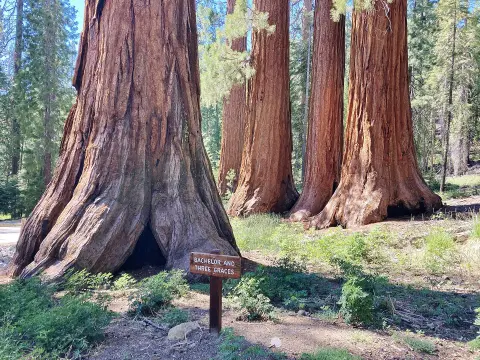
Bachelor and Three Graces
Here a cluster of four sequoias grows close together, three in a tight group and one a little apart. Their roots are intertwined underground. Stand among them and look up. The crowns spread so high that the trunks look like pillars holding up the sky. It is a favourite spot for photographs, but please stay on the trail to protect the roots.
-
4
Grizzly Giant
And now, the Grizzly Giant. Its age is only an estimate, somewhere around two to three thousand years. It stands about 209 feet tall and its base is roughly 30 feet across. One of its branches is thicker than many full-grown trees. Notice the fire scars low on the trunk. This tree has survived many fires, and it is still growing.
-
5
California Tunnel Tree
A short walk on, you reach the California Tunnel Tree. A tunnel was cut through it in 1895 for visitors to pass through, and remarkably the tree is still alive. Walk through it, and imagine the horse-drawn coaches of the time. Today we would never cut into a giant like this, but it is a powerful reminder of how attitudes to nature have changed.
-
6
Return via the Washburn Trail
If you have energy, walk back to the Welcome Plaza on the Washburn Trail instead of taking the shuttle. It is about two miles downhill through mixed forest. In winter, when the road is closed, this trail or the road itself is the only way in, on foot, snowshoes or skis. The grove under snow is quiet and lovely.
Things you might not know
- Galen Clark counted 427 mature sequoias when he explored the grove in 1857.
- The California Tunnel Tree had its tunnel cut in 1895 and is still alive.
- The grove reopened on June 15, 2018, after a three-year restoration.
Researched November 2026 from: en.wikipedia.org, nps.gov, nps.gov. Fees and hours change, so check on the day.