⭐ Must-see · Prinsengracht, Jordaan edge, 1 km from central Amsterdam
Anne Frank House
Behind a moving bookcase, a young girl kept writing
🎧 Listen to this guide · about 6 min
Pop your earphones in and we'll walk you round.
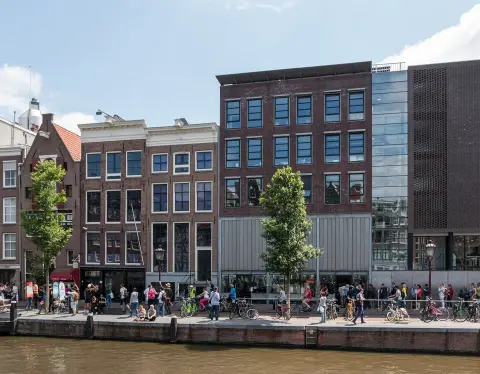
Welcome to Prinsengracht 263. From the outside, it is an ordinary canal house, narrow and brick, like hundreds of others in this city. But behind it lies a set of rooms where eight people lived in hiding for more than two years. One of them was a teenage girl named Anne Frank. She kept a diary here, and that diary has been read by millions around the world. Today we will move gently. This is a place of memory, not a show. The rooms are empty, at the wish of Anne's father. Speak softly, take your time, and let the silence do some of the talking. When you come back out onto the canal, the ordinary city will look a little different.
The story of Anne Frank House
Otto Frank was a German Jewish businessman who moved his family to Amsterdam in 1933, after the Nazis came to power in Germany. His company, Opekta, sold pectin for making jam, and from 1940 it worked from this building. In May 1940, Germany invaded the Netherlands. Step by step, Jewish people were cut off from normal life, and in July 1942 the deportations began.
On 6 July 1942 the Frank family went into hiding in the empty rear part of the building, the Secret Annex. They were joined by the Van Pels family and later by the dentist Fritz Pfeffer. Four of Otto's staff, Miep Gies, Johannes Kleiman, Victor Kugler and Bep Voskuijl, brought them food and news at great personal risk. On 4 August 1944 the hiding place was raided and all eight were arrested. Anne died at Bergen-Belsen in early 1945. Only Otto survived.
Miep Gies had saved Anne's writings and gave them to Otto. He published the diary in 1947 under the title Het Achterhuis, meaning The Secret Annex. When the building was threatened with demolition, citizens campaigned to save it, and the Anne Frank House opened as a museum on 3 May 1960.
The setting
The museum covers the original house on the Prinsengracht and a modern building on the corner beside it, where you enter. You walk through the front house first, past the old offices and storerooms. Then you reach the movable bookcase that hid the stairs to the Secret Annex. Behind it, steep Dutch stairs lead to small rooms on several floors. The windows were covered by day, so the hiders lived in dim light and had to keep quiet during working hours. The tower of the Westerkerk rises just along the canal. Anne could hear its bells, and she wrote about them in her diary.
Why it matters
The Anne Frank House is one of the most visited museums in the Netherlands, and one of the most important places of memory in Europe. It gives a single face and voice to the six million Jewish people murdered in the Holocaust. Anne's diary is honest, funny and searching, and that is why young readers still connect with it. Otto Frank asked that the annex remain unfurnished, so that the empty rooms would speak of what was lost. Today the museum also works in education, teaching about discrimination and human rights in many countries. Its message is simple. This happened to real people, in a real house, on an ordinary street.
Your walk-through
The stops a guide would take you to, in order.
-
1
The warehouse and offices
You begin in the front house, where Otto Frank's business carried on every day. The warehouse workers below did not know that people were hiding upstairs. The helpers worked in these offices while keeping that secret. Notice how normal it all looks. That was the danger and the protection at once. The hiders had to stay silent whenever workers were in the building, which meant no running water and no footsteps during the day.
-
2
The movable bookcase
Here is the bookcase. It was built in August 1942, a few weeks after the families went into hiding, to cover the door to the annex. It hangs on hinges and swings out like a door. Look at the plain files on its shelves, chosen to look dull. Step through it slowly, as they did. For more than two years, this ordinary piece of furniture was all that stood between eight people and the outside world.
-
3
Anne's room
This small room Anne shared with Fritz Pfeffer, which she did not much enjoy. On the walls you can still see the pictures she glued up. Film stars, royal children, pictures from magazines. They are protected behind glass now. Imagine a teenage girl trying to make a cramped room her own. She wrote much of her diary at a little table here. She dreamed of being a writer, and of what she would do when the war was over.
-
4
The attic window
Up in the annex, Anne and Peter van Pels would sometimes sit by the attic window. From there she could see a patch of sky and the great chestnut tree in the garden behind. She wrote about that tree with real joy. The tree became sick over the years and blew down in a storm in 2010. Saplings grown from its chestnuts have been planted in many places around the world, so it lives on.
-
5
The diary
Near the end of the visit, you will see Anne's original red-checked diary, which she received on her thirteenth birthday in June 1942. Later she rewrote many entries, hoping to publish a book after the war, and those loose pages are part of the story too. Take a moment here. Then look for Otto Frank's words on film. When he finally read the diary, he said he had not truly known his own daughter.
Things you might not know
- The movable bookcase was added in August 1942, a few weeks after the families went into hiding.
- Otto Frank asked that the Secret Annex be left unfurnished.
- The chestnut tree Anne wrote about blew down in a storm in 2010.
Researched November 2026 from: annefrank.org, annefrank.org, en.wikipedia.org. Fees and hours change, so check on the day.