⭐ Must-see · Zaandam, Zaanstad, 18 km from central Amsterdam
Zaanse Schans
Wind, wood and the smell of fresh mustard on the Zaan
🎧 Listen to this guide · about 6 min
Pop your earphones in and we'll walk you round.
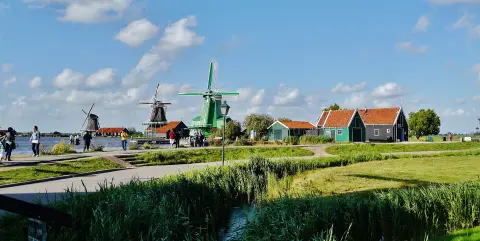
Welcome to the Zaanse Schans. Listen first. You may hear the creak of sails turning and the soft thump of a mill at work. Along the river Zaan stands a row of windmills, their sails sweeping the sky. Behind them sit little green wooden houses with white trim, tidy gardens and small humped bridges. It looks like a picture book, but these mills are real. Some still grind, saw and press, just as they did centuries ago. You can climb inside, feel the floor shake, and smell spices, oil or sawdust. Come early if you can, when the light is soft and the paths are quiet. This is the place to understand how wind once built the wealth of Holland.
The story of Zaanse Schans
The Zaan region, just north of Amsterdam, was once one of the busiest industrial areas in Europe. From the sixteenth century, hundreds of windmills lined the river. They sawed timber for ships, pressed oil from seeds, ground spices, mustard and cocoa, and made paint and paper. Some say this was one of the first industrial landscapes in the world. In 1697, the young Russian tsar Peter the Great came to Zaandam to learn shipbuilding, a sign of how famous the area was.
The name Zaanse Schans comes from a defensive earthwork, a schans, built here during the Eighty Years' War against Spain. By the twentieth century, steam and electricity had replaced wind, and most of the old mills and wooden houses were lost.
To save what was left, preservationists began moving historic buildings here from across the region. Between 1961 and 1974, old houses, workshops and mills were lifted and carried to this site, many on low trailers. The result is not a frozen village but a living neighbourhood. People still live in many of the houses. The Zaans Museum opened beside it in 1994 to tell the region's industrial story.
The setting
The Zaanse Schans lies on the east bank of the river Zaan, in the town of Zaandam. Across the water, you can see factory buildings, a reminder that this is still a working area. Some days the air smells of chocolate from a cocoa plant nearby. The mills stand in a line along the dyke facing the wind. Each has a name. De Kat is a dye mill, De Zoeker an oil mill, Het Jonge Schaap a sawmill and De Huisman a mustard mill. Behind them, a network of lanes, canals and bridges links the wooden houses, a clog workshop, a cheese farm, a pewter workshop and small museums. The houses are painted Zaans green, with white gable trims.
Why it matters
The Zaanse Schans keeps alive a story that is easy to forget: that the Dutch Golden Age ran on wind power. The mills here were the engines of their day. Volunteers and professional millers still keep them turning, passing on a craft that UNESCO recognised in 2017 as intangible cultural heritage of the Netherlands. The site is also now at the centre of a debate about overtourism. Millions come each year, and the town plans to introduce an entry fee to protect it. When you visit with care, staying on paths and respecting the homes, you help keep it a real neighbourhood rather than a theme park.
Your walk-through
The stops a guide would take you to, in order.
-
1
The Zaans Museum
Start at the Zaans Museum at the southern end of the site. It tells the story of the region's mills and factories. Look out for the Verkade pavilion, which recalls the famous Zaandam chocolate and biscuit maker, with its old machines and tins. It is a good place to understand what all those windmills actually made. In bad weather, it is also a warm place to begin.
-
2
The wooden houses
Now walk into the lanes of wooden houses. Notice the green paint, made from a pigment once ground in mills like these. Notice too the white trim on the gables and the little bridges over the ditches. Many of these houses were moved here from other villages in the region. People still live in them, so please stay on the paths and do not peek through windows. Imagine whole riverbanks once lined with homes just like these.
-
3
De Kat dye mill
Climb into De Kat, the cat. This is a paint mill, and it is said to be the last wind-powered dye mill still working in the world. Inside, heavy stone rollers crush chalk, minerals and other raw materials into fine powder for pigments. Artists still buy colours made here. Step out onto the stage, the balcony around the mill, and feel the sails rushing past. Hold the rail and watch your head.
-
4
De Zoeker oil mill
Next, visit De Zoeker, the seeker. This is an oil mill. Huge stones crush seeds to press out oil, once used for lamps, food and paint. The mill moves and groans as it works. Feel the floor vibrate under your feet. The miller often works here, and if you ask kindly, he or she may explain how they read the wind and turn the cap of the mill to face it.
-
5
Het Jonge Schaap sawmill
Finish at Het Jonge Schaap, the young sheep, a sawmill. Sawmills like this helped the Dutch build their great fleets. The wind powered saws that cut huge logs into planks far faster than men could by hand. This mill is a careful reconstruction, built using old drawings of the original that once stood nearby. Watch the frame of saws move up and down. Then walk back along the river dyke to see all the mills together against the sky.
Things you might not know
- Most of the buildings were moved here from elsewhere in the region between 1961 and 1974.
- De Kat is said to be the last working wind-powered paint mill in the world.
- Tsar Peter the Great came to Zaandam in 1697 to learn about shipbuilding.
Researched November 2026 from: zaanseschans.com, zaansmuseum.nl, en.wikipedia.org, rodi.nl. Fees and hours change, so check on the day.