💎 Hidden gem · Lissewege, north of Bruges, 13 km from central Bruges
Lissewege
A white village, a giant barn and a church tower
🎧 Listen to this guide · about 5 min
Pop your earphones in and we'll walk you round.
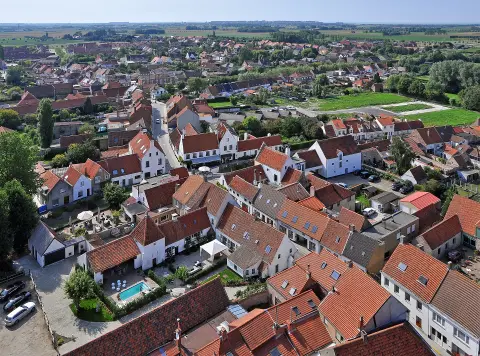
Just north of Bruges, on the way to the coast, lies a village that looks like it was painted. Lissewege is known locally as the white village, because so many of its little houses are whitewashed. A narrow canal runs through the middle. Above it all rises the solid brick tower of the church, which you can climb. Just outside the village, in the fields, stands a huge medieval barn, the last great building of a vanished abbey. It is quiet, it is easy to reach by train or bike, and it gives you a taste of Flemish village life.
The story of Lissewege
Lissewege has been a village since the early Middle Ages, and its history is tied to religion and farming. In 1106 Lambert, the local lord, gave land and a chapel to Benedictine monks. They founded an abbey here called Ter Doest. In 1175 it joined the Cistercian order, linked to the great abbey of Ten Duinen near the coast. The monks drained and farmed the surrounding land, and grew rich.
Around 1250 the monks built a vast barn to store grain and goods. It is about 50 metres long and more than 30 metres high. In 1571, during the religious wars, Calvinists destroyed the abbey's large church. The community later merged with Ten Duinen and moved to Bruges, and the abbey was dissolved in 1796, during the French period. The great barn survived.
In the village, the Church of Our Lady of the Visitation was built between 1225 and 1275, in what is called coastal Gothic style. The spire was never added, so the brick tower stands flat-topped, nearly 50 metres tall. Lissewege was its own municipality until 1971, when it became part of the city of Bruges.
The setting
Lissewege sits in flat polder land, about 13 kilometres north of central Bruges and just inland from the port of Zeebrugge. The village centre is small and walkable. The Lisseweegs Vaartje, a narrow old canal, runs through it, crossed by little bridges and lined with white houses and gardens. The church stands on a slight rise, its heavy tower visible for miles across the fields. About a kilometre south, the Ter Doest barn stands alone among trees, with a farm and the remains of the abbey grounds around it. A gentle walking and cycling route links the village, the barn and the countryside.
Why it matters
Lissewege shows a side of Flanders that has nothing to do with cities and trade. Here, monks and farmers shaped the land itself, draining marshes and building some of the finest farm buildings in Europe. The Ter Doest barn is a rare survivor of medieval monastic farming. The village is also loved by artists and local walkers, and in recent years it has been carefully kept and restored. It is a peaceful counterweight to the crowds of central Bruges.
Your walk-through
The stops a guide would take you to, in order.
-
1
Lissewege station
If you come by train, you arrive at little Lissewege station, on the line between Bruges and Zeebrugge. From here it is a short walk into the village. Follow the signs towards the church, whose tower you can already see over the roofs. Watch how the town changes from modern houses to old white cottages as you get closer.
-
2
The Lisseweegs Vaartje
Now you reach the little canal running through the heart of the village. Look at the white houses along the banks, the small bridges and the flower gardens. This is the picture that gave Lissewege its nickname. Stroll along both sides of the water. It is quiet, often with just a few walkers and the odd cyclist passing by.
-
3
Church of Our Lady of the Visitation
Walk up to the church. It was built between 1225 and 1275, in coastal Gothic style, from yellowish brick. Notice the tower: square, solid and flat at the top. The spire was never built. Inside, look at the carved wooden rood loft and the organ. The church is still a parish church, so please be quiet if a service is on.
-
4
The church tower
If the tower is open, climb it. There are about 264 steps, and it is nearly 50 metres to the top. From up there the flat land spreads out all around you. To the north you see the cranes and ships of Zeebrugge, and on a clear day the line of the sea. To the south, look for the towers of Bruges. And just below, the huge roof of the Ter Doest barn.
-
5
The Ter Doest tithe barn
Finally, walk about a kilometre south through the fields to the Ter Doest barn. Step inside if you can. It was built around 1250 by Cistercian monks, and it is enormous: about 50 metres long and over 30 metres high. Look up at the forest of oak beams holding up the roof. Everything else from the abbey is gone, but this barn has survived nearly eight centuries.
Things you might not know
- The church tower of Lissewege never got its spire and stands about 49.5 metres tall.
- The Ter Doest barn was built around 1250 and is about 50 metres long and over 30 metres high.
- Lissewege became part of the city of Bruges in 1971.
Researched November 2026 from: en.wikipedia.org, nl.wikipedia.org, en.wikipedia.org. Fees and hours change, so check on the day.