🚗 Day trip · Ypres (Ieper), 60 km from central Bruges
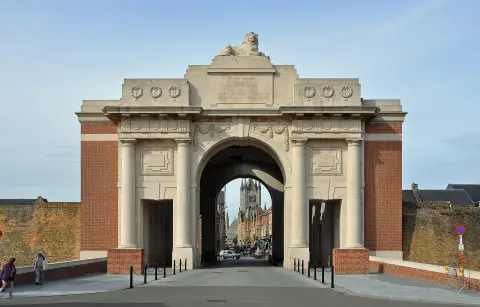
Menin Gate Memorial, Ypres
Names of the missing, and the Last Post every evening
🎧 Listen to this guide · about 5 min
Pop your earphones in and we'll walk you round.
This is a place of remembrance. The Menin Gate stands at the eastern edge of Ypres, the Flemish town at the centre of some of the worst fighting of the First World War. Its walls carry the names of about 54,000 soldiers of Britain and the Commonwealth who died around Ypres and have no known grave. Every evening at eight o'clock, the traffic is stopped and buglers play the Last Post beneath the arch. People gather in silence. It is simple, and it is very moving. Please come with respect, take your time, and stay for the ceremony if you can.
The story of Menin Gate Memorial, Ypres
During the First World War, from 1914 to 1918, the area around Ypres formed a bulge in the front line known as the Ypres Salient. Several major battles were fought here, and hundreds of thousands of soldiers on both sides were killed or wounded. The town itself was almost entirely destroyed. Many troops marched east towards the front along the road that passed through this point in the old town walls.
After the war, the Imperial War Graves Commission, now the Commonwealth War Graves Commission, built a memorial here for the missing. It was designed by Sir Reginald Blomfield and unveiled on 24 July 1927 by Lord Plumer. Rudyard Kipling wrote its inscriptions. The walls bear about 54,000 names. When there was no more space, the names of men missing after 15 August 1917 were recorded at Tyne Cot Memorial instead.
Since 1928, buglers of the local fire brigade, organised by the Last Post Association, have sounded the Last Post here every evening. During the German occupation in the Second World War the ceremony moved to England, to Brookwood Military Cemetery. It returned to Ypres on 6 September 1944, the day Polish forces liberated the town, and it has continued every night since.
The setting
The Menin Gate stands where the road to Menen leaves the old walled centre of Ypres, crossing the moat. It is a large classical arch of pale stone, with a long vaulted hall running through it. The walls of the hall, the stairways and the upper loggias are covered with panels carved with names, grouped by regiment and rank. A recumbent lion sits on top, facing east. On either side, you can climb up to the old town ramparts, which offer a quiet walk along the moat. The town's rebuilt Cloth Hall and cathedral are a few minutes' walk away. A major restoration of the memorial was completed in 2025.
Why it matters
The Menin Gate is one of the best-known war memorials in the world. In 2023 it became part of the UNESCO World Heritage site recognising the funerary and memorial sites of the First World War on the Western Front. For many families, especially from Britain, Canada, Australia, New Zealand, India and South Africa, it is the only place where a relative's name is recorded. The nightly Last Post keeps that memory alive.
Your walk-through
The stops a guide would take you to, in order.
-
1
Approaching from the Market Square
Walk east from the Grote Markt along Meensestraat. Ahead you see the memorial's great arch. Pause before you enter. The town around you was rebuilt after the war, almost from nothing. Through this gateway, many thousands of soldiers marched towards the front lines, only a few kilometres away. Many of them did not return.
-
2
The Hall of Memory
Step inside the hall. On every wall, panel after panel, are names. They are grouped by regiment, then by rank. Look slowly. Each name stands for one person whose body was never found or never identified. Many visitors come looking for a relative. If you have a name to find, the registers kept on site and the Commonwealth War Graves Commission website can help.
-
3
The inscriptions
Look above the arches for the inscriptions written by Rudyard Kipling. Kipling himself lost his only son in the war; John Kipling went missing in 1915 at the Battle of Loos. The words here were chosen to honour the missing and to tell visitors who they were. Read them slowly. They are short, and plain, and meant to be read by people standing exactly where you stand.
-
4
The ramparts
Climb the steps beside the gate onto the old town ramparts. From here you can look out along the moat and east towards the land where the fighting took place. Nearby there is a small Commonwealth war cemetery on the ramparts. It is a quiet place to reflect before the evening ceremony begins.
-
5
The Last Post ceremony
Come back to the hall before eight in the evening. The road is closed to traffic. Then, at exactly eight o'clock, the buglers of the Last Post Association step forward and play. Some evenings include wreaths, a reading, or a moment of silence. Please do not clap, and keep your phone away. Just stand, listen, and remember. The ceremony usually lasts around fifteen minutes.
Things you might not know
- The memorial bears about 54,000 names of soldiers with no known grave.
- The Last Post has been sounded here every evening since 1928, apart from the years of German occupation in the Second World War.
- It became part of a UNESCO World Heritage site in 2023.
Researched November 2026 from: en.wikipedia.org, cwgc.org, lastpost.be. Fees and hours change, so check on the day.