💎 Hidden gem · Çavuşin, 3 km from central Cappadocia
Çavuşin Old Village
Empty homes on a cliff, and an ancient church
🎧 Listen to this guide · about 5 min
Pop your earphones in and we'll walk you round.
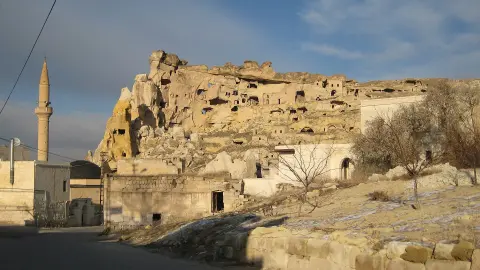
Here is a quieter Cappadocia, just a short ride from Göreme. Look up at the cliff above the modern village of Çavuşin. Its face is honeycombed with homes, doorways and staircases, all empty now. People lived there until the last century. Then the rock began to fall, and they moved down to the flat land below. You can climb the paths up through the old village, past rooms where families cooked and slept. At the top, cut into the cliff, is the old Church of Saint John the Baptist. It is dark and worn, but it is very old. From the ledge, the valleys of Rose and Red spread out before you.
The story of Çavuşin Old Village
Çavuşin has deep roots. The Church of Saint John the Baptist, at the top of the cliff, is one of the oldest and largest cave churches in the region. It is often dated to the fifth or early sixth century. Its paintings are now faint and blackened by smoke, but its carved decoration still shows the ambition of its makers. Pilgrims are said to have come here in Byzantine times.
Nearby, on the road toward Göreme, is a second church known as the Çavuşin Church, or the Church of Nikephoros Phokas. Its paintings show the Byzantine emperor Nikephoros II Phokas and his family. They are usually linked to the years 964 and 965, when the imperial family was in Cappadocia. Later it was used as a dovecote, so locals also call it the Pigeon House.
For centuries, villagers lived in houses cut into the cliff. But in the twentieth century, rockfalls made the old village dangerous. Families moved down to new houses on the plain, and the cliff village was left empty. Today a few old houses near the bottom are used again, but the upper village is a ghost town of rooms and stairs.
The setting
Çavuşin lies about three kilometres north-east of Göreme, on the road to Avanos. The modern village sits at the foot of a steep cliff of pale tuff. The old village climbs up the cliff in tiers, with rooms, arches and stairways cut into the rock and some stone house fronts still standing. Paths zigzag up through the ruins. Much of the cliff face has collapsed, exposing rooms in cross-section. At the top, the old basilica opens off a ledge. From here, trails lead south into Rose Valley and Red Valley.
Why it matters
Çavuşin is one of the best places to see an abandoned cave village up close, with almost no crowds. It also holds some of the oldest Christian sites in Cappadocia. The emperor's portraits in the Çavuşin Church are rare dated paintings that help historians understand Byzantine art here. And it is a natural gateway to some of the region's finest walking. Because it is free and open all day, you can come at the golden hour and stay as long as you like. It is one of the most rewarding short stops near Göreme.
Your walk-through
The stops a guide would take you to, in order.
-
1
Village square
Start in the small square at the foot of the cliff. Look up at the face of the rock and the empty doorways above. A few cafés and craft stalls sit here. This is the new village, built after families moved down from the cliff. You can still see how close the old and new homes are.
-
2
Lower cave houses
As you climb, the path passes old houses with carved fronts, arches and windows. Some are still used for storage or as homes. Peer into the empty rooms and look for niches in the walls, where lamps and dishes were kept. Imagine the smell of bread baking and the sound of animals.
-
3
Collapsed cliff face
Higher up, the cliff has fallen away in places, cutting rooms in half. You can see right into upper floors, like the inside of a doll's house. This is what drove families out. Keep to the path here and do not go near the edges. The rock is still crumbling.
-
4
Church of Saint John the Baptist
At the top, step inside this large cave church. It is often dated to the fifth or early sixth century, among the oldest in the region. Its walls are dark with smoke, and the paintings are faint. But look at the carved columns and arches. People prayed here long before most of Göreme's churches were painted.
-
5
Cliff ledge view
Step back out onto the ledge and look south. The Rose and Red valleys stretch away in folds of pink and cream. On a balloon morning, the sky above is full of them. From here, paths lead down into the valleys. It is a fine place to sit and take it all in.
-
6
Çavuşin Church on the main road
On your way back, stop at the Çavuşin Church beside the road. Inside, paintings show Emperor Nikephoros II Phokas and his family, linked to his stay in Cappadocia around 964. Opening times vary and it is sometimes closed, so check before you go. If open, climb the metal stairs to see it.
Things you might not know
- The Church of Saint John the Baptist is often dated to the fifth or early sixth century.
- The Çavuşin Church shows Emperor Nikephoros II Phokas, painted around 964 to 965.
- The cliff village was abandoned in the twentieth century after rockfalls.
Researched November 2026 from: en.wikipedia.org, monuments.hist.auth.gr, lonelyplanet.com. Fees and hours change, so check on the day.