⭐ Must-see · Göreme, 2 km from central Cappadocia
Göreme Open-Air Museum
Painted saints hiding inside the rock
🎧 Listen to this guide · about 6 min
Pop your earphones in and we'll walk you round.
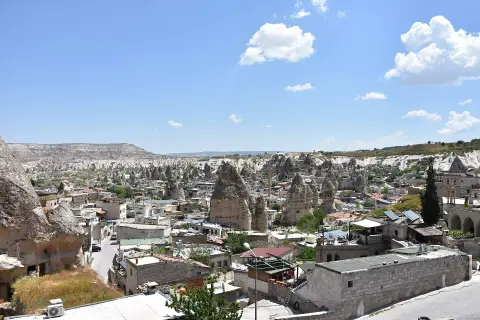
Welcome to the heart of old Cappadocia. From the road it looks like a quiet bowl of cream and rose-coloured cones. Step closer and you see doorways, windows and steps cut into every face of the rock. Behind them are churches. Small ones, mostly, the size of a village chapel, but painted floor to ceiling with saints, angels and the life of Christ. Monks lived, prayed and were buried here for centuries. Today you can walk from one chapel to the next in a single morning. Go slowly. Let your eyes adjust to the low light inside. The colours will come to you, deep reds, ochres and blues, still glowing after a thousand years in the dark.
The story of Göreme Open-Air Museum
Christian hermits were drawn to these valleys early. The ministry that runs the site says ascetic monks were living around Göreme by the second century, and a monastic way of life flourished here from the fourth century to the thirteenth. The fourth century also gave the region its most famous sons, the Cappadocian Fathers: Basil the Great, Gregory of Nyssa and Gregory of Nazianzus. Their ideas about monastic life shaped communities like this one.
The simplest churches here date from around the sixth and seventh centuries. Most of the paintings you will see came later, in the tenth and eleventh centuries, after the long quarrel over religious images had ended. The Apple Church was cut around 1050. The Dark Church followed in the same century. In Byzantine times this whole area belonged to a village called Korama.
After the monks, ordinary life took over. Farmers used some chapels as storerooms and pigeon houses. That is why the Dark Church, sealed from light for so long, kept its colours so well. It served as a dovecote until the 1950s. The site opened to visitors in 1967, and in 1985 UNESCO listed Göreme National Park and the Rock Sites of Cappadocia as a World Heritage Site.
The setting
The museum fills a small horseshoe valley about two kilometres east of Göreme town, on the road towards Ürgüp. Soft volcanic tuff rises in cones and cliffs all around, and paths and stairways link the chapels in a loop. Most churches are small and carved, not built. Their makers copied the look of stone architecture, so you will see domes, columns, arches and even carved roof beams, all shaped from a single mass of rock. Several chapels have a cross-in-square plan with a central dome. A multi-storey nunnery stands near the entrance, its rooms stacked like a rock apartment block. The Tokalı Church lies just outside the main gate, down the road.
Why it matters
This is the best place to understand what made Cappadocia special in the Byzantine world. Nowhere else can you see so many painted cave churches, from so many centuries, in so small a space. Art historians come here to study how Byzantine painting changed over time. Pilgrims come to pray. For you, it is a chance to stand inside a living rock and see faces painted by people who lived here a thousand years ago. The museum is also the anchor of the UNESCO listing, and the reason Göreme grew from a farming village into a place the whole world knows.
Your walk-through
The stops a guide would take you to, in order.
-
1
The Nunnery
Right by the entrance, look up at this tall rock carved into several floors. It is known as the Girls' Monastery, or Kızlar Monastery. Rooms, a kitchen and a chapel are cut inside. Some passages could once be closed with rolling stones, like the doors of the underground cities. Imagine the women who lived here climbing these narrow tunnels between floors, hidden from the world.
-
2
Apple Church (Elmalı Kilise)
This chapel was cut around 1050. Four columns hold up a central dome, all carved from the rock. Look for the Last Supper, where a fish lies on the table, an early Christian symbol. The name probably comes from an orb in the hand of the Archangel Gabriel that people took for an apple. The paintings were cleaned and restored in 1991.
-
3
Saint Barbara Church
A small cross-domed chapel from the late eleventh century. The walls are covered in simple red patterns, lines, crosses and strange insect-like shapes, painted straight onto the stone. In the dome, Christ sits on his throne. On the north wall, Saint George and Saint Theodore ride out to fight a dragon and a snake. It feels playful and mysterious at once.
-
4
Snake Church (Yılanlı Kilise)
A long barrel-vaulted room, named for its painting of Saint George and Saint Theodore killing a great serpent. Opposite, you will see Emperor Constantine and his mother Helena holding the True Cross between them. Look too for Saint Onuphrius, the desert hermit, with his long white beard. These were the heroes the monks wanted beside them as they prayed.
-
5
Dark Church (Karanlık Kilise)
Here is the jewel, and it has a separate ticket. Only a tiny window lets in light, and that darkness saved the paintings. Used as a pigeon house until the 1950s, then carefully cleaned, its eleventh-century frescoes are thought to be the best preserved in Cappadocia. Look up at Christ Pantocrator in the dome, then find the Nativity and the Crucifixion, rich with deep blue.
-
6
Sandals Church (Çarıklı Kilise)
Climb the stairs to this small eleventh-century church. Below the painting of the Ascension, two footprints are carved into the floor. They gave the church its name, the Church with Sandals. Tradition links them to the footprints Christ left on the Mount of Olives. Around you are the four Evangelists, the Nativity, the Baptism and the Crucifixion.
-
7
Tokalı Church
Leave the main valley and walk a short way down the road. This is the largest church in Göreme. It has an Old Church from the tenth century and a New Church added soon after. The blue backgrounds were made with lapis lazuli, a costly stone brought from far away. The full cycle of the life of Christ runs around the walls like a picture book.
Things you might not know
- The Dark Church served as a pigeon house until the 1950s, which helped keep its frescoes out of the light.
- Tokalı Church's deep blue backgrounds were painted with ground lapis lazuli.
- The site opened to visitors in 1967, eighteen years before the UNESCO listing in 1985.
Researched November 2026 from: muze.gov.tr, whc.unesco.org, en.wikipedia.org. Fees and hours change, so check on the day.