⭐ Must-see · Downtown Cebu, 4 km from central Cebu
Basilica Minore del Santo Niño
The Holy Child of Cebu, and five centuries of devotion
🎧 Listen to this guide · about 6 min
Pop your earphones in and we'll walk you round.
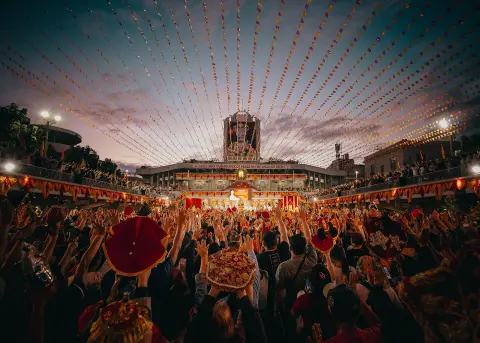
Welcome to the church Cebuanos simply call Santo Nino. Before you even reach the doors you will hear it. Hymns from the open-air Pilgrim Center, the shuffle of thousands of feet, the soft clatter of candle vendors. People come here every day, but on Fridays and Sundays the courtyard fills with families, office workers and grandmothers in their best clothes. They have come to see a small wooden statue of the Christ Child, dressed in a red cape and a golden crown. It is the oldest Christian image in the Philippines, and it has a remarkable story. Stay close, keep your bag in front of you, and let the place carry you along.
The story of Basilica Minore del Santo Niño
In 1521 Magellan gave a small statue of the Christ Child to the wife of Rajah Humabon as a baptismal gift. Magellan died weeks later at Mactan, and for more than forty years the Spanish did not return. When Miguel Lopez de Legazpi's fleet arrived in 1565 and fought its way ashore, a soldier named Juan de Camuz found the same image in a partly burned house. The Augustinian friars Andres de Urdaneta and Diego de Herrera founded a church on the spot on 28 April 1565, the day still remembered as the Kaplag, or finding.
The first churches were of wood and nipa palm, and they burned. A church built in the early 1600s burned in 1628. The present stone church was begun in February 1735 and completed in January 1740, with the Augustinian friar Juan de Albarran credited as architect. It was renovated in 1789, 1889 and 1965.
In 1965, the four hundredth year of Christianity in the islands, Pope Paul VI raised the church to a minor basilica. On 15 October 2013 a magnitude 7.2 earthquake centred on Bohol destroyed most of the bell tower and parts of the facade. Masses moved to the Pilgrim Center, the church reopened on Christmas Eve 2014, and the belfry was fully restored by 2016.
The setting
The Basilica stands at the edge of downtown, between Osmena Boulevard and Plaza Sugbo, with Magellan's Cross just outside its walls. The church is a long cruciform building of coral stone, about 62 metres long, with a heavy facade and a square bell tower rising at one corner. Its style mixes earthquake baroque, with thick low walls, and later neoclassical touches. Inside, look for painted ceilings and gilded side altars. Next to the church is a convent, and across the courtyard is the Pilgrim Center, a huge open-sided hall built for outdoor Masses that can hold thousands. The Santo Nino image itself is kept behind glass in a side chapel, and devotees queue patiently to pass by it and offer a prayer.
Why it matters
The Santo Nino is the most loved religious image in the Visayas, and copies of it stand on shop counters, car dashboards and home altars across the country. The church has been called the mother and head of all churches in the Philippines. Each January the Fiesta Senor and the Sinulog festival bring huge crowds to the city, and the procession and street dancing all start from devotion to this image. The church was declared a National Historical Landmark in 1973 and a National Cultural Treasure in 2021. It is also a living parish, run by the Augustinians, so remember you are a guest at people's prayers.
Your walk-through
The stops a guide would take you to, in order.
-
1
The courtyard and candle stands
Start in the courtyard. To one side are the candle stands, where people light tall candles and leave their intentions. Watch the women who sell candles at the gate. If you buy one, many will dance the Sinulog step, two steps forward and one back, while praying for you. That small dance is where the great January festival takes its name and rhythm.
-
2
The facade and bell tower
Stand back and look at the front. The stone church you see was finished in 1740. The bell tower on the corner is the one rebuilt after the 2013 earthquake, which brought much of it crashing down. Its bells rang again in 2016. Notice how thick and low the walls are. Builders across the Philippines designed churches this way to survive earthquakes and typhoons.
-
3
The nave
Step inside quietly. The long nave leads your eye to a gilded main altar. Look up at the ceiling paintings, which show scenes from the life of Christ and the story of the Santo Nino in Cebu. Some were cracked in 2013 and carefully repaired. If a Mass is under way, stand at the back or take a seat and wait. Photos without flash are generally fine when no service is on.
-
4
Santo Nino chapel
Now join the line to the Santo Nino. The image is small, well under a metre tall, dressed in rich robes, holding a globe and a sceptre. It is believed to have been made in Flanders and carried across the world on Magellan's ships. Devotees touch the glass, whisper a prayer and move on. Follow their lead. A short, respectful pause is all anyone expects of you.
-
5
Pilgrim Center
Cross to the Pilgrim Center, the big open hall facing the church. Since the earthquake, the main Masses on Fridays and Sundays are held here, because the old church cannot hold the crowds. On a busy day thousands stand shoulder to shoulder, waving their hands toward the altar when the priest gives the blessing. Below this hall is the Basilica museum, with vestments, church records and devotional objects from the colonial era.
Things you might not know
- The Santo Nino image is the oldest surviving Christian relic in the Philippines, given by Magellan in 1521.
- The present stone church was completed on 16 January 1740.
- The Sinulog festival is held on the third Sunday of January, which falls on 17 January in 2027.
Researched November 2026 from: en.wikipedia.org, newsinfo.inquirer.net, cebudailynews.inquirer.net. Fees and hours change, so check on the day.