💎 Hidden gem · Parian, Cebu City, 4 km from central Cebu
Yap-San Diego Ancestral House
Three centuries under one creaking timber roof
🎧 Listen to this guide · about 5 min
Pop your earphones in and we'll walk you round.
Welcome to one of the oldest homes in the whole country. From the street on Mabini, it does not look like much. A low wall, a gate, some greenery. But step inside and time slows right down. The floors creak under your feet. The air smells of old wood. Everywhere you turn there is something to look at, religious statues, worn chairs, old jars, faded photographs. This house was built more than three centuries ago by a Chinese merchant and his Cebuana wife, and their descendants still care for it today. Go gently. Touch nothing unless you are invited. And imagine all the family dinners these walls have heard.
The story of Yap-San Diego Ancestral House
Under Spanish rule, Chinese residents of Cebu were required to live in one district, the Parian, just north of the Spanish city. It became a lively quarter of merchants, warehouses and family homes. Here, sometime between about 1675 and 1700, the Chinese merchant Don Juan Yap and his wife Dona Maria Florido built this house. Don Juan is said to have come from Fujian in southern China. The colonial government wanted the Chinese close enough to trade, yet kept apart. Many Chinese men married local women and became Catholic, and their children grew into some of Cebu's leading merchant families. The Yap household was part of that story.
The house passed down through the generations, and through marriage it later came into the San Diego family line, which is how it got its double name. Over three centuries it survived fires, typhoons and the Second World War, while much of old Parian was lost.
In 2008 the family opened it to the public as a private museum. Today it is cared for by descendant Val San Diego and is protected as a heritage structure. It is often described as one of the oldest surviving Chinese houses outside China.
The setting
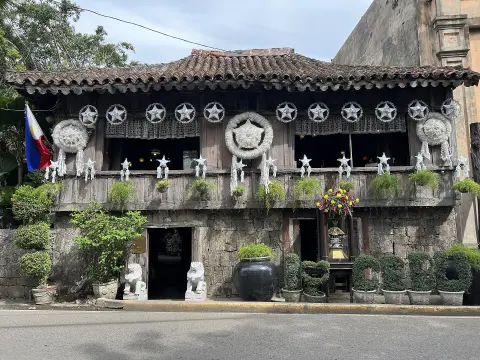
The house stands on Mabini Street in Parian, a short walk from the Heritage of Cebu Monument. It is a two-storey house in the bahay na bato style, the classic Filipino colonial home. The ground floor is of thick coral stone, cool and solid. The upper floor is built of heavy hardwood, with wide windows to catch the breeze, and a steep roof that slopes down over everything. A small open-air garden sits on the ground level, with plants and old stone pieces. Upstairs are the main living rooms, bedrooms and a family altar, all filled with antiques collected over generations.
Why it matters
Very few homes from the 1600s survive anywhere in the Philippines, so this is a rare chance to walk inside one. It also tells the story of Cebu's Chinese community and how it mixed with local families to create something uniquely Cebuano. Because it is still a family home in spirit, it feels personal and lived-in rather than like a formal museum. It is the best place in the city to understand everyday life in the colonial era. Go slowly and ask questions, because the staff often know the stories behind the objects.
Your walk-through
The stops a guide would take you to, in order.
-
1
Gate and garden
Begin at the gate. Notice how the house hides behind its wall, a sign of a merchant family that valued privacy. Step into the small garden. Look at the coral-stone walls of the ground floor, thick enough to keep the rooms cool in the hottest months. The plants and stone pieces here have been arranged by the family to make a quiet courtyard.
-
2
Ground floor storerooms
Walk into the ground floor. In houses like this, the lower level was often used for storage and business, goods waiting to be sold or shipped. Look at the heavy stone, the low light, the old jars and tools. You can almost hear the bargaining of traders in the Parian street outside, three hundred years ago.
-
3
Wooden staircase
Now climb the wooden staircase. Feel how solid the hardwood is under your feet, polished by generations of hands and shoes. Go slowly and hold the rail. At the top, notice how the air changes. The upper floor is open and breezy, built of wood so it could flex a little in earthquakes.
-
4
Sala and family altar
This is the sala, the main living room, where guests were received. Look at the antique chairs, tables and cabinets, the old photographs, and the religious statues. Find the family altar. Saints and the Santo Nino stand side by side, showing how Catholic faith blended into this Chinese merchant household. Ask the staff about any piece that catches your eye.
-
5
Bedrooms and windows
Finish in the bedrooms and by the big windows. Look at the four-poster beds and the old trunks for clothes and treasures. Open windows faced the street, so the family could watch the life of Parian go by. Before you leave, take one last look down at the garden. Then walk a few steps to the Heritage of Cebu Monument nearby.
Things you might not know
- The house was built sometime between about 1675 and 1700.
- During Spanish rule, Chinese residents of Cebu were required to live in the Parian district.
- The family opened the house to visitors in 2008.
Researched November 2026 from: en.wikipedia.org, rappler.com, newsinfo.inquirer.net. Fees and hours change, so check on the day.