⭐ Must-see · Corniche, 1 km from central Doha
Museum of Islamic Art
Pei's pale stone jewel, floating off the Corniche
🎧 Listen to this guide · about 7 min
Pop your earphones in and we'll walk you round.
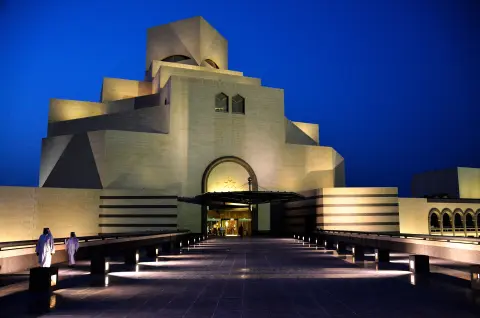
Welcome to the Museum of Islamic Art, the building that put Doha on the cultural map. Look at it first from the water's edge. Pale limestone, stacked in clean geometric blocks, rising against a hard blue sky. It sits on its own small island just off the Corniche, joined to the city by bridges. Inside, you will find manuscripts, ceramics, metalwork, glass and textiles gathered from Spain to Central Asia and beyond, spanning some fourteen centuries. Take your time here. The building rewards slow looking, and the collection rewards it even more. And when you step out again, the whole curve of the bay and the West Bay towers will be waiting for you across the water.
The story of Museum of Islamic Art
The museum was the first great cultural project of modern Qatar. Its architect was I. M. Pei, the Chinese-born American who designed the glass pyramid at the Louvre. He had largely stepped back from work and had to be persuaded to take this one on. The Emir, Sheikh Hamad bin Khalifa Al Thani, inaugurated it on 22 November 2008, and it opened to the public that December. Pei was by then ninety-one years old.
Pei travelled widely to study Islamic architecture before he drew a line. In the end he said his strongest inspiration was the small ablution fountain in the courtyard of the ninth-century Ibn Tulun Mosque in Cairo, a simple domed structure where geometry does all the work. You can feel that austere spirit in the stacked cubes and octagons of the facade.
In 2021 the museum closed for a major refit ahead of the FIFA World Cup. It reopened on 4 October 2022 with eighteen redesigned galleries and more than a thousand objects, many of them never shown before. A month later it became the first museum in the Middle East to be certified carbon neutral.
The setting
The museum stands on an artificial island about sixty metres off the southern end of the Corniche, the seven-kilometre waterfront promenade that wraps Doha Bay. You approach along a palm-lined ramp and cross to the entrance. The main block rises in tiers of cream limestone, each layer stepping back, so the light changes on every face through the day. Inside, a soaring atrium leads up to a domed ceiling, and a huge window frames the bay and the skyline of West Bay. Galleries open off the upper floors. Beside the museum lies MIA Park, a long green crescent of lawns, palms and cafes that curls around the water. At its tip stands Richard Serra's tall steel sculpture called 7.
Why it matters
For many visitors this is the single best introduction to the Islamic world's art. The collection is broad, crossing dynasties, regions and crafts, so you see how ideas, patterns and techniques travelled along trade routes. For Qatar, the museum signalled a choice: to invest its wealth in culture and heritage, not only in towers. It became the model for the institutions that followed, from the National Museum to Mathaf. For the people of Doha, the park is simply part of daily life, a place for picnics, evening walks and the regular weekend bazaar.
Your walk-through
The stops a guide would take you to, in order.
-
1
The ramp and fountains
Pause on the approach, before the doors. The ramp lifts you slightly above the city, so the building appears to float on the water. Pei wanted that sense of arrival. Look at the facade: square blocks, then octagons, then a slim cube at the top, a geometry he drew from the fountain at Ibn Tulun in Cairo. Notice how the stone is almost white in the morning and turns golden late in the afternoon. The windows are few and small, so the building feels closed, like a treasure box.
-
2
The atrium and the great window
Step inside and look up. The atrium rises through the full height of the building to a dome, where the octagon slowly resolves into a circle. Light falls down the walls in soft bands. Then turn to the north. A window several storeys high frames the bay, the dhows and the towers of West Bay. It is one of the finest views in the city, and it is free with your ticket. Many people simply sit on the steps here for a while.
-
3
The galleries of the early centuries
Begin with the earliest galleries. Here you meet the art of the first Islamic centuries: carved wood, early ceramics, and the beginnings of the calligraphy that runs through everything. Keep an eye out for the museum's leaf from the Blue Qur'an, a celebrated manuscript written in gold on indigo-dyed parchment, probably in North Africa around the tenth century. Its pages are now scattered among museums around the world, so seeing even one is special.
-
4
Ceramics, glass and metalwork
Move on through the rooms of crafts. Look closely at the lustre ceramics, which shimmer like metal when you shift your head. Look at the enamelled glass lamps made for mosques, and the inlaid brass bowls where silver and copper threads trace tiny scenes and inscriptions. These were luxury goods, made in workshops from Syria and Egypt to Iran, and they moved along the same roads as silk and spice. The detail repays a patient eye.
-
5
Carpets and courtly arts
Higher up, the galleries turn to the great empires of later centuries, the Ottomans, the Safavids of Iran and the Mughals of India. Here you find carpets, jewelled objects, arms and armour, and pages from illustrated books. Notice how plant scrolls and geometric stars recur from one empire to the next. Each court had its own taste, yet you can read a shared visual language across thousands of kilometres.
-
6
MIA Park and Serra's 7
Finish outside in MIA Park. Walk the curve of the promenade toward the tip of the park, where Richard Serra's steel sculpture rises from the waterfront. It is made of seven tall steel plates, a nod to the importance of the number seven in Islamic tradition. Turn back toward the city and you see the museum and the Corniche together. At sunset the skyline lights up across the water, and families settle on the grass with tea.
Things you might not know
- I. M. Pei was ninety-one when the museum opened in November 2008.
- After its 2022 refit, it became the first museum in the Middle East certified as carbon neutral.
- The museum owns a page of the Blue Qur'an, written in gold on indigo parchment.
Researched November 2026 from: en.wikipedia.org, mia.org.qa, qatarliving.com. Fees and hours change, so check on the day.