⭐ Must-see · Corniche (east end), 2 km from central Doha
National Museum of Qatar
A desert rose in concrete, wrapped around a royal palace
🎧 Listen to this guide · about 6 min
Pop your earphones in and we'll walk you round.
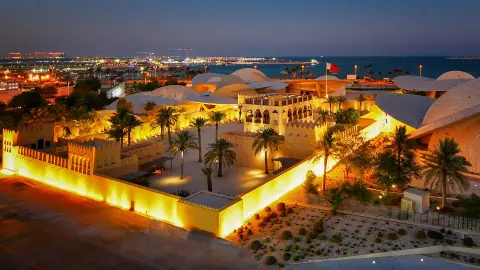
Welcome to the National Museum of Qatar. As you walk up, you may feel you are looking at something grown rather than built. Huge curved discs tilt and overlap, sandy pink against the sky. The architect, Jean Nouvel, took his idea from the desert rose, a crystal formation found in Qatar's sands. Inside, you follow a long loop through the story of this peninsula, from ancient seabeds to Bedouin camps, pearling boats and the arrival of oil. And at the heart of it all sits something modest and real: the old palace of a ruler, kept just as it was. Give yourself time, because the journey here is told in sound, film and space as much as in objects.
The story of National Museum of Qatar
Qatar first opened a national museum in 1975, in the restored palace of Sheikh Abdullah bin Jassim Al Thani. That palace was built in the early twentieth century and served for years as both the ruler's home and the seat of government. It was a simple courtyard compound of coral stone and plaster, typical of the Gulf before oil.
In the 2000s Qatar decided to build a new national museum around the old one. The French architect Jean Nouvel won the commission. The palace itself was restored in 2015, and the new museum opened on 28 March 2019.
Nouvel's design is built from 539 interlocking discs, clad in about 76,000 panels, enclosing roughly 40,000 square metres. The visitor route runs through eleven permanent galleries and loosely follows time. It begins with the formation of the peninsula, moves through the life of the desert and the coast, and ends with modern Qatar. The collection numbers some 8,000 objects, from archaeological finds to textiles, jewellery and documents.
The setting
The museum stands at the southern end of the Corniche, on the site of the old palace, facing a lagoon. From outside, the discs rise and fall like petals, some cantilevered far out to throw deep shade. The colour comes from sand mixed into the concrete, so the building blends with the desert light. Inside, the walls lean and curve, and the galleries are long, dim and immersive, with films projected across whole walls. The restored palace sits in a courtyard at the centre, low and pale, the old heart of the site. Outside, in the lagoon, a field of fountains by Jean-Michel Othoniel throws water in arcs.
Why it matters
This is the place where Qatar tells its own story, in its own voice. Many of the galleries draw on oral histories, so you hear the memories of pearl divers, fishermen and Bedouin families. For a country that changed beyond recognition in two generations, that matters. The building also shows how far contemporary architecture can go. And the old palace reminds every visitor how recent the modern city really is. Within living memory, this was a quiet coastal town of stone houses and boats.
Your walk-through
The stops a guide would take you to, in order.
-
1
The approach and the discs
Stop outside and look up at the discs. Each one is a curved plate, set at its own angle, intersecting with its neighbours. Nouvel was inspired by the desert rose, a cluster of thin crystal blades formed when gypsum and sand crystallise near the surface of a salt flat. You can find small desert roses in Qatar's interior. Notice how much shade the overhangs create. In this climate, that is not decoration. It is comfort.
-
2
The beginnings gallery
Inside, the journey starts long before people. The opening galleries explain how this peninsula formed, how it once lay under the sea, and how its plants and animals survive in heat and salt. Large projections wrap the walls, so you feel you are standing inside the landscape. Look out for fossils and for the desert roses themselves, displayed so you can compare them with the building around you.
-
3
Life in the desert and on the coast
Next you meet the people. One set of galleries follows Bedouin life, with tents, camel gear and the rhythms of moving between grazing grounds. Another turns to the coast, where towns lived from fishing and pearling. Look at the diving gear: the nose clip, the weighted rope, the basket. Divers spent summer months at sea, holding their breath again and again. Listen to the recorded voices here, many of them memories from families who lived this life.
-
4
The palace of Sheikh Abdullah bin Jassim
Step out into the courtyard, and the noise of the galleries falls away. This is the restored palace of Sheikh Abdullah bin Jassim Al Thani, built in the early twentieth century. Look at the thick walls, the carved wooden doors, the shaded verandas and the wind-catching layout. This was where a ruler lived and governed, and later it became Qatar's first national museum. Its simplicity is the point. It shows you Doha before the towers.
-
5
The modern story
The final galleries tell of oil, independence in 1971, and the rapid building of a modern state. Photographs show old Doha streets, the first cars, the first schools. Watch how the pace of the displays quickens, just as change itself sped up. It is a fascinating contrast with the slow seasons of the desert galleries you walked through earlier.
-
6
Othoniel's fountains in the lagoon
Before you leave, walk to the lagoon. The French artist Jean-Michel Othoniel created a work called Alfa, a field of 114 fountain sculptures that spout water in curling shapes, inspired by Arabic calligraphy. Stand still for a few minutes and watch the patterns change. With the discs of the museum behind them, it is a lovely last view.
Things you might not know
- The building is made of 539 interlocking discs.
- Qatar's first national museum opened in the same palace in 1975.
- Jean-Michel Othoniel's Alfa is a group of 114 fountain sculptures in the lagoon.
Researched November 2026 from: en.wikipedia.org, nmoq.org.qa, qatarliving.com. Fees and hours change, so check on the day.