⭐ Must-see · Pile, 3 km from central Dubrovnik
Fort Lovrijenac
Dubrovnik's rock of liberty, facing the open sea
🎧 Listen to this guide · about 5 min
Pop your earphones in and we'll walk you round.
Welcome to Lovrijenac, the fortress of Saint Lawrence. You have climbed the stairs from the little cove of Pile, and now you stand on a rock 37 metres above the sea. Look back east. There is the Old Town, its western walls and Fort Bokar right across the water. Dubrovnik people sometimes call this fort their Gibraltar. It stood guard over the western approach for centuries. Before you enter, stop under the gate and read the Latin words carved there. They are the closest thing the old Republic had to a national motto. Then step inside, into a courtyard where on summer nights actors still play Hamlet.
The story of Fort Lovrijenac
Chroniclers placed the fort's origins in the early eleventh century, around 1018 or 1038, but the first written record comes from 1301, when the city council voted on its commander. According to the old Chronicles of Ragusa, Venice planned to build its own fort on this rock to control the city. The people of Dubrovnik, so the story goes, raced to build theirs first, finishing in about three months, and the Venetian ships carrying building materials had to turn back.
The fort was rebuilt and strengthened over the following centuries. Its commander was chosen from the nobility and changed often, because the Republic did not want any one man to control such a strong point for long.
In modern times Lovrijenac found a second life as a stage. Since the Dubrovnik Summer Festival began in 1950, productions of Hamlet here have become a symbol of the festival, with the sea and the walls as the backdrop. Other plays, including A Midsummer Night's Dream in 2017 and 2018, have also been staged within these walls.
The setting
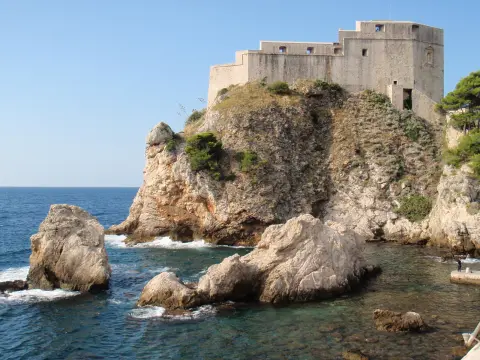
The fortress stands on a steep rock rising 37 metres above the sea, separated from the Old Town by the small inlet of Pile. It has a roughly triangular plan that follows the shape of the rock. The walls facing the sea and any attacker are up to 12 metres thick. The wall facing the city is only about 60 centimetres thick. Inside is an open courtyard with arches, and above it terraces with old cannons pointing out to sea. Stairs climb from the Pile cove, and there is little shade on the way up.
Why it matters
Lovrijenac sums up what Dubrovnik valued most: its freedom. The inscription over the gate says that liberty should not be sold for all the gold in the world. The fort is also one of the best viewpoints in the city, and in summer it is one of its most loved theatres. Your city walls ticket includes entry, so it is easy to add to your day.
Your walk-through
The stops a guide would take you to, in order.
-
1
Pile cove
We start at the little cove of Pile, below the fort. Look up at the sheer rock and the walls rising out of it. Fishing boats bob in the water, and in summer people swim here. To the right are the western walls of the Old Town and Fort Bokar. The two forts faced each other across this water and together guarded the city's main gate.
-
2
The climb
Now the stairs. Take them slowly. As you climb, stop to look back. The view of the Old Town walls grows with every step, and the sea gets deeper blue below. There are some places to pause. This approach was designed to be hard for an enemy. For us, it is a short climb with a big reward.
-
3
The gate inscription
Stop at the gate and look above it. The carving reads Non bene pro toto libertas venditur auro. In plain English: freedom should not be sold for all the gold in the world. These words sum up the spirit of the Republic, which kept its independence through clever diplomacy for centuries. Many locals know the phrase by heart.
-
4
The courtyard
Step into the courtyard, framed by stone arches. This is the space that becomes a theatre during the Dubrovnik Summer Festival. Hamlet has been performed here so often that the production became a symbol of the festival. Imagine the actors on these steps, the audience under the arches, and the sea darkening behind. Few stages anywhere feel so dramatic.
-
5
The thick and thin walls
Look closely at the walls. On the sea side they are up to twelve metres thick. On the side facing the city, only about sixty centimetres. The reason, it is often said, was to keep the commander loyal: a thin wall could be broken easily by the city's own cannon if he ever turned against the Republic. It was security, Dubrovnik style.
-
6
Upper terrace
Finally climb to the top terrace. Old cannons still point out to sea. Turn east and you have one of the best views of the Old Town, its walls running along the cliffs, Minčeta tower crowning the top, and Lokrum beyond. Turn west and you see open water. Stay a while. At sunset this terrace glows.
Things you might not know
- The fort stands 37 metres above sea level.
- Its seaward walls are up to 12 metres thick, but the wall facing the city is only about 60 centimetres.
- The first written record of the fort dates from 1301.
Researched November 2026 from: en.wikipedia.org, en.wikipedia.org, citywallsdubrovnik.hr. Fees and hours change, so check on the day.