⭐ Must-see · Lokrum, off the Old Town, 5 km from central Dubrovnik
Lokrum Island
Pine woods, peacocks and a monk's curse across the water
🎧 Listen to this guide · about 6 min
Pop your earphones in and we'll walk you round.
Welcome aboard. From the old harbour, the boat to Lokrum takes only a few minutes, but it feels like crossing into another world. The island is small, under a square kilometre, and wrapped in pine and holm oak. There are no cars and no hotels. Peacocks wander the paths and shriek from the trees. You will find a ruined Benedictine monastery, a botanical garden, a fortress on the summit and a little salt lake where you can float. Lokrum is a protected nature reserve, so we walk gently. Bring a swimsuit, a picnic, and plenty of time to do nothing. That is the whole point of coming here.
The story of Lokrum Island
Lokrum enters the written record in 1023, when Benedictine monks were already living here. Their monastery grew over the centuries, and you will see its cloister and church walls today. Legend says Richard the Lionheart was shipwrecked off Lokrum in 1192 on his way home from the Crusades, and vowed to build a church where he came ashore. So the story goes, the people of Dubrovnik persuaded him to build it in the city instead.
In the early nineteenth century the monks were forced to leave. Local legend says that on their last night they walked around the island in procession, dripping candle wax, and cursed anyone who would claim Lokrum for pleasure. Many Dubrovnik people still enjoy telling you about it. Under the French, work began in 1806 on a fort at the island's highest point, later completed by Austria.
In 1859 Archduke Maximilian of Habsburg had a summer residence built here, and laid out gardens. He brought the peacocks, whose descendants still rule the island. Maximilian later became Emperor of Mexico and was executed there in 1867, which only fed the legend of the curse. A botanical garden was founded on Lokrum in 1959, and the island is now protected as a nature reserve.
The setting
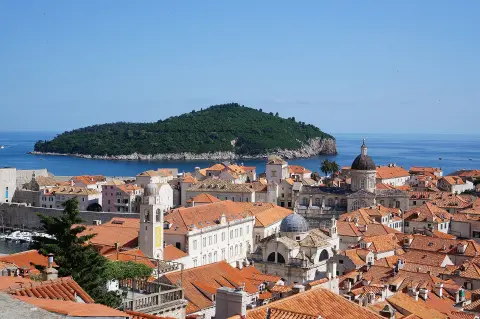
Lokrum lies about 600 metres from the city, long and narrow, with an area of about 0.8 square kilometres. Its northern side, facing Dubrovnik, is gentle, with the landing pier and the monastery close by. The south and east are rocky, with flat limestone shelves that make natural sunbathing platforms. Near the south shore is the Dead Sea, a small salt lake about ten metres deep, linked to the open sea through cracks in the rock. Shaded paths cross the island, and one climbs to Fort Royal at 96 metres. The whole island is covered in Mediterranean woodland with planted exotic trees around the monastery.
Why it matters
Lokrum is Dubrovnik's green lung and its local escape. On hot days families come to swim off the rocks, and in a city famous for crowds, this is where you can still find silence. As a nature reserve it protects rare plants and the island's woodland. It also keeps the stories of the monks, the curse and the Habsburgs alive, all within sight of the city walls. And it frames the most loved view of Dubrovnik itself, seen from the sea.
Your walk-through
The stops a guide would take you to, in order.
-
1
Portoč landing
We step off at the little harbour of Portoč. Turn around before you go anywhere. That is Dubrovnik, the whole walled city, rising from the water. It is one of the best views of the walls you will get. The paths start right here. Follow the signs to the monastery, and listen. That wailing sound in the trees is a peacock, not a child.
-
2
Benedictine monastery and cloister
Here are the remains of the Benedictine monastery, first recorded in 1023. Walk into the cloister and look at the old stone arches. Later Maximilian's summer residence was built into this complex. Inside you may also find a replica of the Iron Throne, because Game of Thrones filmed here. Take a quiet moment. The monks lived on this island for centuries.
-
3
Botanical garden
Behind the monastery spreads the botanical garden, founded in 1959. Look for agaves, cacti, eucalyptus and palms from as far as Australia and South America, growing happily in the Adriatic sun. Maximilian started importing exotic plants here in the nineteenth century, and the gardeners continued his idea. Peacocks love this part of the island, so watch where you step.
-
4
The Dead Sea
A short walk south brings you to the Dead Sea, a small, sheltered salt lake. It is connected to the open sea through cracks in the rock, so the water is salty and calm. The lake is about ten metres deep at most. Families swim here because there are no waves. Slip in and float for a while with the cliffs around you.
-
5
Rocky south shore
Now the island opens onto its wild southern coast. Flat limestone shelves step down into deep, clear water. This is where locals come to swim and sunbathe. There are ladders in some spots, but wear water shoes. Part of this shore has long been a naturist area, marked by signs, so be respectful. Look out to sea. Next stop, Italy.
-
6
Fort Royal
Finally, climb the shaded path to Fort Royal at the island's highest point, 96 metres above the sea. The French began it in 1806 and Austria finished it in 1835. Climb to the roof terrace. From up here you look back across the water at the Old Town, Mount Srđ behind it and the coastline running south toward Cavtat. Then wander down slowly to catch your boat.
Things you might not know
- The Benedictine community on Lokrum is first recorded in 1023.
- The island's peacocks descend from birds brought by Archduke Maximilian in the nineteenth century.
- No one may stay on the island overnight; the last boat takes everyone back to the city.
Researched November 2026 from: en.wikipedia.org, lokrum.hr, lokrum.hr. Fees and hours change, so check on the day.