💎 Hidden gem · Khola, Canacona, 45 km from central Goa
Cabo de Rama Fort
Ramparts, cannons and a legend on the edge of the sea
🎧 Listen to this guide · about 5 min
Pop your earphones in and we'll walk you round.
Welcome to Cabo de Rama. Stand on these walls and feel the wind. Below you the cliffs drop straight into the Arabian Sea, and on a clear day the coast stretches north toward Colva and south toward Canacona. This is an old fort on a rocky headland, built and rebuilt by many rulers over the centuries. Today it is mostly ruins, with crumbling walls, a few old cannons and a small white chapel that is still used for worship. There is no crowd here, and no rush. Just the sound of the waves, the cry of seabirds, and a sense of history all around you. Bring water and a hat. The sun is strong on these walls.
The story of Cabo de Rama Fort
Long before any fort, the headland had a legend. Tradition says Lord Rama, hero of the Ramayana, stayed here with his wife Sita during their years of exile from Ayodhya, and the cape takes its name from him. It is a story, not history, but it is told with affection.
The first fort here was built by local Hindu rulers, and over the following centuries control passed back and forth between Hindu and Muslim kingdoms. In the eighteenth century the area was held by the rajas of Soonda. In 1763, so the record goes, the raja gave up these lands to the Portuguese in return for protection against Hyder Ali of Mysore. The Portuguese rebuilt the fort, armed it with 21 guns, and added barracks, a commander's house and a chapel.
When the threat from Mysore faded at the end of the eighteenth century, the fort lost its military purpose. It was later used as a government prison, which, according to most accounts, operated here until 1955. After that it was largely abandoned, and the forest and weather slowly took over the walls.
The setting
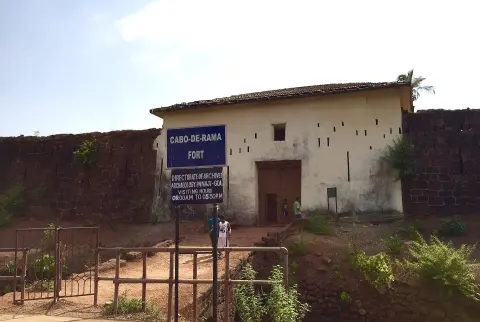
The fort sits on a high laterite headland jutting into the Arabian Sea, with sheer cliffs on the western side. A thick outer wall with bastions and gun platforms runs around the landward side, with a gateway leading in. Inside are open, grassy grounds, ruined buildings, the remains of barracks, and the small Chapel of Saint Anthony, still painted white. From the seaward ramparts you look down onto crashing waves and rocky coves. A path leads down from near the fort to a small beach below. The colour of the stone, a deep rust red, glows in late afternoon light.
Why it matters
Cabo de Rama is a good place to understand how contested this coast once was. Hindu kingdoms, Muslim sultans, the Marathas, Mysore and the Portuguese all wanted control of these harbours and trade routes. The fort's walls hold that story. It is also one of the few places in Goa where a legend from the Ramayana sits beside a Portuguese chapel, a reminder of the many layers of belief here. And it is simply one of the finest sea views in the state.
Your walk-through
The stops a guide would take you to, in order.
-
1
The main gate
Start at the fort's gateway. Look at the thick laterite walls on either side, built to withstand cannon fire. A few old guns still sit nearby. Imagine soldiers posted here, watching the land approach while their comrades watched the sea.
-
2
Chapel of Saint Anthony
Inside the walls, find the small white chapel dedicated to Saint Anthony. It is the best preserved building in the fort and is still used for prayer, with a feast held here each year. Please be respectful if the doors are open and someone is praying.
-
3
The barracks ruins
Walk across the grassy ground to the ruined buildings. These were once barracks and quarters, and later prison cells. Roofs have fallen, trees grow from the walls, and lizards sun themselves on the stones. It is a quiet, slightly eerie place.
-
4
The seaward ramparts
Now walk to the western edge and climb carefully onto the ramparts. The cliffs fall straight to the sea. On a clear day you can see the coastline running north to Colva and south toward Agonda. Stay well back from the edges, there are no rails, and the stone can be loose.
-
5
The cannons and bastions
Along the walls, look for the old cannons lying in their bastions. They are rusted and still now, but once they guarded the approach by sea. Picture the fort in 1763, freshly taken by the Portuguese, with 21 guns pointing out across the water.
-
6
The path to the cove
If you have energy left, take the path down toward the small beach below the cliffs. It is steep and rocky in places, so wear good shoes. At the bottom you may have the sand almost to yourself. Then climb back up for sunset over the walls.
Things you might not know
- Tradition says Lord Rama stayed on this headland during his exile, giving the cape its name.
- The Portuguese took control of the fort in 1763 and armed it with 21 guns.
- The fort was later used as a prison, which operated until 1955.
Researched November 2026 from: en.wikipedia.org, lonelyplanet.com, outlookindia.com. Fees and hours change, so check on the day.