💎 Hidden gem · Tambdi Surla, Sanguem, 45 km from central Goa
Tambdi Surla Mahadev Temple
A stone temple the forest kept safe for eight centuries
🎧 Listen to this guide · about 6 min
Pop your earphones in and we'll walk you round.
Welcome to Tambdi Surla. Listen for a moment. Birdsong, a stream, the wind in the trees. Out here at the foot of the Western Ghats, far from any town, stands a small dark stone temple dedicated to Shiva, the Mahadev, or Great God. It is not big. It is not gilded. But it is old, very old, and it is the finest piece of medieval temple architecture left in Goa. The temple was built when the Kadamba kings ruled this coast, around the twelfth or thirteenth century. Many other temples of that age were destroyed. This one survived because it was hidden. Walk slowly, take off your shoes when asked, and let the quiet sink in.
The story of Tambdi Surla Mahadev Temple
The Kadambas ruled Goa from roughly the tenth to the fourteenth century, with their capital at Gopakapattana, near present day Panaji. They were great builders, and their emblem, an elephant trampling a horse, appears on coins and carvings. This temple is believed to date from the twelfth or thirteenth century, from the later years of Kadamba rule, when influences from the Yadava kingdom of the Deccan were also strong.
In the centuries that followed, Goa saw invasions from the Deccan sultanates and later, after 1510, Portuguese rule, which in the sixteenth century saw many temples in the coastal areas pulled down. Tambdi Surla was spared. Its remote position in thick forest, far from the main roads and ports, kept it out of sight.
The temple has never fully stopped being a place of worship. Local villagers still come here, especially for Mahashivratri, the great night of Shiva, in February or March. Today it is protected by the Archaeological Survey of India as a monument of national importance, and it lies within the Bhagwan Mahaveer Sanctuary.
The setting
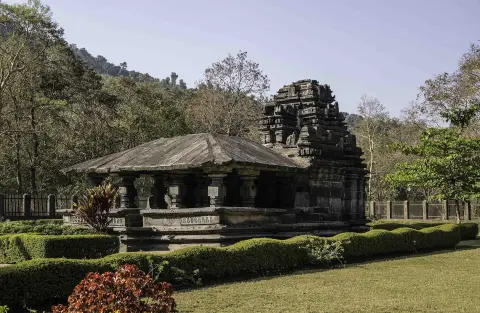
The temple stands in a forest clearing beside the small Ragado River, with stone steps leading down to the water for ritual bathing. It is built of basalt, a dark, hard stone not found in this part of Goa and believed to have been brought from the Deccan plateau. The plan is classic: a pillared hall, called the mandapa, then a small vestibule, then the inner sanctum where the lingam, the symbol of Shiva, rests. Above the sanctum rises a tiered tower, its top now incomplete. The temple faces east so the first sunlight falls on the deity. All around, tall trees press in close.
Why it matters
Tambdi Surla matters because it is almost all that survives of a whole chapter of Goa's past. Before the churches and the beaches, there were kingdoms, temples and trade routes along this coast, and this little building is their clearest witness. It shows the skill of medieval stone carvers and the links between Goa and the temple building traditions of Karnataka. For local people, it remains a living place of prayer. For visitors, it is a reminder that Goa's story is much older and more varied than most people realise.
Your walk-through
The stops a guide would take you to, in order.
-
1
The approach through the forest
As you walk in from the road, notice how the forest closes around you. This is the reason the temple survived: it is hard to find and was even harder to reach in the past. Tall trees, creepers, the sound of water. You are inside the Bhagwan Mahaveer Sanctuary here, so keep your voice low and you may hear hornbills or see a giant squirrel in the branches.
-
2
The temple from the front
Stop in front of the temple and take it in. It is compact and perfectly proportioned, built of dark grey basalt. Look at the roof of the hall, with its plain sloping slabs, and at the tower behind it, rising in tiers above the sanctum. Its upper part is incomplete. No one knows for sure whether it was never finished or was taken down long ago.
-
3
The pillared hall
Step into the mandapa, the hall, if you are allowed. Look up at the ceiling, carved with a lotus flower. Then look at the four central pillars, decorated with elephants and chains. Find the base of one column showing an elephant trampling a horse. That is the emblem of the Kadamba kings, carved here as a royal signature.
-
4
Nandi and the sanctum
In the hall sits Nandi, the bull who carries Shiva, now headless. Beyond, through the narrow vestibule, is the inner sanctum, dark and cool, where the lingam stands. The temple faces east, so in the morning light reaches straight in. Legend says a king cobra lives somewhere in the dim interior. Respect the space, and do not step inside the sanctum.
-
5
The carved outer walls
Walk slowly around the outside. Look for panels showing Shiva, Vishnu, Brahma and their consorts, and small decorative motifs. The carving is fine and sharp, thanks to the hardness of the basalt. Notice how few signs of damage there are compared with other temples of this age.
-
6
The Ragado River steps
End at the river. Stone steps lead down to the water, where worshippers once bathed before entering the temple. Sit for a moment and listen to the stream. You are standing where people have come to pray for around eight hundred years.
Things you might not know
- The temple is built of basalt, a stone believed to have been brought from the Deccan plateau.
- The Kadamba emblem, an elephant trampling a horse, is carved at the base of one of its pillars.
- It is protected by the Archaeological Survey of India as a monument of national importance.
Researched November 2026 from: en.wikipedia.org, goa.gov.in, incredibleindia.gov.in. Fees and hours change, so check on the day.