⭐ Must-see · Ba Dinh, 2 km from central Hanoi
Imperial Citadel of Thang Long
A thousand years of kings, soldiers and buried palaces
🎧 Listen to this guide · about 6 min
Pop your earphones in and we'll walk you round.
Welcome to the Imperial Citadel of Thang Long. Thang Long means Rising Dragon, the old name of Hanoi. This ground was the seat of Vietnamese power for most of a thousand years. Kings were crowned here. Armies rode out from here. Much later, generals planned a war here, deep underground. At first glance it may look like a quiet park with an old gate and a few buildings. But under your feet lie layer upon layer of palaces, one on top of the other. Today we will walk through the story from top to bottom. Bring your imagination with you. You will need it, and it will be well rewarded.
The story of Imperial Citadel of Thang Long
In 1010, Emperor Ly Thai To moved his capital to this spot on the Red River and named it Thang Long. Building began that year, and the court moved in by early 1011. Before that, there had been a fortress here under Chinese rule, called Dai La. For the next eight centuries, the Ly, Tran and Le dynasties all ruled from this citadel, each one building on top of the last.
In 1789 the capital was moved to Hue, and the citadel lost its royal role. In 1805, Emperor Gia Long rebuilt Hanoi's citadel in a new style, and most of what survives above ground comes from that time. The Hanoi Flag Tower was added in 1812. When the French took control in the late nineteenth century, they knocked down much of the citadel. They spared the North Gate and the Flag Tower.
In the twentieth century, the site became a military headquarters. During the American War, the leadership of North Vietnam worked here, in a building known as D67 and in bunkers below it. In 2002, digging for a new parliament building at 18 Hoang Dieu Street uncovered remarkable layers of ancient foundations. In 2010, the year Hanoi turned one thousand, UNESCO listed the central sector as a World Heritage Site.
The setting
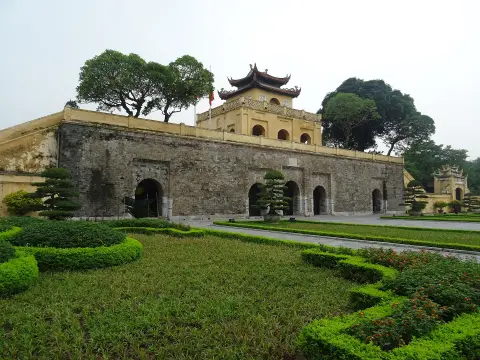
The site is a large walled area in the Ba Dinh district, shaded by old trees. You enter from Hoang Dieu Street. The main axis runs north from Doan Mon, the great southern gate, to the raised foundations of Kinh Thien Palace, and on to the Rear Palace and the North Gate. Most of the old palaces are gone. What remains are gates, foundations, stone steps and later military buildings. Across Hoang Dieu Street is the excavation site, where you can look down at old wells, drains and the bases of wooden columns. To the south, just outside, the hexagonal Flag Tower rises above the trees.
Why it matters
The citadel is the clearest place in Hanoi to see how long Vietnam has been a nation with its own rulers. UNESCO listed it because few places show such a long, unbroken stretch of power on one spot, with layers from China, Vietnam's own dynasties, France and the modern state. For Vietnamese people, it is also a place of pride. It holds the memory of independence won and defended, again and again. And it is still being uncovered, so the story is not finished.
Your walk-through
The stops a guide would take you to, in order.
-
1
Doan Mon Gate
We start at Doan Mon, the southern gate to the Forbidden City. It has five arches. The middle one was for the king alone. The stone gate you see dates from the Le dynasty, though it has been repaired many times. Look down through the glass panel near the gate. You can see older brick roads from earlier dynasties, buried beneath your feet. Climb to the top if it is open, and look north along the royal axis.
-
2
Kinh Thien Palace and the Dragon Steps
Walk north to this raised platform. Here stood Kinh Thien Palace, the main hall where the court held its grandest ceremonies. The palace itself is gone. But look at the stone steps leading up. Carved dragons with long, curling bodies run down the side rails. They date from the Le dynasty, in the fifteenth century. They are some of the finest stone carvings in Vietnam. Imagine the court in silk, climbing these steps toward the throne.
-
3
House D67 and the bunkers
Now we jump forward to the twentieth century. This plain building, D67, was built in 1967. It was the meeting place of the military leadership during the war. Inside, the long table, maps and old telephones are kept as they were. Behind it, steps lead down to a bunker with thick walls and air filters. Think about the contrast. Above, a thousand years of kings. Below, a modern war.
-
4
Hau Lau, the Rear Palace
This elegant three-storey building is Hau Lau, sometimes called the Princess Tower. It was built in the Nguyen period on top of much older foundations, and it is said to have housed women of the court. The French repaired it in a mixed style. It is one of the few royal buildings still standing in the citadel. Look at the curved roofs and the small windows. It feels almost like a watchtower.
-
5
North Gate
At the far end is Bac Mon, the North Gate, from the Nguyen rebuilding. Look closely at the wall above the arch. You will see marks left by French cannon in 1882, when the citadel was attacked. Inside the gate tower is a small shrine to two officials who died defending Hanoi. It is a modest gate, but it carries a heavy memory.
-
6
Excavation site at 18 Hoang Dieu
Cross back to Hoang Dieu Street for our last stop. Here, under shelters, archaeologists opened the ground and found more than a thousand years of building. Look for the round bases of wooden columns, old wells and drainage pipes, and broken roof tiles shaped like dragons and phoenixes. It is like reading the pages of a history book, one layer at a time.
Things you might not know
- Construction of the citadel began in 1010 under Emperor Ly Thai To.
- The Hanoi Flag Tower, built in 1812, is about 33 metres tall.
- The central sector was listed by UNESCO in 2010, the year of Hanoi's thousandth anniversary.
Researched November 2026 from: hoangthanhthanglong.vn, en.wikipedia.org, whc.unesco.org. Fees and hours change, so check on the day.