💎 Hidden gem · Cau Giay, 8 km from central Hanoi
Vietnam Museum of Ethnology
Fifty-four peoples, one garden of houses
🎧 Listen to this guide · about 6 min
Pop your earphones in and we'll walk you round.
Welcome to the Vietnam Museum of Ethnology. Many visitors to Hanoi never make it out here, and they miss one of the best museums in Southeast Asia. Vietnam is not one people but many. The government recognises fifty-four ethnic groups, from the Kinh majority in the lowlands to the Hmong, Tay, Ede and Cham in the hills and along the coast. In this museum you will see their clothes, tools, instruments and beliefs. Then you will step outside into a garden where real houses have been rebuilt, from a towering communal house to a long house on stilts. You can climb inside them. It feels like travelling the country in an afternoon.
The story of Vietnam Museum of Ethnology
The museum was approved in 1987, built over the following years, and opened to the public on 12 November 1997. It belongs to the Vietnam Academy of Social Sciences, and it was set up as a research centre as well as a museum. From the start it took an unusual approach. Instead of simply showing objects behind glass, it worked closely with the communities themselves.
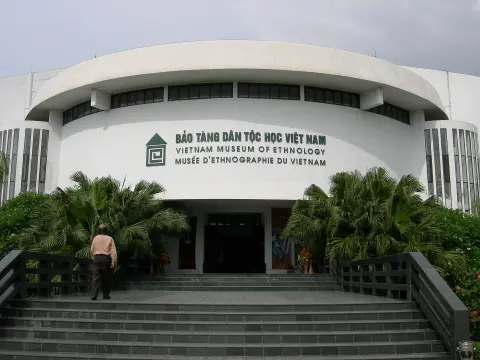
The main building was designed by Ha Duc Linh, an architect from the Tay ethnic group. Its round shape was inspired by the bronze drums of the ancient Dong Son culture. The French architect Veronique Dollfus designed the interior. Over time, the museum added the outdoor garden of traditional houses. Many of them were built by craftspeople brought from their home villages, using their own materials and methods.
In 2013, a second building opened, shaped like a kite. It focuses on the peoples and cultures of the wider Southeast Asia region. Today the museum holds more than 15,000 objects, along with thousands of photographs and recordings.
The setting
The museum sits on a large plot in the Cau Giay district, west of the old centre. The round main building holds two floors of galleries, organised by language family and region. Behind it is the open-air garden, about two hectares of paths, trees and streams. Here stand full-size houses from across Vietnam. The tall Bahnar communal house has a steep thatched roof that rises like an axe blade. The Ede long house stretches on stilts. There is a Giarai tomb with carved wooden figures, a Hmong house of wood, a Tay stilt house and a Kinh house with a tiled roof. A pond at the edge sometimes hosts water puppet shows.
Why it matters
This museum gives a voice to Vietnam's minority peoples, who are often seen only as colourful costumes in tourist photos. Here you see how they live, farm, pray, marry and bury their dead. Exhibitions also tell honest stories of modern life, change and hardship. For visitors, it fills in the picture of Vietnam beyond Hanoi and Ho Chi Minh City. And it shows the respect many Vietnamese researchers have for the country's diversity. You will leave with a far richer idea of who the Vietnamese are.
Your walk-through
The stops a guide would take you to, in order.
-
1
The drum-shaped main building
Start outside and look at the main building. Its rounded form echoes a Dong Son bronze drum, one of the great symbols of ancient Vietnam. Then go inside. The ground floor begins with the Kinh, the majority people, and their village life. Look for the fishing tools, ceramics and the reconstruction of a family altar. It sets the scene for everything else.
-
2
Upland and highland galleries
Move through the galleries of the northern mountain peoples, such as the Tay, Thai, Hmong and Dao. Look closely at the embroidery and indigo dyed cloth. Every pattern carries meaning. You will find shaman's tools, wedding costumes and baskets carried on the back. Take your time with the photographs and films, which show how these crafts are still used today.
-
3
The Bahnar communal house
Now step outside into the garden. The first thing you will notice is this huge Bahnar communal house, with its roof soaring nearly twenty metres high. In the Central Highlands, villages build a house like this as a meeting place for men, guests and ceremonies. Climb the ladder carefully and step inside. Feel the cool shade under the thatch, and look at the carvings on the posts.
-
4
The Ede long house
Next, the Ede long house. Ede families are traditionally matrilineal, meaning family belongs to the mother's line. When a daughter married, the house was extended for her new family, so it grew longer and longer. Look at the two staircases at the entrance, carved with breasts and a moon, symbols of the female line. Inside, gongs and jars show the wealth of the household.
-
5
The Giarai tomb
Here is the Giarai tomb house, surrounded by carved wooden statues. You will see figures squatting, weeping and even couples. They were made to keep the dead company. In Giarai belief, there is a final ceremony, after which the family lets the dead go and no longer cares for the tomb. Stand quietly for a moment. These statues are full of feeling.
-
6
Southeast Asia kite building
Finish in the kite-shaped building, opened in 2013. It reaches beyond Vietnam's borders to show the cultures of neighbouring countries, from masks to puppets and textiles. It reminds you that the peoples of this region share many roots. Then rest by the pond, or catch a water puppet performance if one is on.
Things you might not know
- The museum opened to the public on 12 November 1997.
- Its main building was designed to echo an ancient Dong Son bronze drum.
- Vietnam officially recognises 54 ethnic groups, all represented here.
Researched November 2026 from: en.wikipedia.org, vme-en.vass.gov.vn, vietnamtourism.com. Fees and hours change, so check on the day.