💎 Hidden gem · Atsubetsu-ku, Nopporo Forest Park, 17 km from central Hokkaido (Sapporo)
Historical Village of Hokkaido
Walk the streets of Hokkaido's frontier days
🎧 Listen to this guide · about 5 min
Pop your earphones in and we'll walk you round.
Welcome to the Historical Village of Hokkaido. Step through the gate and you step back more than a hundred years. Ahead of you is a main street of wooden shops, a post office, a bank and a barber, all real buildings gathered from towns across Hokkaido. Beyond them lie a fishing village, a farm village and a mountain village, set among the trees. In summer a horse pulls a tram car along the main street. In winter, when snow covers everything, the tram becomes a sleigh. There is no rush here. Push open a door, peek into a kitchen, and imagine life on this cold, new frontier.
The story of Historical Village of Hokkaido
For centuries, Hokkaido was the land of the Ainu people, with small Japanese trading posts on its coasts. After 1868 the new Meiji government set out to settle and develop the island. Farmers, fishermen, merchants and former samurai arrived from across Japan. They built towns of wood, often borrowing ideas from America and Europe to cope with the long, harsh winters.
By the late twentieth century, many of these early buildings were disappearing. The Historical Village of Hokkaido was created to save some of them. It opened in April 1983, inside the Nopporo Forest Park on the eastern edge of Sapporo. Buildings were carefully taken apart, moved and rebuilt here, and some were faithfully recreated.
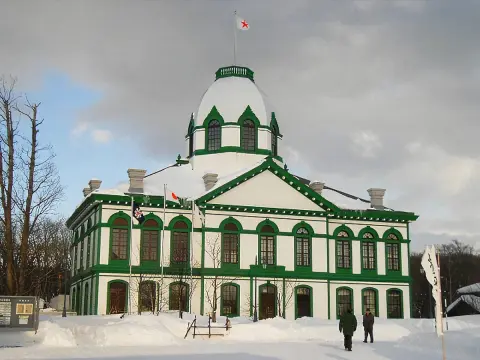
Today the village holds 52 buildings from the Meiji period to the early Showa period, roughly from 1868 to the 1920s. They include a herring fishing family's house that once also lodged their workers, farmhouses, a school, shops and inns. Among the most precious is the Kaitakushi Industrial Office, completed in 1877, the only surviving government office building linked to the Hokkaido Colonization Commission. At the entrance stands a four-fifths scale copy of the third Sapporo Station building, which served the city from 1908 to 1952.
The setting
The village spreads across a gentle slope at the edge of the Nopporo forest. It is laid out in four areas. The town area has 31 buildings along a main street, with a narrow-gauge track down the middle for the horse tram. The fishing village has the big herring house. The farm village has barns and farmhouses in open fields. The mountain village, the smallest, shows life in the forests. Paths link them all, and the woodland around keeps the outside world out of sight.
Why it matters
This village tells the story of how modern Hokkaido was built, house by house. It is also honest about how hard that life was, with its cramped worker lodgings and cold kitchens. For locals it is a place to bring children to see how their great-grandparents lived. For visitors it gives real depth to everything else you see in Sapporo. Remember too that this land was Ainu land first; pair your visit with the Hokkaido Museum next door for that wider story.
Your walk-through
The stops a guide would take you to, in order.
-
1
Old Sapporo Station building
We enter through a copy of the third Sapporo Station building, built at four-fifths the size of the original. The real one served the city from 1908 to 1952. Look at the wooden detail and the tall windows. Inside are the ticket desk and a shop. Step through, and the old town is waiting for you.
-
2
Main street and the horse tram
Here is the main street of the town area. Look down at the narrow track in the road. In summer a horse pulls a small tram car along it, and in winter the same service runs as a sleigh. Take a ride if it is running. The clip of hooves on the street sets the pace for the whole visit.
-
3
Kaitakushi Industrial Office
This white wooden building is the Kaitakushi Industrial Office, finished in 1877. It is the only surviving government office building of the Hokkaido Colonization Commission. Notice the glass sash windows and the double floors. They were American ideas, used to keep out Hokkaido's bitter cold. It shows how much the early planners looked abroad.
-
4
Shops and homes of the town
Wander into the shops and houses along the street. You may find an old pharmacy, a barber, a newspaper office or a soba shop, each furnished as it would have been. Look at the stoves and the thick walls. Ask yourself how you would have managed a Sapporo winter in a house like this.
-
5
Herring fishermen's house, fishing village
Walk down to the fishing village and the great herring house of the Aoyama family. In its day, herring fishing brought huge wealth to Hokkaido's coasts. This house held the owner's family and also sleeping quarters for about sixty seasonal workers. Stand in the big room and imagine it full of tired men after a long day at sea.
-
6
Farm village
Finish in the farm village, among barns and farmhouses in open fields. Settler families cleared forest by hand to make farms like these. The work was slow and hard, and many did not succeed. When you look out over Hokkaido's wide fields today, remember they began with families like these.
Things you might not know
- The village opened in April 1983 and holds 52 historic buildings from across Hokkaido.
- The Kaitakushi Industrial Office, completed in 1877, is the only surviving government office building of the Hokkaido Colonization Commission.
- The horse-drawn tram runs on rare narrow-gauge track, and in winter it becomes a horse-drawn sleigh.
Researched November 2026 from: en.wikipedia.org, kaitaku.or.jp, japan-guide.com. Fees and hours change, so check on the day.