💎 Hidden gem · Higashi-ku, northeast Sapporo, 15 km from central Hokkaido (Sapporo)
Moerenuma Park
A sculptor's last dream, shaped from an old rubbish ground
🎧 Listen to this guide · about 5 min
Pop your earphones in and we'll walk you round.
Welcome to Moerenuma Park. Look around you. Gentle green hills, a perfect cone of earth, a glass pyramid catching the sky, wide lawns curving away to the water. It all looks so natural, and yet every line here was drawn by one man, the artist Isamu Noguchi. He saw the whole park as a single sculpture, one you can walk across, climb and lie down in. And the most surprising part? Under your feet was once a rubbish tip. In winter the hills turn white, and locals come with skis and sledges. In summer the fountain dances. Today we will walk his sculpture together.
The story of Moerenuma Park
This land was once a low, wet area inside a bend of the Moerenuma, a curving old river channel that gives the park its name. From 1979 it was used as a landfill site for the city's rubbish. Sapporo, meanwhile, had a plan to ring the city with green spaces, and this site was chosen to become one of them.
In 1988 the city invited Isamu Noguchi to design the park. Noguchi was a Japanese American sculptor and designer who had long dreamed of shaping land itself into art, playgrounds and hills you could climb. He visited the site and made a master plan and a model. Then, on 30 December 1988, he died in New York, before a single hill was built.
The city decided to carry on. Construction followed his plan from 1989, guided by the people who had worked with him. Rubbish dumping stopped completely in 1990, and the park was opened in stages as work went on. The project was finished on 1 July 2005, more than sixteen years after Noguchi's death. It is sometimes called his last great work, completed by others with great care.
The setting
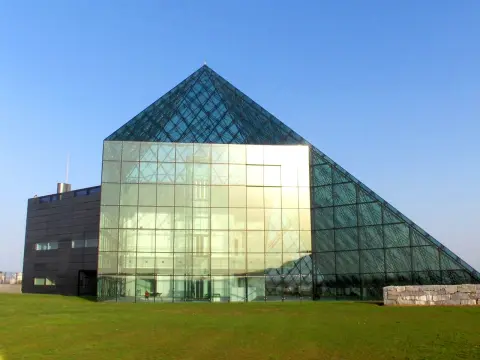
The park covers about 189 hectares, wrapped in the loop of the old river. The largest feature is Mount Moere, a stepped hill 62 metres high, built up over the old landfill. From the top you can see across the plain to the city. Nearby is Play Mountain, a smaller hill of stone steps and grass, one of Noguchi's oldest ideas. The Glass Pyramid, called Hidamari, meaning a sunny spot, stands near the east entrance and holds a gallery, a restaurant and rest areas. Around the park are playgrounds with brightly coloured equipment designed by Noguchi, a geometric Tetra Mound, and the Sea Fountain, which shoots water up to 25 metres high in summer.
Why it matters
Moerenuma Park shows that a city can turn a rubbish dump into something beautiful. For Sapporo it is a place for families, runners, skiers and picnickers. For lovers of art and design, it is a pilgrimage site, the largest work by one of the twentieth century's great sculptors. It is free, it is spacious, and even on a busy day you can find a quiet slope all to yourself.
Your walk-through
The stops a guide would take you to, in order.
-
1
Glass Pyramid, Hidamari
Start at the Glass Pyramid by the east entrance. Its name, Hidamari, means a sunny spot, and even on a cold day the light inside is warm. Look for the displays about Noguchi and his plan for the park. In winter, this is also where you can rent snowshoes, skis and sledges. Climb to the upper level for a first look across the park.
-
2
Mount Moere
Now walk to Mount Moere, the great stepped hill. It is 62 metres tall, built on what was once a landfill. You can take the gentle paths or the steep stone steps straight up. From the top, look across the whole park and on to the city and the mountains. In winter, people slide and ski down its slopes.
-
3
Tetra Mound
Next is the Tetra Mound, a grassy mound framed by a huge triangle of stainless steel poles. It is pure geometry set on soft ground. Walk around it and watch how the lines change against the sky. Noguchi loved this contrast between hard shapes and gentle earth, and here it is at its most simple.
-
4
Play Mountain
Find Play Mountain, a hill with stone steps up one side and smooth grass on the other. Noguchi first imagined a play mountain as a young artist, decades before this park existed. He never saw one built in his lifetime. Climb it slowly, and think about how long that idea waited.
-
5
Playground groves
Wander through the groves of cherry trees where bright playground sets sit among the trunks. Noguchi designed these as sculptures for children to climb and swing on. Each set has a different colour and shape. It is a joy to watch families here; the art is being used exactly as he hoped.
-
6
Sea Fountain
End at the Sea Fountain, a large circle of water. From spring to autumn it runs a show of jets and mist that can shoot as high as 25 metres. In winter it is switched off and the basin rests under snow. Either way, it is a calm place to finish and look back at the hills you have just climbed.
Things you might not know
- The site was a landfill for city rubbish from 1979, and dumping ended completely in 1990.
- Isamu Noguchi died in December 1988, before construction began; the park was completed in 2005.
- Mount Moere, the park's highest hill, is 62 metres tall and built over the old landfill.
Researched November 2026 from: en.wikipedia.org, moerenumapark.jp, moerenumapark.jp. Fees and hours change, so check on the day.