🚗 Day trip · Near Overton, Moapa Valley, 90 km from central Las Vegas
Valley of Fire State Park
Sandstone that burns red in the desert sun
🎧 Listen to this guide · about 5 min
Pop your earphones in and we'll walk you round.
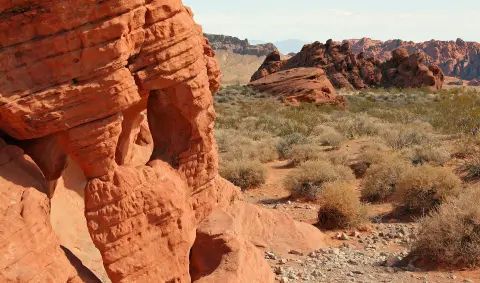
Welcome to the Valley of Fire. When you first drive in, you will understand the name. The rocks rise in waves of deep red, orange and pink, and when the sun is low they seem to glow, as if the hills are smouldering. In between lie pale domes, twisted shapes and sandy washes. This is Nevada's oldest state park, about an hour from Las Vegas, and it feels like another planet. Today we will see a rock shaped like an elephant, climb to ancient carvings, and walk among striped sandstone. Bring plenty of water, wear a hat, and keep your camera ready. Every turn of the road is a new picture.
The story of Valley of Fire State Park
People have come to this valley for thousands of years. Ancestral Puebloans visited the area from roughly 300 BC to 1150 AD, hunting, gathering and leaving behind petroglyphs carved into the dark surface of the rocks. Some of these images are more than 2,000 years old. Later the Southern Paiute used the region.
In 1931 the federal government passed the land to Nevada, and from 1933 young men in the Civilian Conservation Corps built roads, trails, campgrounds and stone cabins here. The park opened in 1934 and was officially designated in 1935, making it Nevada's first state park. In 1968 it was named a National Natural Landmark.
The red landscape has long attracted filmmakers, and scenes for Viva Las Vegas, The Professionals, Total Recall and Star Trek Generations were shot here. A new visitor center, costing about 30 million dollars, opened on 10 November 2025.
The setting
The park covers about 46,000 acres in the Mojave Desert, roughly 50 miles northeast of Las Vegas and 16 miles south of Overton. Its red rock is Aztec Sandstone, formed from great shifting dunes about 150 million years ago, and later lifted, faulted and carved by wind and water. The red outcrops stand among grey and tan limestone. The 10.5-mile Valley of Fire Road, a Nevada Scenic Byway, runs east to west through the park, with a scenic side road leading north past Mouse's Tank to the White Domes. Summers are fierce, often above 40 degrees Celsius.
Why it matters
Valley of Fire protects some of the finest rock art in Nevada and a landscape of rare beauty. It preserves the story of ancient peoples, the work of Depression-era CCC crews, and the deep geological past of the Mojave. For Las Vegas visitors, it is the easiest way to see the wild red-rock country of the Southwest. Its fragile petroglyphs and formations depend on visitors treating them with care.
Your walk-through
The stops a guide would take you to, in order.
-
1
Elephant Rock
Near the east entrance, take the short walk to Elephant Rock. Look at the arch and the long trunk-like shape hanging down. Wind and water carved it from sandstone over thousands of years. From the right angle, it really does look like an elephant dipping its trunk into the sand. It is a gentle introduction to the park's playful shapes.
-
2
Visitor Center
Next, stop at the new visitor center, opened in November 2025. Exhibits explain the park's geology, plants and animals, and its human history. Rangers can tell you which trails are open. From May to September many trails close for heat safety, but in the cooler months most are open. Fill your water bottles here.
-
3
Atlatl Rock
Drive on to Atlatl Rock. A metal staircase climbs the side of a tall rock face, and at the top you come eye to eye with petroglyphs. Look for an image that appears to show an atlatl, a spear-throwing tool used before the bow and arrow. These carvings were made by people who lived here long ago. Please look but never touch.
-
4
Mouse's Tank
Take the scenic road north to Mouse's Tank. A short trail runs through a sandy canyon whose walls are covered with petroglyphs. At the end is a natural basin that holds rainwater. So the story goes, it is named after a Southern Paiute man called Mouse, who hid here in the 1890s. Walk slowly and scan the walls; there are carvings everywhere.
-
5
The Fire Wave
Further on is the trail to the Fire Wave, a sweeping dome of sandstone striped in red, pink and cream, like a frozen wave. The walk is about a mile and a half return, over sand and slick rock. In the late afternoon the stripes glow brightest. This trail closes in summer, so the cool months are the time to see it.
-
6
White Domes
Finish at the White Domes, at the end of the scenic road. Here the rock turns pale and creamy, with red patches mixed in. A loop trail leads through a narrow slot canyon and past the ruins of a film set. It is a wonderful last walk, and the contrast of white and red sums up the strange beauty of this valley.
Things you might not know
- Valley of Fire was designated in 1935, making it Nevada's oldest state park.
- Some of its petroglyphs are more than 2,000 years old.
- The red rock is Aztec Sandstone, formed from desert dunes about 150 million years ago.
Researched November 2026 from: en.wikipedia.org, parks.nv.gov, travelnevada.com. Fees and hours change, so check on the day.