⭐ Must-see · Hollywood, 11 km from central Los Angeles
Hollywood Walk of Fame and TCL Chinese Theatre
Walk on the names that made the movies
🎧 Listen to this guide · about 6 min
Pop your earphones in and we'll walk you round.
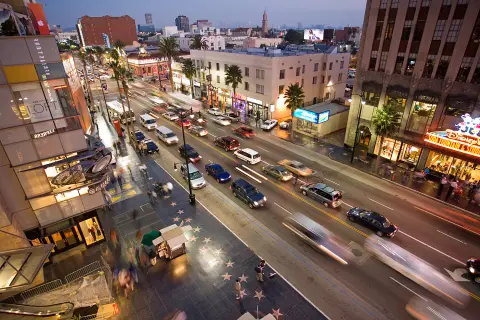
Welcome to Hollywood Boulevard. Look down. Under your feet are pink terrazzo stars edged in brass, each carrying a name and a small emblem: a film camera, a television set, a record, a microphone, a pair of theatre masks. There are thousands of them, running block after block. This is a busy, noisy, slightly chaotic street, with costumed performers, tour buses and souvenir shops. But it is also a real piece of history. Here the studios premiered their films, and here the stars pressed their hands into wet cement. Keep an eye on your belongings, ignore the hustlers, and let's walk the boulevard the way the movie crowds once did.
The story of Hollywood Walk of Fame and TCL Chinese Theatre
Hollywood began as a small farming town and was absorbed into Los Angeles in 1910. Within a few years filmmakers had arrived, drawn by sunshine, cheap land and varied scenery, and by the 1920s the name Hollywood meant the movies. In 1927 the showman Sid Grauman opened his Chinese Theatre on the boulevard. That same year, the first stars pressed their hands and feet into the cement of its forecourt, beginning a tradition that continues today.
After the Second World War, Hollywood's streets grew shabby. In 1953 local business leaders proposed a Walk of Fame to restore some glamour. Eight prototype stars were shown in September 1958, and the actress Joanne Woodward is often called the first honoree because she was the first to pose with hers. Groundbreaking came on 8 February 1960, the first permanent star, for the director Stanley Kramer, was set on 28 March 1960, and the Walk was dedicated on 23 November 1960.
The Walk is run by the Hollywood Chamber of Commerce. Each year a committee chooses new names, and the honoree's sponsor pays a fee that funds the star and the Walk's upkeep. By September 2026 there were 2,857 stars. In 2001 the Kodak Theatre, now the Dolby Theatre, opened next to the Chinese Theatre, and it has hosted the Academy Awards since 2002.
The setting
The Walk runs about 2 kilometres along Hollywood Boulevard, from La Brea Avenue to Gower Street, and about 600 metres along Vine Street. The busiest section is around Hollywood and Highland, where the Chinese Theatre, the Dolby Theatre and the Ovation Hollywood shopping centre stand together. The Chinese Theatre is pure 1920s fantasy, with a pagoda-style roof, a huge dragon across the front and stone guardian lions imported from China. Further east, the boulevard is lined with old movie palaces such as the El Capitan and the Pantages. From the upper terraces of the shopping centre you can see the Hollywood Sign on the hills to the north.
Why it matters
The Walk of Fame is one of the most visited free attractions in Los Angeles, and new stars are still added several times a month at public ceremonies. It records not just famous actors but directors, musicians, radio hosts and theatre performers, so it reads like a long, uneven history of popular entertainment. The Chinese Theatre forecourt remains the most honoured spot. A handprint ceremony there is still one of the highest compliments the industry can pay. For visitors, it is a chance to see where the dream factory meets an ordinary city sidewalk.
Your walk-through
The stops a guide would take you to, in order.
-
1
TCL Chinese Theatre forecourt
Start in front of the Chinese Theatre. In the cement forecourt are around two hundred sets of hand and footprints and signatures, dating back to 1927. Look for the old studio-era names as well as recent ones. People love to fit their own hands into the prints of their heroes, so go ahead. Then step back and admire the building itself: the dragon, the bronze roof and the stone lions at the entrance.
-
2
Dolby Theatre
Just a few steps east is the Dolby Theatre, home of the Academy Awards since 2002. On Oscar night this stretch of the boulevard is closed and covered in red carpet. Stars of Oscar-winning names are often placed nearby. On most days you can join a guided tour inside, which shows you the auditorium and the backstage halls where the winners walk off with their statuettes.
-
3
The Hollywood Sign view
Take the escalators up into the Ovation Hollywood centre and find the upper terrace facing north. From here you get a clear view of the Hollywood Sign on Mount Lee. It was put up in 1923 as an advertisement for a housing development called Hollywoodland. The last four letters came down in 1949, and the sign has stood for the whole film industry ever since.
-
4
El Capitan Theatre
Back on the boulevard, cross to the El Capitan Theatre, opened in 1926 as a live stage house and later turned into a cinema. Today it is run by Disney and often shows its films with live shows before the screening. Look at the ornate facade and the bright marquee. This is how many movie palaces on the boulevard looked in their prime.
-
5
Hollywood and Vine
Walk east along the stars to the crossing of Hollywood and Vine. In the golden age of radio and film, this corner was famous as the heart of Hollywood. Just north on Vine stands the round Capitol Records Building, opened in 1956 and shaped, so the popular story goes, like a stack of records. The stars carry on along Vine in both directions.
-
6
Pantages Theatre
Finish at the Pantages Theatre, a little east of Vine. It opened in 1930 as a grand Art Deco movie palace and hosted the Academy Awards during the 1950s. Today it stages touring Broadway musicals. Even if you do not see a show, admire the facade. It is a good place to end, looking back west along the boulevard of names.
Things you might not know
- There were 2,857 stars on the Walk as of September 2026.
- The first permanent star, for director Stanley Kramer, was set on 28 March 1960.
- Stars come in categories marked by emblems, including motion pictures, television, recording, radio, live performance and sports entertainment.
Researched November 2026 from: en.wikipedia.org, walkoffame.com, en.wikipedia.org. Fees and hours change, so check on the day.