💎 Hidden gem · San Marino, 19 km from central Los Angeles
The Huntington Library, Art Museum and Botanical Gardens
Gardens of the world and treasures on paper
🎧 Listen to this guide · about 6 min
Pop your earphones in and we'll walk you round.
Welcome to San Marino, a quiet, leafy town just beyond Pasadena, and to one of the great estates of California. Here, a century ago, a railway magnate and his wife gathered rare books, fine paintings and plants from around the world. Then they gave it all to the public. Today you can walk from a Japanese garden with a moon bridge to a Chinese garden with a lake, then through a forest of giant cactus. Indoors, you can stand before a Gutenberg Bible and the famous painting called The Blue Boy. It is a place to wander for hours. Most local people know it, but many visitors to Los Angeles never find it.
The story of The Huntington Library, Art Museum and Botanical Gardens
Henry E. Huntington made his fortune in railways and land in Southern California. He built the Pacific Electric Railway, whose red streetcars once linked towns across the region. In 1903 he bought the San Marino Ranch, and he built a grand house here, completed in 1911. He married Arabella Huntington, the widow of his uncle Collis, in 1913. Both were serious collectors: Henry of rare books and manuscripts, Arabella of art.
In 1919 the couple signed papers turning the estate into a public research and educational institution. Gardeners led by William Hertrich spent years building the grounds, starting the Desert Garden in 1907 and completing the Japanese Garden in 1912. Arabella died in 1924 and Henry in 1927. Under his will, the collections and gardens opened to the public in 1928. The couple lie in a domed mausoleum on the grounds.
The Huntington has kept growing ever since. The Chinese garden, called Liu Fang Yuan or Garden of Flowing Fragrance, was built with craftsmen from Suzhou in China. Its first phase was dedicated in February 2008 and its second phase opened in March 2014. It is often called the largest Chinese garden outside China.
The setting
The botanical gardens cover about 120 acres of rolling ground at the foot of the San Gabriel Mountains. More than a dozen themed gardens fill the estate. The Desert Garden holds one of the oldest and largest outdoor collections of cacti and succulents in the world, with more than 5,000 species. The Japanese Garden has a traditional house, a moon bridge over a pond and a dry raked-gravel garden. There are also a rose garden, a jungle garden, camellias and a conservatory. The Beaux-Arts mansion now holds the art galleries, with more art in modern buildings nearby. The library building holds the rare books and manuscripts.
Why it matters
The Huntington is both a public attraction and a working research library, used by scholars from around the world. Its collections of British and American history and literature are among the richest anywhere. For gardeners and botanists, its plant collections are important for conservation, including rare cacti and cycads. For visitors, it offers a rare kind of calm in a huge metropolitan area, and a sense of how wealthy collectors of the early twentieth century shaped the culture of Southern California.
Your walk-through
The stops a guide would take you to, in order.
-
1
The Library exhibition hall
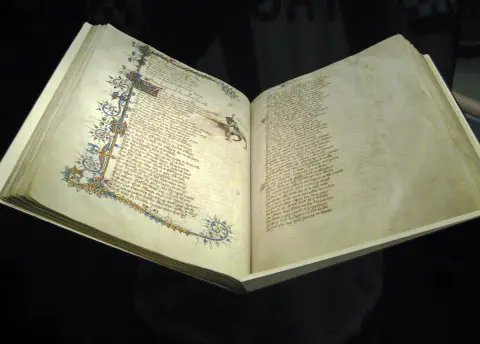
Start in the Library building. In the exhibition hall you can see some of the rarest books in the world. Look for the Gutenberg Bible, printed in the 1450s on vellum, one of only a handful of such copies known. Nearby is the Ellesmere Chaucer, an early fifteenth-century manuscript of The Canterbury Tales, with little painted portraits of the pilgrims in the margins.
-
2
The Huntington Art Gallery and The Blue Boy
Walk to the old mansion, now the Huntington Art Gallery. In the long Thornton Portrait Gallery, look for The Blue Boy by Thomas Gainsborough, a full-length portrait of a young man in shimmering blue satin. Facing it is Pinkie by Thomas Lawrence, a girl in a white dress against a stormy sky. Together they are the Huntington's most famous paintings.
-
3
The Desert Garden
Now head outside to the Desert Garden. Here giant barrel cacti, tall columns and spiky agaves fill the slopes, many planted more than a century ago. Some look like sculptures, others like creatures from another planet. Walk the paths slowly and look for flowers in spring and winter, when many succulents bloom in reds and yellows. Stay on the paths; the spines are sharp.
-
4
The Japanese Garden
Follow the paths down into the Japanese Garden. Cross the red moon bridge over the pond, where koi glide below. On the hill stands a traditional Japanese house brought to the estate in the early twentieth century. Beyond it is the dry garden of raked gravel and stones, and a bonsai court with tiny, ancient-looking trees. This garden was completed in 1912.
-
5
Liu Fang Yuan, the Chinese Garden
Next, walk on to Liu Fang Yuan, the Garden of Flowing Fragrance. Pavilions with tiled roofs stand around a lake, linked by stone bridges and covered walkways. Many of the stones and details were made by craftsmen from Suzhou. Find the teahouse for a rest and a view across the water. Each window frames a different picture, which is part of the design.
-
6
The Rose Garden and mausoleum view
End in the Rose Garden near the mansion, where hundreds of varieties bloom from spring into autumn. From the edge of the lawns, look toward the hill where the domed Huntington Mausoleum stands among the trees. Henry and Arabella are buried there. It is a quiet place to finish, looking out over the gardens they left to the public.
Things you might not know
- The Desert Garden holds more than 5,000 species of cacti and succulents.
- The Huntington owns one of the few Gutenberg Bibles printed on vellum.
- Henry Huntington built the Pacific Electric Railway, whose red cars once linked towns across Southern California.
Researched November 2026 from: huntington.org, en.wikipedia.org. Fees and hours change, so check on the day.