⭐ Must-see · Upcountry Maui, Summit District, 60 km from central Maui
Haleakalā National Park Summit
Waiting for the sun at the House of the Sun
🎧 Listen to this guide · about 7 min
Pop your earphones in and we'll walk you round.
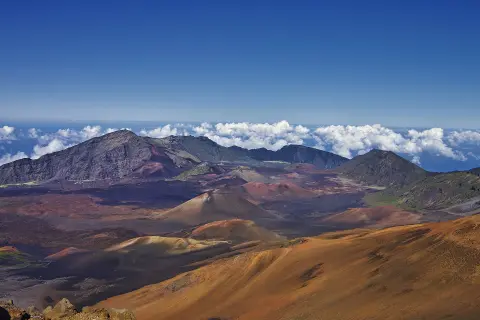
Welcome to Haleakalā. Wrap up warm, because up here it can be below freezing before dawn, even when the beaches below are balmy. We are climbing to more than three thousand metres, higher than the clouds that usually sit on the mountain's shoulders. If you came for sunrise, you will stand in the dark with strangers, all of you quiet, all of you watching one thin line of orange. Then the light spills across the crater, and the colours come up out of the ground: rust, ochre, charcoal and pink. If you came later in the day, you get the same wide silence, more warmth, and far fewer people. Either way, breathe slowly, walk gently, and remember that you are a guest on a mountain that is sacred to Native Hawaiians.
The story of Haleakalā National Park Summit
Haleakalā means house of the sun. Hawaiian tradition tells how the demigod Māui climbed this mountain and snared the sun with ropes, forcing it to slow its race across the sky so that his mother's kapa cloth could dry. It is a story, but stand here at dawn and you will understand why it was told here. For centuries the summit was a place of ceremony, travel and the gathering of stone for tools, and it remains a living sacred place today.
The mountain itself is a shield volcano. Its last eruption, low on the southwest rift, is now dated to sometime between about 1480 and 1600. The summit area was protected in 1916 as part of Hawaii National Park, together with the volcanoes of Hawaiʻi Island. In 1961 it became its own national park, and it later grew to include the Kīpahulu coast near Hāna. Much of the park is now designated wilderness.
The twentieth century also brought scientists. Clear, dry air above the clouds made the summit ridge a prime site for observatories, and today the white domes nearby include the Daniel K. Inouye Solar Telescope, built to study the sun. Popularity brought pressure too. Sunrise crowds grew so large that the park introduced a reservation system, and today you need a booking to drive in between three and seven in the morning.
The setting
The summit sits at 3,055 metres, or 10,023 feet, at Puʻu ʻUlaʻula, the Red Hill. Below it lies what everyone calls the crater, although geologists will tell you it is really a vast erosional valley, shaped by water and later filled with young cinder cones. It runs about eleven kilometres long and three kilometres wide, and drops nearly eight hundred metres from rim to floor. The road up climbs through ranch land and eucalyptus, past the park entrance, then switches back and forth over bare red cinder with no streetlights and no guardrails. Near the top the plants thin out to scattered shrubs and the strange silver globes of the Haleakalā silversword, which grows nowhere else on earth. On a clear day you can see the Big Island's peaks floating on the horizon.
Why it matters
Haleakalā matters on several levels at once. For Native Hawaiians it is a sacred summit, and you may see people offering chants at dawn; please give them space and quiet. For scientists it is one of the best places in the world to observe the sun. For conservation it is a refuge for species found nowhere else, such as the silversword and the nēnē, the Hawaiian goose. And for visitors it is a lesson in scale and patience. The reservation system, the cold and the early start all ask something of you, and the mountain gives back a morning you will not forget.
Your walk-through
The stops a guide would take you to, in order.
-
1
Leleiwi Overlook
Our first stop sits at about 2,700 metres. It is quieter than the summit at sunrise, and many locals prefer it. Walk the short path to the rim and look into the crater from the west. On some afternoons, with the sun behind you and cloud below, you might see your own shadow on the mist, ringed with a halo of colour. That effect is called a Brocken spectre. Keep to the path and do not step over the edge for photos.
-
2
Kalahaku Overlook
Here, a little higher, is the best place to meet the silversword, or ʻāhinahina. Each plant is a rosette of silver, sword-shaped leaves that reflect the fierce sunlight. It can live for decades, then sends up one tall flower stalk covered in purple-red blooms, sets seed, and dies. Grazing goats and souvenir hunters once came close to wiping it out. Fences and protection brought it back, so look closely, but never touch.
-
3
Haleakalā Visitor Center
At about 2,970 metres, the visitor centre stands right on the crater rim. Step inside to see displays on the volcano, the native plants and birds, and the cultural meaning of the mountain. Outside, the view across the crater floor shows a chain of cinder cones in red, brown and black. This is where most people watch sunrise. Rangers are here for questions, and the restrooms are the last ones before the summit.
-
4
Puʻu ʻUlaʻula Summit
This is the top, the Red Hill, at 3,055 metres. A small glass shelter protects you from the wind. Look east over the crater, then south across the ocean to the volcanoes of Hawaiʻi Island. Behind you on the ridge are the observatory domes, which are not open to the public. The air is thin up here, so walk slowly, and if you feel dizzy or short of breath, head back down the mountain.
-
5
Keoneheʻeheʻe Trailhead (Sliding Sands)
Back near the visitor centre is the start of the Sliding Sands Trail, which drops into the crater over loose cinder. Even walking just ten minutes down gives you a sense of the silence and space inside. Remember the rule of this trail: every step down is a harder step back up at high altitude. Carry water, sun protection and a warm layer, and turn around early.
-
6
Hosmer Grove
On the way down, near the park entrance, Hosmer Grove offers a short loop through a stand of trees planted in the early twentieth century and a patch of native shrubland. Listen here for native honeycreepers, small bright birds that sip nectar from flowering trees. It is also one of the park's two campgrounds. After the stark summit, the birdsong feels like a gentle welcome back to the living world.
Things you might not know
- The famous crater is really an erosional valley, about 11 km long and nearly 800 m deep.
- The Haleakalā silversword grows naturally only on this one mountain.
- Haleakalā last erupted sometime between about 1480 and 1600, not in 1790 as was long believed.
Researched November 2026 from: nps.gov, nps.gov, en.wikipedia.org. Fees and hours change, so check on the day.