💎 Hidden gem · Between Kīhei and Māʻalaea, 12 km from central Maui
Keālia Pond National Wildlife Refuge
Stilts, coots and quiet wetlands beside the sea
🎧 Listen to this guide · about 5 min
Pop your earphones in and we'll walk you round.
Welcome to Keālia Pond. Most people speed past this place on the way to the beaches, and that is exactly why it is so peaceful. Step onto the boardwalk and listen. You will hear the wind in the grasses, the soft lapping of the bay and the sharp, yappy call of a bird with long pink legs. That is the aeʻo, the Hawaiian stilt, an endangered bird found only in these islands. This refuge protects one of the last big lowland wetlands left on Maui. Bring binoculars if you have them, walk slowly and quietly, and let the birds come to you. In winter, migrating shorebirds arrive from as far away as Alaska, adding to the scene.
The story of Keālia Pond National Wildlife Refuge
For centuries, Hawaiians used this low-lying land near the shore. Coastal ponds like Keālia provided fish and salt, and nearby fishponds were part of a sophisticated system of aquaculture. Over time, the pond's water levels rose and fell with the seasons, filling in the wet winter and shrinking in the dry summer.
In the twentieth century, much of Hawaiʻi's lowland wetland was drained or filled for farming, roads and building. Native waterbirds that depended on these habitats declined sharply, and several became endangered. The Hawaiian stilt and Hawaiian coot were among them.
In 1992 the United States Fish and Wildlife Service established Keālia Pond National Wildlife Refuge to protect this habitat. Today it covers about 700 acres, making it the largest remaining lowland wetland on Maui. The refuge manages water levels to create good feeding and nesting conditions, controls predators such as mongooses and cats, and works to restore native plants. A boardwalk was later built along the coast so visitors can enjoy the wetland and dunes without disturbing them.
The setting
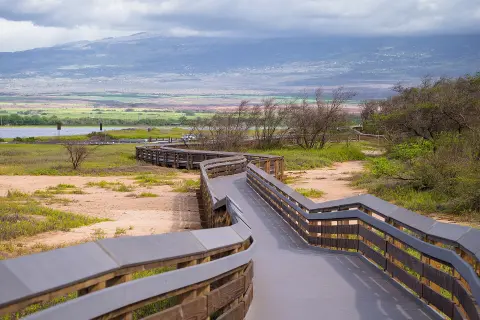
The refuge lies on the narrow isthmus between the West Maui Mountains and Haleakalā, right where the land meets Māʻalaea Bay. It includes a large shallow pond, mudflats, marsh and coastal dunes. In the dry season the pond shrinks and can turn pinkish from salt-loving microbes. The coastal boardwalk runs along North Kīhei Road, over the dunes between the wetland and the beach. From here you can see across the water to the West Maui Mountains, often streaked with cloud, and up the long slope of Haleakalā. The beach beside the refuge is also a nesting site for the rare hawksbill sea turtle.
Why it matters
Keālia Pond is a quiet success story for Hawaiian wildlife. Hawaiʻi has lost most of its native wetlands, and the birds that live in them are found nowhere else on earth. Refuges like this give them space to feed and breed. It also matters for people: wetlands soak up floodwater and filter runoff before it reaches the reef. For visitors, it is a free, simple way to connect with Hawaiʻi's native wildlife, away from crowds, and to see the islands' natural heritage beyond beaches and resorts.
Your walk-through
The stops a guide would take you to, in order.
-
1
Visitor Center
If it is a weekday, start at the visitor centre off Mokulele Highway. Inside you will find displays on the refuge, the birds and the wetland. Staff and volunteers can tell you what has been seen lately. Outside, look out over the pond from the viewing area. On weekends the centre is usually closed, but the coastal boardwalk is still open.
-
2
Coastal Boardwalk entrance
Now head to the boardwalk off North Kīhei Road. Signs here explain the dunes and the wildlife. Notice how the boardwalk lifts you above the plants, protecting both the dunes and nesting birds. Take your time, and walk quietly. The best sightings often come to those who stop and wait.
-
3
Wetland viewing area
From the boardwalk, look inland over the marsh. The bird with the long pink legs and black-and-white body is the aeʻo, the Hawaiian stilt. The dark, duck-like bird with a white forehead shield is the ʻalae keʻokeʻo, the Hawaiian coot. Both are endangered. In winter, look also for migratory shorebirds such as the kōlea, the Pacific golden plover.
-
4
The dunes and native plants
Look down at the dunes beside the walkway. Native plants like ʻakulikuli and pōhuehue, beach morning glory, help hold the sand in place. Restoration crews have replanted many of these. Dunes like these protect the land from storm waves, and once they are lost, they are hard to rebuild.
-
5
Ocean view over Māʻalaea Bay
Turn toward the sea. This is Māʻalaea Bay, and in winter it is a favourite place for humpback whales. On the beach below, hawksbill turtles sometimes come ashore to nest, which is one reason lights and dogs are discouraged here. Look across to the West Maui Mountains and imagine this whole coast as wetland, as it once was.
Things you might not know
- The refuge was established in 1992 and covers about 700 acres.
- It is the largest remaining lowland wetland on Maui.
- The Hawaiian stilt and Hawaiian coot found here are both endangered species found only in Hawaiʻi.
Researched November 2026 from: fws.gov, fws.gov. Fees and hours change, so check on the day.