🚗 Day trip · Bergamo, 55 km from central Milan
Bergamo Città Alta
A walled hilltop town, a funicular ride above the plain
🎧 Listen to this guide · about 6 min
Pop your earphones in and we'll walk you round.
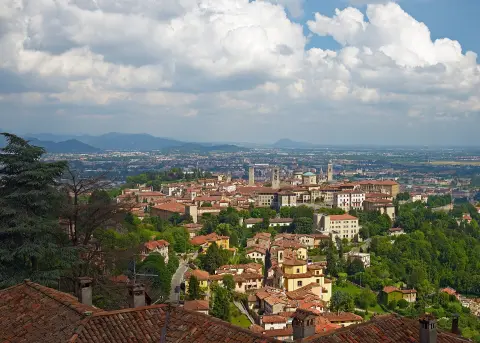
Less than an hour from Milan, the flat plain suddenly gives way to hills. And on the first one, wrapped in massive stone walls, sits Bergamo's Città Alta, the Upper Town. From the station in the modern lower town, you will ride up in a little red funicular, climbing steeply past gardens and villas. Then the doors open onto a world of narrow lanes, stone palaces, fountains and bell towers. There are no wide boulevards up here, just alleys that open onto beautiful squares. Bring an appetite, too. Bergamo is famous for its food, from polenta to the little stuffed pasta called casoncelli.
The story of Bergamo Città Alta
Bergamo has been a city since Roman times, and the Upper Town follows the shape of the old hilltop settlement. In the Middle Ages it was a free commune, then fell under the lords of Milan. In 1428 it passed to the Republic of Venice, and for almost four centuries, until 1797, it was the westernmost outpost of Venetian power on the mainland. You will see the Lion of Saint Mark, the Venetian symbol, on many walls.
To defend this border city, Venice built the great walls you see today. Work began in 1561 and went on for some decades. Whole neighbourhoods and churches were demolished to make room. The walls were so strong that they were never attacked in earnest. In 2017 they were listed by UNESCO as part of a World Heritage Site of Venetian defence works shared with Croatia and Montenegro.
Bergamo's most famous son in the Renaissance was the soldier Bartolomeo Colleoni, a mercenary captain who served Venice. His splendid chapel was built in the 1470s. Later, the composer Gaetano Donizetti was born here in 1797, and he is buried in the city's main basilica. In 1887 the funicular opened, linking the Upper Town to the growing city below.
The setting
The Upper Town sits on a hill about a hundred metres above the lower town and the plain. Its walls run for roughly five to six kilometres, with bastions, platforms and four monumental gates. Inside, the town is compact. The main street runs along the ridge from the funicular to Piazza Vecchia, the old square, and on toward the Citadel at the western end. Behind Piazza Vecchia, through the arches of the old town hall, is the cathedral square, with the Colleoni Chapel and the Basilica of Santa Maria Maggiore. Above the town, a second funicular climbs to San Vigilio and its castle hill.
Why it matters
Città Alta is one of the best-preserved hilltop towns in northern Italy, and a striking example of how Venice protected its empire. The walls are now a favourite walk for locals, with views over the plain and, on clear days, as far as the Apennines. Bergamo was one of the cities hit hardest in the early months of the Covid pandemic in 2020, and its recovery has given the town a special place in Italian hearts. In 2023 it was Italian Capital of Culture together with Brescia.
Your walk-through
The stops a guide would take you to, in order.
-
1
The funicular
Start in the lower town at the funicular station on Viale Vittorio Emanuele. The line opened in 1887, and the climb takes only about two minutes, but it is steep, more than fifty percent at the top. Stand by the window and watch the gardens and villas slip past. When the doors open, you'll step out at the top into Piazza Mercato delle Scarpe, the old shoe market square.
-
2
Via Gombito and the Gombito Tower
Walk up Via Gombito, the main street of the Upper Town, lined with bakeries, pastry shops and wine bars. Look for the tall, plain Gombito Tower, a medieval tower house from the twelfth century. In the Middle Ages, noble families built towers like this to show their power and to defend themselves. Bergamo once had many. Keep an eye out for polenta e osei, little yellow domed cakes topped with marzipan birds, a local treat.
-
3
Piazza Vecchia
The street opens into Piazza Vecchia, the heart of the Upper Town. In front of you is the Palazzo della Ragione, the old town hall, with arches at ground level. In the middle, a white marble fountain, a gift from a Venetian governor in 1780. Above you rises the Campanone, the great civic bell tower. Every night at ten, its bell still rings out, a memory of the old curfew when the city gates were closed.
-
4
Colleoni Chapel
Walk under the arches of the Palazzo della Ragione into the cathedral square. On your right is the Colleoni Chapel, built in the 1470s by Giovanni Antonio Amadeo, the same sculptor who worked on the Certosa of Pavia. Its facade is a dazzling pattern of white, pink and dark marble. Inside lies Bartolomeo Colleoni, the soldier who made his fortune serving Venice. Look up at the gilded equestrian statue above his tomb.
-
5
Basilica of Santa Maria Maggiore
Next door is the Basilica of Santa Maria Maggiore. The outside is Romanesque, but the inside bursts with later decoration: gilded stucco, frescoes and huge Flemish tapestries. Look for the wonderful wooden inlays in the choir, designed by the Venetian painter Lorenzo Lotto. And find the tomb of Gaetano Donizetti, the opera composer, born in Bergamo in 1797. There is a small entry fee.
-
6
Along the Venetian walls
End your visit on the Venetian walls. Walk out toward Porta San Giacomo, the most elegant of the four gates, faced with white stone. Then follow the tree-lined avenue along the top of the walls. Below you stretches the plain, toward Milan. Find a bench and watch the sunset. These walls were never seriously tested in battle, and today they are simply a beautiful place to stroll.
Things you might not know
- Bergamo belonged to the Republic of Venice from 1428 to 1797.
- The Venetian walls were begun in 1561 and became part of a UNESCO World Heritage Site in 2017.
- The funicular to the Upper Town opened in 1887 and climbs 85 metres in about two minutes.
Researched November 2026 from: visitbergamo.net, whc.unesco.org, en.wikipedia.org, lonelyplanet.com. Fees and hours change, so check on the day.