⭐ Must-see · Castello / Parco Sempione, 1 km from central Milan
Sforza Castle (Castello Sforzesco)
Dukes, cannons, Leonardo's trees and Michelangelo's last goodbye
🎧 Listen to this guide · about 6 min
Pop your earphones in and we'll walk you round.
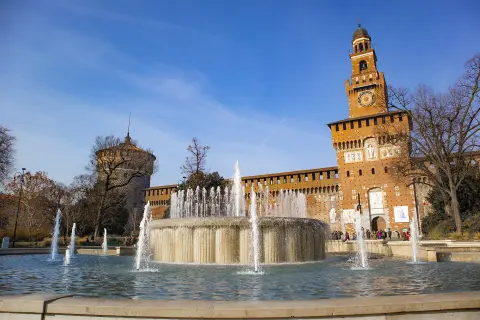
Look at the long red brick walls in front of you, and the tall tower above the gate. This is the Castello Sforzesco, the Sforza Castle, home of the dukes who ruled Milan in the Renaissance. It was a palace, then a barracks, then almost demolished, and now it is a treasure house of museums. You can walk into its courtyards for nothing, and many Milanese use it as a shortcut to the park behind. Inside the museums, you will find armour, tapestries, Egyptian mummies, old musical instruments, a room painted by Leonardo, and one of the most moving sculptures in Italy. Let's go through the gate.
The story of Sforza Castle (Castello Sforzesco)
The first castle on this spot was built by Galeazzo II Visconti in the mid-fourteenth century, guarding the city walls. When the Visconti line died out in 1447, Milan declared a short-lived republic and the people pulled much of the hated fortress down. Three years later, in 1450, the soldier Francesco Sforza took power and began to rebuild it, now as a grand residence. He hired the Florentine architect Filarete to design the tall central gate tower.
Under Francesco's son Ludovico, known as il Moro, the castle became one of the most brilliant courts in Europe. From the 1490s, artists such as Leonardo da Vinci and Bramante worked here. Leonardo painted the ceiling of the Sala delle Asse as a bower of interlaced trees. But the good times did not last. French, then Spanish and Austrian armies held Milan, and the castle became a huge military citadel. In 1521 the Filarete tower was destroyed when stored gunpowder exploded.
By the late nineteenth century there were calls to tear the whole thing down. Instead, the architect Luca Beltrami restored it between 1891 and 1905, rebuilding the Filarete tower from old drawings. The castle became home to the city's museums. Bombs damaged it badly in 1943, and after the war it was carefully restored again as a museum complex.
The setting
The castle is a vast square of red brick with round corner towers and a moat, now dry and grassy. Through the Filarete tower you enter the Piazza d'Armi, the huge parade ground. At the far end lie the two inner courts. On the left, the Rocchetta was the fortified last refuge of the dukes. On the right, the Corte Ducale, with its elegant arcades, was their residence. Behind the castle stretches Parco Sempione, the city's great park, with lawns, a pond and, at its far end, the Arch of Peace. In front, a fountain and a straight avenue, Via Dante, lead back toward the Duomo.
Why it matters
The Sforza Castle tells the story of Milan's power and its many masters, from Renaissance dukes to foreign armies to modern citizens who chose to save it. Today it is a public space and a cultural centre at once. Its museums hold the civic collections, including paintings by Mantegna and Bellini, the Trivulzio Library with a notebook by Leonardo, and Michelangelo's Rondanini Pietà. For many locals, the walk from the Duomo through the castle to the park is simply part of a Sunday in Milan.
Your walk-through
The stops a guide would take you to, in order.
-
1
The Filarete Tower
Start at the main gate on the city side. The tall tower above you looks fifteenth century, but what you see is Luca Beltrami's rebuilding, finished in 1905, closely based on the lost original. The first tower, designed by Filarete for Francesco Sforza, was destroyed in 1521 when gunpowder stored inside exploded. Look for the statue of Saint Ambrose, Milan's patron saint, in the niche above the arch.
-
2
Piazza d'Armi
Walk through into the great parade ground. It is enormous, and that was the point. Here soldiers drilled and the dukes displayed their power. Today it is calm, with people crossing toward the park. Look to the corners for the round towers, and to the far side for the two inner courts. On a sunny day this is a perfect place to stand and get your bearings.
-
3
Corte Ducale
Pass into the ducal courtyard on the right. This was the family's residence, with graceful arcades and a pretty loggia. Notice the change in mood, more palace than fortress. The main entrance to the museums is here. Inside, rooms of sculpture lead you through Milan's history, from Roman stones to the tomb monument of the condottiero Bernabò Visconti on horseback.
-
4
Sala delle Asse
Inside the museum route, look for the Sala delle Asse, a square room in the north tower. Leonardo painted its vault as a bower of sixteen trees whose branches weave together, tied with a golden cord. Centuries of overpainting and damage left it faint, and it has been under long restoration, so what you can see may be limited. Even a glimpse gives you Leonardo the observer of nature, turning a ceiling into a living canopy.
-
5
The Rondanini Pietà
Now go to the former Spanish Hospital at the back of the castle, home of the Rondanini Pietà. This is Michelangelo's last sculpture. He was still working on it in early 1564, in his late eighties, only days before he died. Mary holds the body of Christ, both figures thin and fused together, part polished, part rough. A spare arm from an earlier version still hangs in the air. Walk around it slowly. Many people find it the most moving thing in Milan.
-
6
Out to Parco Sempione
Finish by leaving through the back gate into Parco Sempione. The park was laid out in the late nineteenth century on the old parade grounds. Ahead, at the end of the long lawn, rises the Arch of Peace, begun under Napoleon. Find a bench, or follow the paths among the trees. It is the best way to let everything you have just seen settle.
Things you might not know
- The Filarete Tower you see was rebuilt in 1905; the original blew up in 1521 when stored gunpowder exploded.
- Michelangelo was still carving the Rondanini Pietà days before his death in 1564.
- The Trivulzio Library inside the castle holds Leonardo's Codex Trivulzianus notebook.
Researched November 2026 from: milanocastello.it, en.wikipedia.org, mentelocale.it. Fees and hours change, so check on the day.