💎 Hidden gem · French Quarter, 1 km from central New Orleans
New Orleans Pharmacy Museum
Bottles, potions and remedies from an old Creole apothecary
🎧 Listen to this guide · about 6 min
Pop your earphones in and we'll walk you round.
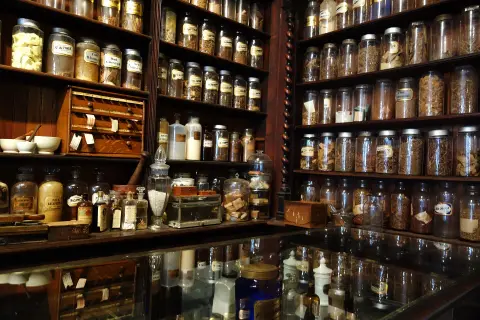
Welcome to the Pharmacy Museum. Step in off Chartres Street and let your eyes adjust. Dark wooden cabinets reach to the ceiling, filled with hundreds of glass bottles in amber, cobalt and green. There are brass scales, old pill-making machines, and jars with labels in Latin and French. It smells faintly of old wood and dried herbs. This narrow Creole townhouse was once a working pharmacy, run by a man often called America's first licensed pharmacist. Today it holds one of the largest collections of pharmacy history in the country. Some of what you will see is fascinating. Some of it will make you very grateful for modern medicine. Let us take a look.
The story of New Orleans Pharmacy Museum
In 1816, Louis J. Dufilho Jr. was licensed as a pharmacist in New Orleans. He is often described as the first licensed pharmacist in the United States. In 1822 and 1823 he built this two-storey Creole townhouse on Chartres Street to serve as his home and his shop. The architect was J. N. B. de Pouilly, who later designed the rebuilding of St. Louis Cathedral. Dufilho lived and worked here until 1855.
After him, the building passed to Dr. James Dupas. Local ghost tours tell dark stories about Dupas, but there is little or no evidence for them, though records do show he enslaved two people. After Dupas died, his widow sold the building, and for some years it housed a paper warehouse.
In 1950 the building opened as a museum dedicated to the history of pharmacy and medicine. Since then it has gathered a large collection of medicines, medical tools and shop fittings from the nineteenth and early twentieth centuries. The courtyard has been planted with herbs and plants of the kind Dufilho might have used in his remedies.
The setting
The museum occupies a classic Creole townhouse, with a shop at street level and living quarters above, built of brick and stucco and opening straight onto the pavement. The ground floor recreates an old pharmacy, with hand-carved wooden cabinets, display cases and a long counter. A narrow passage leads to a walled courtyard at the back, planted with medicinal herbs and shaded by greenery, with a small fountain. Upstairs, rooms hold exhibits on surgery, optometry, dentistry, patent medicines and the practices of nineteenth-century doctors. The building is small and intimate, so you move through it at an easy pace, room by room.
Why it matters
The museum shows a side of New Orleans history that most visitors never see. In the nineteenth century the city suffered repeated epidemics of yellow fever and cholera, and pharmacists and doctors tried every remedy they knew. Seeing their tools and medicines makes that struggle real. It also shows how folk medicine, Creole traditions and voodoo practice sat alongside formal science here. The museum reminds you that New Orleans' history is not only about music and food, but about survival in a hot, wet, often dangerous place. And it is a rare chance to step inside a complete Creole townhouse from the 1820s.
Your walk-through
The stops a guide would take you to, in order.
-
1
The front pharmacy
Start in the front room, the old shop. Look at the hand-carved cabinets and the rows of bottles. Many of these held medicines that were prescribed in the nineteenth century, some useful, some dangerous. Notice the show globes in the window, large glass vessels filled with coloured liquid. Pharmacies used them as signs, so that people who could not read could still find the shop. Imagine customers coming in with fevers, coughs and wounds, and the pharmacist mixing a remedy by hand.
-
2
The patent medicines case
Find the case of patent medicines. These bottled cures promised to fix almost anything, from headaches to heartache. Many contained alcohol, opium or cocaine, which explains why people felt better for a while. Read some of the labels and the claims. There was little regulation then, and anyone could sell a tonic. It is a funny display at first glance, but also a sobering one.
-
3
The voodoo and folk remedies display
Look for the display of folk remedies and voodoo potions. In New Orleans, people often mixed formal medicine with traditional cures, charms and gris-gris bags. Pharmacists sometimes sold both. The museum presents these with respect, as part of the city's real history of healing. Notice how many remedies relied on herbs and roots, some of which are still used today.
-
4
The courtyard garden
Step through to the courtyard. This is a peaceful little walled garden, planted with herbs and medicinal plants of the kind Dufilho might have grown or bought. Read the labels and see how many you recognise from your own kitchen. Every old French Quarter house has a courtyard like this, hidden behind the street wall. They kept homes cooler and gave families a private outdoor space. Stay a moment and enjoy the quiet.
-
5
The upstairs medical rooms
Climb the stairs to the upper rooms. Here you will find surgical tools, early spectacles, dental instruments and a sickroom set up as it might have looked. Some tools look alarming, and they were. Before anaesthesia became common, surgery was fast and painful. Look also for exhibits on the yellow fever epidemics that struck the city again and again in the nineteenth century. Thousands died in the worst years.
-
6
The balcony view of Chartres Street
Before you leave, look out over Chartres Street from upstairs. This is how Dufilho and his family would have seen their street, with neighbours' balconies and shopfronts all around. The house you are standing in has stood since the early 1820s, through fires, floods and epidemics. Then head back down, and as you step outside, notice how close you are to Jackson Square, just a short walk away.
Things you might not know
- The building was designed by J. N. B. de Pouilly, the architect associated with the 1850 rebuilding of St. Louis Cathedral.
- Louis J. Dufilho Jr. was licensed as a pharmacist in 1816.
- The museum opened in 1950.
Researched November 2026 from: en.wikipedia.org, pharmacymuseum.org. Fees and hours change, so check on the day.