⭐ Must-see · Warehouse District, 1 km from central New Orleans
The National WWII Museum
The Second World War told one voice at a time
🎧 Listen to this guide · about 6 min
Pop your earphones in and we'll walk you round.
Welcome to the National WWII Museum. This is a place for slowing down. Over the next few hours you will walk from the beaches of Normandy to the islands of the Pacific, and you will hear the voices of the people who were there. You might wonder why this museum is in New Orleans. The answer is a boat, built right here, that carried soldiers onto the beaches of the war. When you check in, you will receive a dog tag card linked to a real person who served. Follow their story as you go. It is a small thing, but by the end of the day you will feel you have walked beside someone. Take your time, and take breaks.
The story of The National WWII Museum
The museum grew from the work of the historian Stephen Ambrose, who taught at the University of New Orleans. In 1964, while working with Dwight Eisenhower, Ambrose heard the former general credit Andrew Higgins, the New Orleans boat builder, with helping to win the war. Higgins Industries had designed, tested and built thousands of shallow landing craft in this city. Those boats carried troops ashore at Normandy, in the Pacific and elsewhere.
Ambrose and his colleague Nick Mueller set out to build a museum about the D-Day landings. It opened as the National D-Day Museum on 6 June 2000, the 56th anniversary of the Normandy invasion, in a former brewery building. In 2003 Congress designated it America's official National WWII Museum, and it took that name in 2006.
Since then, the museum has grown into a campus of several buildings. A restoration pavilion opened in 2011. The US Freedom Pavilion, housing aircraft, opened in 2013, and the Campaigns of Courage Pavilion, with galleries on the European and Pacific wars, followed in 2014. The Liberation Pavilion, covering the end of the war and its aftermath, opened in 2023.
The setting
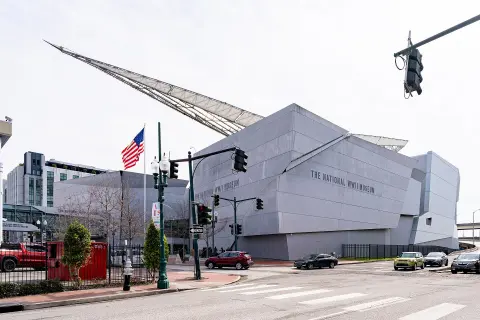
The museum spreads across several blocks in the Warehouse District, between Camp Street and Magazine Street on Andrew Higgins Drive. The original Louisiana Memorial Pavilion is a brick former brewery, where a Higgins boat often stands in the main hall. Across the street, newer glass and steel pavilions rise high enough to hold full-size aircraft hanging from the ceiling, including bombers and fighters you can view from walkways at different levels. Galleries are designed to feel immersive, with sound, light and recreated landscapes, from a snowy Ardennes forest to a Pacific jungle. Walkways link the buildings above the street. There is a theatre, cafés and plenty of benches for rest.
Why it matters
This museum matters because the generation who fought the war is almost gone. It holds thousands of oral histories, recorded so that their voices will be heard long after them. It is also honest about the cost of the war, about loss, fear and moral complexity, and not only about victory. For visitors from abroad, it explains how the United States moved from isolation to total war in a few short years. For New Orleans, it is a point of pride that a local factory played such a large part. Many visitors leave quieter than they came in. That is a sign the museum has done its work.
Your walk-through
The stops a guide would take you to, in order.
-
1
Louisiana Memorial Pavilion and the Higgins boat
Begin in the original brick building. Look for the Higgins boat, a flat-bottomed wooden landing craft with a front ramp that dropped down onto the beach. Higgins Industries built them in New Orleans, on the shores of Lake Pontchartrain and in factories across the city. Imagine thirty or so soldiers packed inside, crossing open water under fire. This is the boat Eisenhower spoke of, and the reason the museum is here.
-
2
The Home Front galleries
Nearby, the galleries on the home front show how the war changed life in America. Women went to work in factories and shipyards. Families planted gardens and used ration books. New Orleans itself boomed, with Higgins employing many thousands of workers, both men and women, Black and white. Look for the posters, letters and objects from ordinary homes. Victory was built in places like this city, as well as on battlefields far away.
-
3
Beyond All Boundaries theatre
If you have bought a film ticket, now is a good time to see Beyond All Boundaries, a short immersive film about the whole war, narrated by Tom Hanks. The seats shake, snow falls, and the stage changes around you. It is powerful and a little intense. It gives you the big picture before you walk through the detailed galleries, so many visitors find it helps to see it early in the day.
-
4
Campaigns of Courage: Road to Berlin
Cross to the Campaigns of Courage Pavilion and enter the Road to Berlin galleries. You will move through North Africa, Italy, the Normandy landings and the Battle of the Bulge. The rooms recreate the landscapes, from desert to snowy forest. Listen to the oral histories at each station. These are the voices of real veterans. Take a moment at the end to consider the scale of what happened in Europe, including the Holocaust.
-
5
Campaigns of Courage: Road to Tokyo
Upstairs or alongside, the Road to Tokyo galleries tell the Pacific story, from Pearl Harbor to the islands, jungles and the end of the war in Japan. The fighting here was often brutal and the distances vast. Look for objects from the Pacific campaigns and the recreated jungle path. The galleries also cover the atomic bombings, presented carefully and without glamour. Give yourself time here, and pause where you need to.
-
6
US Freedom Pavilion: The Boeing Center
Finally, walk into the tall glass hall of the US Freedom Pavilion. Look up. Full-size aircraft hang above you, among them a B-17 bomber, the type that flew over Europe. Climb the walkways to see them from different heights. Here too is the USS Tang Submarine Experience, a recreation of a real submarine's final patrol. The pavilion is a fitting place to end, among the machines, after a day spent with the people who used them.
Things you might not know
- The museum opened as the National D-Day Museum on 6 June 2000.
- Congress named it America's official National WWII Museum in 2003.
- The Higgins boats that carried troops ashore on D-Day were designed and built in New Orleans.
Researched November 2026 from: en.wikipedia.org, nationalww2museum.org, nationalww2museum.org. Fees and hours change, so check on the day.