🚗 Day trip · Las Croabas, Fajardo, 60 km from central Puerto Rico (San Juan)
Laguna Grande Bioluminescent Lagoon
A lagoon that glows when you touch it
🎧 Listen to this guide · about 5 min
Pop your earphones in and we'll walk you round.
Welcome to Laguna Grande in Fajardo. We will start at dusk, when the last light fades over the mangroves. You settle into your kayak, take up your paddle, and glide into a dark, narrow channel. Branches arch overhead. The only sounds are frogs, insects and the soft splash of water. Then, as you dip your paddle, the water around it lights up with a cool blue-green glow. Every stroke leaves a trail of light. Drag your hand and sparks swirl through your fingers. It feels like magic, but it is pure nature at work. Tonight you will see one of the rare places on Earth where the sea itself shines.
The story of Laguna Grande Bioluminescent Lagoon
The glow in Laguna Grande comes from tiny single-celled organisms called dinoflagellates, mainly a species called Pyrodinium bahamense. When the water is disturbed, they give off a short flash of light through a chemical reaction. In this lagoon they live in great numbers, so the whole surface sparkles when anything moves.
Puerto Rico is home to three well-known bioluminescent bays: Mosquito Bay on Vieques, La Parguera in the south-west, and Laguna Grande here in Fajardo. Each depends on a delicate balance of warm water, nutrients from mangroves and a narrow opening that keeps the organisms from washing out to sea.
Laguna Grande lies within the Las Cabezas de San Juan Nature Reserve, which covers about 316 acres and is cared for by the Conservation Trust of Puerto Rico, working through its Para la Naturaleza programme. On the headland above stands the Cabezas de San Juan lighthouse, built in 1880 and first lit in 1882. In 2001 ownership passed to the Conservation Trust, making it the first lighthouse in Puerto Rico handed to a non-governmental group. Pollution, development and storms are ongoing threats, so careful management matters.
The setting
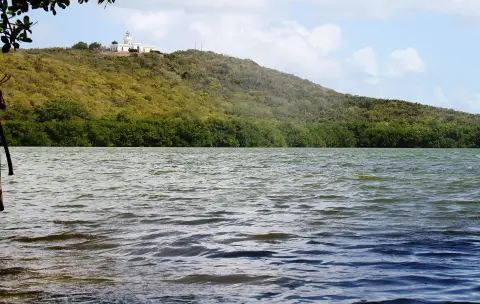
Laguna Grande sits on the north-eastern tip of Puerto Rico, near the fishing village of Las Croabas in Fajardo. The lagoon is surrounded by red, black and white mangroves, whose roots reach into the water. A winding channel links it to the sea, and kayak tours paddle through this channel to reach the open lagoon. On the nearby headland, the reserve protects beaches, dry forest, rocky shores and the lighthouse. At night, with no city lights close by, the sky can be very dark, which helps the glow stand out.
Why it matters
Bioluminescent bays like Laguna Grande are rare worldwide, and Puerto Rico's are among the best known. They draw visitors from around the world and support local guides and businesses in Fajardo. They are also a reminder of how fragile coastal ecosystems are. Mangroves, water quality and dark skies must all be protected for the light to keep shining. When you visit with a responsible operator and follow the rules, you help keep this lagoon healthy.
Your walk-through
The stops a guide would take you to, in order.
-
1
The launch at Las Croabas
Your trip begins at the launch near Las Croabas. Your guide will hand out life jackets and paddles and explain how to steer. Listen carefully, because the channel is narrow and you will paddle in a line. Look around as the sun sets. Fishing boats bob nearby and the sky turns pink and gold. Then the light drops and it is time to go.
-
2
The mangrove channel
Paddle into the mangrove channel. The trees close in on both sides, and the water is calm and dark. Follow the kayak ahead of you and keep your paddle strokes steady. Look down. You may already see faint sparks in the water. Listen to the frogs and insects. This channel is the lifeline that connects the lagoon to the sea.
-
3
The opening to the lagoon
As the channel opens out, the lagoon spreads before you. Your guide will usually stop the group here. Let your eyes adjust to the darkness. Then gently dip your paddle and watch the water glow. Each movement sets off thousands of tiny flashes from the dinoflagellates living in the water.
-
4
Hands in the glow
Your guide may invite you to trail your hand in the water, or scoop some up and watch it sparkle. Do it gently. Swimming is not allowed, and that rule protects this fragile place. Look at the drops running off your fingers like falling stars. On the darkest nights, the glow is strongest.
-
5
The stars and the return
Before you paddle back, look up. On a clear night, away from the city, the sky can be full of stars. The lighthouse on the headland may flash in the distance. Then turn and follow the channel home, watching the light ripple out from every stroke. It is a peaceful, quiet ending to a remarkable night.
Things you might not know
- The glow comes mainly from a single-celled organism called Pyrodinium bahamense.
- Puerto Rico has three well-known bioluminescent bays: in Fajardo, Vieques and La Parguera.
- The nearby Cabezas de San Juan lighthouse was first lit in 1882.
Researched November 2026 from: en.wikipedia.org, paralanaturaleza.org. Fees and hours change, so check on the day.