💎 Hidden gem · Old San Juan, 2 km from central Puerto Rico (San Juan)
Santa María Magdalena de Pazzis Cemetery
A resting place between the fort walls and the sea
🎧 Listen to this guide · about 5 min
Pop your earphones in and we'll walk you round.
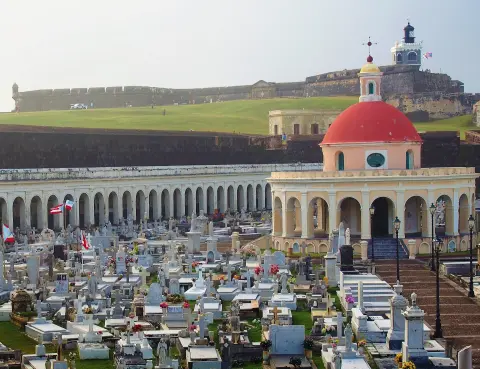
This is the Santa María Magdalena de Pazzis Cemetery, an old burial ground on the seaward side of El Morro. Many visitors see it only from above, a field of white tombs and chapels beside the waves. If you choose to walk down, please do so quietly and respectfully. This is a working cemetery, and families still come here to remember their loved ones. Among the graves are poets, teachers, doctors and political leaders who shaped modern Puerto Rico. We will move slowly, read a few names, and think about the lives behind them.
The story of Santa María Magdalena de Pazzis Cemetery
The cemetery was laid out outside the walls of El Morro in the 19th century. Construction began in 1863 under Ignacio Mascaró. Placing it outside the city walls, on open ground by the sea, followed the public health thinking of the time, which moved burials away from crowded streets and churches. It is named for Saint Mary Magdalene de' Pazzi, an Italian Carmelite nun of the 1500s.
Over the following decades, many prominent Puerto Ricans were buried here. They include José Gautier Benítez, a 19th-century poet of love and of the island. There is Rafael Cordero, a self-taught Afro-Puerto Rican teacher, remembered as the father of public education in Puerto Rico because he taught children of all races and backgrounds, often without charge. There is José Celso Barbosa, a physician and political leader who founded the movement for Puerto Rican statehood. And there is Pedro Albizu Campos, the leader of the Nationalist Party, who spent many years in prison for his campaign for independence.
Their presence side by side, with very different views of the island's future, makes this ground part of Puerto Rico's political and cultural memory.
The setting
The cemetery lies on a narrow strip of land between the northern walls of El Morro and the Atlantic Ocean. White marble tombs, carved angels and family mausoleums fill the slope. A small domed chapel stands among them. The sea is close enough to hear on every visit, and on rough days spray rises over the rocks. To the east is the neighbourhood of La Perla, which also sits outside the walls. Above, the stone bulk of the fort and the lawn of El Morro frame the view.
Why it matters
This cemetery holds the graves of people whose ideas still shape debates in Puerto Rico today, about education, status and identity. For many families it is also simply where their grandparents rest. For visitors, it is a place to reflect on the island's history beyond the forts and battles. Please treat it as you would any cemetery: walk on paths, do not climb on tombs, and keep photos discreet.
Your walk-through
The stops a guide would take you to, in order.
-
1
The view from above
Begin on the edge of the El Morro grounds, looking down. From here you can see the whole cemetery spread along the shore, white against the blue sea. Notice how it sits outside the city walls. In the 1800s, authorities moved burials away from the crowded town for reasons of public health. Take a moment before going down.
-
2
The entrance and main path
Walk down to the entrance and pause at the gate. Keep your voice low. Follow the main path between the rows of tombs. Look at the different styles: simple crosses, carved angels, family vaults with iron doors. Many are decades or even more than a century old. Some are well kept with fresh flowers. Others are weathered by salt and wind.
-
3
The chapel
Stop near the small domed chapel. It is the quiet centre of the cemetery. Services and prayers have been held here for generations. Stand for a moment and listen. The sound of the waves is constant, close and steady. If the chapel is closed, simply view it from outside.
-
4
Graves of national figures
Look for the tombs of some of the island's best known figures. Pedro Albizu Campos, who led the Nationalist Party and was imprisoned for many years. José Celso Barbosa, physician and founder of the statehood movement. Rafael Cordero, the teacher who opened his classroom to all children. José Gautier Benítez, the poet. Each one represents a different chapter in Puerto Rico's story.
-
5
The seaward edge
End near the low wall facing the ocean. Here the land runs out and the Atlantic begins. Think about the people buried behind you, their arguments and hopes for the island, and the families who still visit. Then make your way back up quietly, toward the fort and the city.
Things you might not know
- Construction of the cemetery began in 1863.
- Nationalist leader Pedro Albizu Campos and statehood founder José Celso Barbosa are both buried here.
- Rafael Cordero, buried here, is known as the father of public education in Puerto Rico.
Researched November 2026 from: en.wikipedia.org, en.wikipedia.org. Fees and hours change, so check on the day.