🚗 Day trip · Off Punta de Mita, Nayarit, 40 km from central Puerto Vallarta
Islas Marietas National Park
Seabirds, sea caves and a beach inside the earth
🎧 Listen to this guide · about 6 min
Pop your earphones in and we'll walk you round.
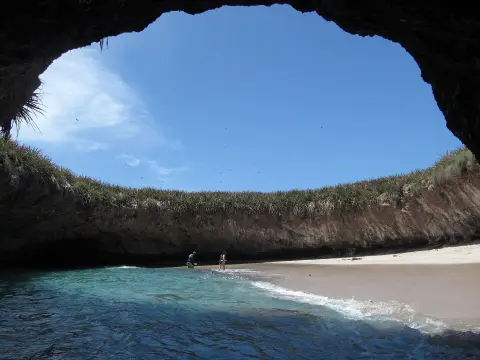
Welcome to the Islas Marietas, a scatter of small, rocky islands at the mouth of Banderas Bay. From a distance they look bare and pale, crowned with white from the seabirds that nest here. Come closer, and you will see caves, arches and cliffs carved by the sea, with clear water full of fish below. Blue-footed boobies stand on the rocks and watch you with curious eyes. And hidden inside one island is a beach that seems almost impossible: a ring of sand open to the sky, reached through a tunnel from the sea. This is a protected place, with strict rules. Follow them, and you will see why it deserves every one.
The story of Islas Marietas National Park
The Marietas Islands were formed by volcanic activity thousands of years ago. They are uninhabited and lie in federal waters about eight kilometres southwest of Punta de Mita, in the state of Nayarit.
In the early twentieth century, the Mexican government used the islands for military testing, including bombing. Most accounts say these explosions, together with erosion by the sea, helped create the caves and the famous hidden beach, Playa del Amor. In the late 1960s, the ocean explorer Jacques Cousteau helped lead an international campaign to protect the islands, and over time they were given legal protection. They were declared a national park in 2005, are a Ramsar wetland site, and are part of UNESCO's Man and the Biosphere network.
As photos of the hidden beach spread online, visitor numbers soared. By 2016, thousands of people were arriving on some days, damaging coral and the beach. In May 2016, the national protected areas commission, CONANP, closed the islands to the public. They reopened with strict limits, based on a University of Guadalajara study which found the hidden beach could handle about 116 visitors a day.
The setting
The islands rise from the Pacific at the northern entrance to Banderas Bay. The two main islands are low and rocky, with steep cliffs, sea caves and natural arches, and small beaches in sheltered coves. The rock is volcanic, pale and pitted, and in places the sea has worn deep tunnels through it. The water around is clear and rich with coral, fish and turtles. On one island, the roof of a large cave has collapsed, leaving an open crater with a small beach of fine sand at the bottom. You reach it by swimming through a short tunnel when the tide and waves allow.
Why it matters
The Marietas are one of the most important wildlife sites on Mexico's Pacific coast. They shelter breeding colonies of seabirds, including blue-footed boobies and red-billed tropicbirds, along with coral reefs and many fish species. Humpback whales pass nearby in winter. The islands also became a lesson in tourism and protection. The 2016 closure and reopening with strict limits showed that even the most famous places can be saved if access is controlled. Visiting under the rules is a privilege, and it helps fund conservation and protect the islands for the future.
Your walk-through
The stops a guide would take you to, in order.
-
1
Crossing the bay
Your trip begins on a licensed tour boat from Puerto Vallarta, Nuevo Vallarta or Punta de Mita. As you cross, watch the bay. In winter, from December to March, humpback whales come here to breed and give birth, and you may see spouts, tails or even a full breach. Licensed boats follow federal rules on how close they can get, so be patient and enjoy the show.
-
2
First sight of the islands
As the islands come into view, notice how pale and bare they look, streaked white by the birds. Look at the cliffs, caves and arches cut by the waves. This is all volcanic rock, shaped over thousands of years. Your guide will explain the park rules: where boats can go, where you can swim, and why landing is so tightly controlled.
-
3
The seabird colonies
Look closely at the rocks. Those birds with bright blue feet are blue-footed boobies, which nest on the islands. You might also see brown boobies, frigatebirds gliding overhead and red-billed tropicbirds with their long tail streamers. Keep your voice low and do not try to approach them. Their calm is the reason they still nest here.
-
4
Snorkelling the reef
In the permitted areas, your guide will invite you to snorkel. Slip into the clear water and look down. You may see colourful reef fish, sea turtles, rays and corals. Never touch or stand on the coral, and use only reef-safe sunscreen, or none at all, before you swim. Stay close to your group and the boat, as currents can be strong.
-
5
Playa del Amor
If your tour holds a permit for the hidden beach, this is the moment. With a life jacket on, you swim with your guide through a short tunnel in the rock. Then you come out into a sunlit crater, with a small ring of sand under open sky. Visits are short and numbers are strictly limited each day. Stand still for a moment, look up at the circle of sky, and take it in.
-
6
The return
As the boat heads back, look again at the islands growing smaller behind you. Think about how close they came to being damaged by too many visitors, and how the rules have helped them recover. Watch the bay once more for whales and dolphins. And when you share your photos, consider sharing the story of the rules too.
Things you might not know
- The islands were closed to the public in May 2016 after tourism damaged coral and the beach.
- A University of Guadalajara study set the hidden beach's carrying capacity at about 116 visitors a day.
- Blue-footed boobies nest on the islands.
Researched November 2026 from: en.wikipedia.org, travelagentcentral.com, foodandpleasure.com, banderasnews.com. Fees and hours change, so check on the day.