🚗 Day trip · Sierra Madre, Jalisco, 90 km from central Puerto Vallarta
San Sebastián del Oeste
A silver town asleep in the pine-clad mountains
🎧 Listen to this guide · about 6 min
Pop your earphones in and we'll walk you round.
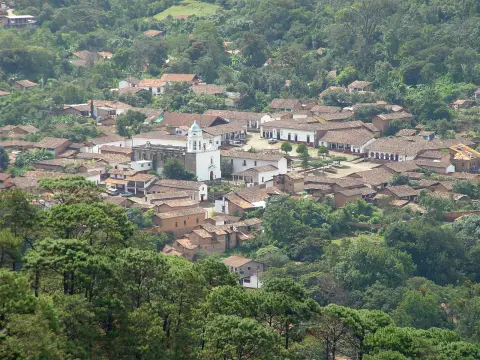
Welcome to San Sebastián del Oeste, high in the Sierra Madre, where the air is cool and smells of pine and wood smoke. After the winding road up from the coast, you arrive in a town that feels frozen in time: cobbled streets, whitewashed adobe houses with red-tiled roofs, and a quiet plaza in front of an old stone church. Once, this was a rich silver town of thousands. Today it is home to a few hundred people, coffee growers, farmers and families who keep its old ways. Mist often drifts over the hills in the morning. Walk slowly, look closely, and let the town tell you about its days of silver and its long, peaceful sleep.
The story of San Sebastián del Oeste
San Sebastián was founded in 1605 as a mining town, when Spanish settlers came to dig for gold, silver and lead in these mountains. Work on its church began in 1608. Over the next two centuries, the mines grew in number, and by 1785 there were more than 25 mines and several foundries in the area. The town was formally made a city in 1812.
At its peak, around 1900, San Sebastián had about 20,000 people, making it one of the most important towns in the region. Then came the Mexican Revolution of 1910. Mining declined, the population fell, and many families left for other towns and cities. San Sebastián became remote and quiet, and because it was left alone, much of its old architecture survived.
In recent decades, as roads improved, visitors began to rediscover the town. In 2011, the Mexican government named San Sebastián del Oeste a Pueblo Mágico. Today, it has around 600 people in the town itself, and lives from coffee, farming and tourism, while carefully keeping its colonial charm.
The setting
The town sits at about 1,480 metres above sea level, in a mountain valley surrounded by pine and oak forests. Its streets are paved with stones and lined with adobe and brick houses, many with wooden balconies and inner patios full of flowers. At the centre is the main plaza with a bandstand, facing the church of San Sebastián. Around the town are old haciendas, remains of mines and coffee farms on the slopes. Above it rises the Cerro de la Bufa, a peak of around 2,500 metres, whose summit offers wide views over the mountains, and on clear days toward the coast.
Why it matters
San Sebastián del Oeste is a living window into the mining past of western Mexico. Its well-preserved streets and buildings show how people lived in a mountain silver town centuries ago. As a Pueblo Mágico, it is protected and promoted for its heritage. For Puerto Vallarta, it offers a complete change of scene: mountains instead of beaches, cool air instead of humidity, and quiet history instead of resort life. It also supports local families through coffee, crafts and small guesthouses, so a visit helps keep the town alive.
Your walk-through
The stops a guide would take you to, in order.
-
1
The main plaza
Begin in the main plaza, with its trees, benches and bandstand. Look around at the old buildings with their thick walls, wooden doors and balconies. In the morning, mist may hang over the hills. People here move slowly, and you should too. Sit for a while, maybe with a cup of local coffee, and listen to the quiet. It is very different from the coast below.
-
2
Church of San Sebastián
Facing the plaza is the church of San Sebastián, whose construction began in 1608. Look at its stone front, built in the colonial Spanish Baroque style. Inside, notice the columns and the frescoes painted on the ceiling vaults. This church has seen the town grow rich and then fall quiet. If a service is on, enter quietly and stand at the back.
-
3
Casa Museo Doña Conchita
A short walk from the plaza is the Casa Museo Doña Conchita, a family home turned into a small museum. Inside you will find old photographs, documents and objects that tell the story of the town and its mining families. It is a personal, intimate look at the past. Take your time here, and ask questions if someone is there to share the family's stories.
-
4
The old streets
Wander the cobbled streets away from the centre. Look at the adobe walls, the red-tiled roofs and the flowers in the patios. Notice old doorways and the remains of grand houses from the mining days. You may pass small shops selling coffee, sweets or local spirits. Wear good shoes, as the stones are uneven and some streets are steep.
-
5
A coffee farm or hacienda
Just outside town, several old haciendas and coffee farms welcome visitors. Coffee grows on the shady slopes here, and you can learn how it is harvested, dried and roasted. At some haciendas you can still see old equipment from the mining era, such as grinding stones and ovens. Ask in town which ones are open, and taste a fresh cup before you go.
-
6
Cerro de la Bufa
For a final view, travel up to the Cerro de la Bufa, the peak above town. The road is rough, so most people go with a local guide in a sturdy vehicle, then hike the last stretch. From the top, at around 2,500 metres, you look out over waves of forested mountains, and on clear days toward the coast. Bring a jacket; it can be chilly up here.
Things you might not know
- San Sebastián del Oeste was founded as a mining town in 1605.
- Around 1900 it had about 20,000 people; today the town has around 600.
- It was named a Pueblo Mágico in 2011.
Researched November 2026 from: en.wikipedia.org, visitmexico.com, mexicodesconocido.com.mx, escapadas.mexicodesconocido.com.mx. Fees and hours change, so check on the day.