💎 Hidden gem · Centro, 1 km from central Rio de Janeiro
Royal Portuguese Cabinet of Reading
A cathedral of books in the heart of old Rio
🎧 Listen to this guide · about 5 min
Pop your earphones in and we'll walk you round.
On a busy street in the old centre, you could walk right past this narrow stone facade. Please don't. Step through the doors of the Real Gabinete Português de Leitura and look up. Above you rises a reading room like a cathedral made of books. Dark carved wood climbs three storeys, with iron galleries, rows of leather spines and, high above, a great skylight pouring soft light into the room. It smells of old paper and polish. People speak in whispers. Take your time. This is one of the most beautiful libraries in the world, and it is free to enter.
The story of Royal Portuguese Cabinet of Reading
In 1837, a group of Portuguese immigrants in Rio, many of them political refugees, founded a reading society. They wanted to share books and keep Portuguese culture alive in their new home. It was the first association of the Portuguese community in the city, and it grew quickly as Rio's Portuguese population prospered.
By the 1870s the society needed a grand home. The Portuguese architect Rafael da Silva e Castro designed a building in the Neo-Manueline style, a romantic revival of the decoration used in Portugal during the age of the great sea voyages. Emperor Pedro II laid the cornerstone on 10 June 1880. The building was inaugurated on 10 September 1887 by Princess Isabel and her husband, the Count of Eu. The facade was built from stone carved in Lisbon and shipped across the Atlantic.
The library has been open to the public since 1900. In its early years it also hosted the first sessions of the Brazilian Academy of Letters. Today it holds around 350,000 items, including a rare first edition of Camões's epic poem The Lusiads from 1572. In 2014 Time magazine named it among the most beautiful libraries in the world, and visitors have been arriving ever since.
The setting
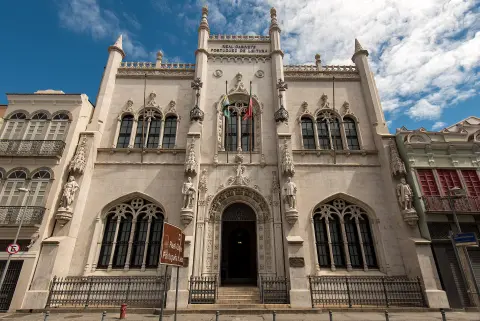
The library stands on Rua Luís de Camões, a short street near Praça Tiradentes in the old centre. The facade is pale limestone, heavy with Manueline carving: twisted ropes, armillary spheres, crosses of the Order of Christ, and statues of Portuguese heroes, including the navigator Pedro Álvares Cabral and the poet Camões. Inside, the main reading room is a tall rectangle lined with carved wooden shelves on three levels, linked by iron galleries. Above, an iron and stained-glass skylight, said to be the first of its kind in Brazil, lights the room. At the centre hangs a large chandelier, and long reading tables fill the floor.
Why it matters
The Real Gabinete is a living library, still used by researchers, and a symbol of the deep ties between Brazil and Portugal. It reminds you that Rio was once the capital of the Portuguese Empire, from 1808 to 1821. For visitors it is a moment of stillness in the old centre, a place where you can feel the weight of five centuries of the Portuguese language. Many travellers say it is their favourite surprise in Rio.
Your walk-through
The stops a guide would take you to, in order.
-
1
The facade on Rua Luís de Camões
Stand across the street first. Look at the carved stone: ropes, sea shells, crosses and spheres, all symbols of Portugal's age of navigation. In the niches stand Portuguese heroes, among them Pedro Álvares Cabral, who reached Brazil in 1500, and the poet Luís de Camões. This stone was carved in Lisbon and shipped across the ocean.
-
2
The entrance hall
Step inside. The entrance is quiet and cool, with a small desk where staff may ask you to leave large bags. Notice the carved doorway ahead and the polished floors. Keep your voice low. This is a working library, and people are reading and researching here.
-
3
The main reading room
Now walk into the great hall and look up. Three storeys of books in carved wooden cases, joined by iron galleries. Around 350,000 items are held here. The room was built to make you feel small, and grateful for knowledge. Take a slow turn around the room and let your eyes climb the shelves.
-
4
Under the skylight and chandelier
Stand in the centre under the skylight. Its iron frame and coloured glass let in a soft, warm light that changes with the sun. Hanging below it is the large chandelier. On a bright morning, the light falls across the reading tables like a stage spotlight. This is the photo everyone wants.
-
5
Display cases and treasures
Look around the room for the glass display cases. The library owns a first edition of The Lusiads, printed in 1572, the great epic of Portuguese discovery. Displays change, so you may see different rare books, maps or manuscripts. Each is a small piece of the Portuguese world brought across the sea.
Things you might not know
- Emperor Pedro II laid the cornerstone in 1880, and Princess Isabel opened the building in 1887.
- It holds a first edition of Camões's The Lusiads, printed in 1572.
- Time magazine listed it among the world's most beautiful libraries in 2014.
Researched November 2026 from: en.wikipedia.org, timeout.com, riofilmcommission.com. Fees and hours change, so check on the day.