⭐ Must-see · Off Victoria, east coast of Mahé, 9 km from central Seychelles (Mahé)
Sainte Anne Marine National Park
Eight islands, clear lagoons and the first footprints of Seychelles
🎧 Listen to this guide · about 6 min
Pop your earphones in and we'll walk you round.
Welcome aboard. Look back for a moment at Victoria, with the green mountains rising straight behind it. Now look ahead. Those low, wooded islands floating just offshore are Sainte Anne Marine National Park, and in a few minutes we will be gliding over their reefs. The water here changes colour as you cross it, from deep blue to pale turquoise to almost clear over the sand. Below you are seagrass meadows, coral gardens and shoals of reef fish going about their day. Today you will snorkel, you will float, and you will probably stop talking for a while, which is exactly how it should be. Keep your camera close and your sunscreen closer.
The story of Sainte Anne Marine National Park
The French explorer Lazare Picault sighted Sainte Anne in 1742. In 1770 it became the site of the first French settlement in Seychelles. A small party landed here from Île de France, today's Mauritius. It included French colonists and enslaved people brought from Africa and India, and their forced labour was part of that first settlement from the very start. The venture struggled, and within a few years most of the settlers had moved on.
In the early twentieth century the island had a very different use. The St Abbs Whaling Company briefly ran a whaling station on Sainte Anne, and its ruins can still be found today. Plantations came and went across these islands too.
The big change came in 1973. The government declared the waters and islands a marine national park, the first of its kind in the Indian Ocean. Fishing and water-skiing were banned inside it. Since then, life on the reefs has been protected, and the islands have turned to tourism, with a resort on Sainte Anne and a small community living on Cerf Island. Cerf, Moyenne and the smaller islands each have their own story of owners, plantations and changing fortunes. Moyenne, the most famous, became a national park of its own in 2008 after decades of replanting by its owner.
The setting
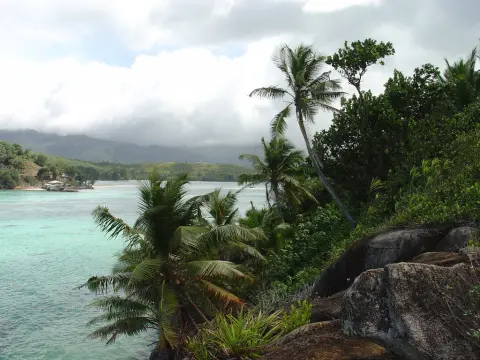
The park spreads across about fourteen square kilometres, most of it shallow sea. Eight islands sit inside it. Sainte Anne and Cerf are the largest. Around them lie Moyenne, Round Island, Long Island, Île Cachée, Sèche Island and Harrison Rock. The islands are granite, like Mahé, cloaked in palms and coastal forest, with white beaches tucked between boulders. Between them, the lagoon floor is carpeted with one of the largest seagrass meadows in Seychelles, a feeding ground for turtles and fish. Coral reefs fringe the islands, and the little islet of Île Cachée is a nesting site for seabirds. From the water you can see the whole of Victoria's harbour and the peaks of Mahé behind it.
Why it matters
This park showed Seychelles that protecting the sea could pay. It was set up decades before marine conservation became fashionable, and it helped shape a country that now protects a large share of its ocean. For you, it means healthy reefs within sight of the capital. For local families, the islands are a weekend escape. Sea turtles still nest on the beaches of Sainte Anne between late November and February. Every entrance fee goes back into ranger patrols and reef care, so simply by visiting, you are helping keep this lagoon alive.
Your walk-through
The stops a guide would take you to, in order.
-
1
Leaving Victoria harbour
As we pull away, look at how close everything is. The capital, the port and the mountains sit almost on top of each other. Sainte Anne lies only about five kilometres off this coast. Watch the water colour start to change as we leave the harbour channel and cross into the park boundary. From here on, nothing can be fished, and you will notice the difference as soon as you put your face in the water.
-
2
The seagrass meadows
Look down now, over the side. Those dark green patches are not rocks. They are seagrass, swaying in the current. This is one of the largest seagrass meadows in Seychelles. Seagrass shelters young fish, feeds turtles and holds the sand in place. If you are lucky, you may see a turtle surface for air nearby. Keep your voices low and your hands inside the boat.
-
3
Moyenne Island
That small, thickly wooded island is Moyenne. In the 1960s an English newspaper editor named Brendon Grimshaw bought it and spent the rest of his life planting trees and caring for giant tortoises here. In 2008 it became a national park in its own right. When you walk its short trail, you are walking through a forest that one patient man helped bring back.
-
4
Snorkelling off Cerf Island
Here we stop and slip into the water. The reef starts close to shore, so take it slowly. Look for parrotfish nibbling the coral, and listen for the faint crunching sound they make. Butterflyfish move in pairs. Please do not stand on the coral or touch anything. Float, breathe, and let the fish come to you. Cerf is one of the two largest islands in the park, and about a hundred people live here.
-
5
Île Cachée
That little rocky islet is Île Cachée, which means hidden island. It is a nesting site for seabirds, so we keep our distance and do not land. Watch the birds wheeling over it and returning with fish. It is a reminder that this park protects life above the water as well as below it. Take a moment here before we move on.
-
6
The beaches of Sainte Anne
Our last view is Sainte Anne itself, the largest island in the park. It was here, in 1770, that the first French settlement in Seychelles was founded. Today a resort occupies part of the shore, and the beaches are quiet. Between late November and February, sea turtles come ashore here at night to lay their eggs. If you see marked nests on the sand, give them plenty of room.
Things you might not know
- It was declared in 1973, the first marine national park of its kind in the Indian Ocean.
- Fishing and water-skiing are banned everywhere inside the park.
- Sainte Anne was the site of the first French settlement in Seychelles, in 1770.
Researched November 2026 from: en.wikipedia.org, en.wikipedia.org, spga.gov.sc. Fees and hours change, so check on the day.