🚗 Day trip · Praslin, 45 km from central Seychelles (Mahé)
Vallée de Mai Nature Reserve
The forest of the coco de mer, once called the Garden of Eden
🎧 Listen to this guide · about 6 min
Pop your earphones in and we'll walk you round.
Welcome to the Vallée de Mai. Step inside and let your eyes adjust to the green light. All around you, giant palms rise high above your head, their huge leaves creaking and rustling in the breeze. This is a forest unlike any other on earth. It is home to the coco de mer, a palm with the largest seed in the plant kingdom, and to the Seychelles black parrot, found nowhere else but here on Praslin. Walk softly and listen. You may hear the parrot's whistle, the drip of water and the clatter of palm fronds. It feels ancient, because it is.
The story of Vallée de Mai Nature Reserve
For thousands of years, this valley stayed almost untouched. Even after people settled Praslin, its steep slopes and dense palms kept it wild. The coco de mer, with its strange double nut, became famous long before anyone found where it grew. Nuts washed up on distant shores, and people believed they came from trees beneath the sea.
In 1881, the British general Charles Gordon visited Praslin. He was so struck by this valley that he proposed it was the original Garden of Eden, and that the coco de mer was the forbidden fruit. The idea was never taken seriously by scientists, but it gave the valley its romantic reputation.
The valley stayed largely undisturbed as virgin forest until the 1930s. It became a nature reserve in 1966 and a national park in 1979. In 1983 it was listed as a UNESCO World Heritage Site. Today it is managed by the Seychelles Islands Foundation, which also looks after the remote atoll of Aldabra. Its staff now carry out research on the black parrot and the coco de mer, guard against poaching of the valuable nuts, and work to reduce the risk of fire, which is one of the biggest threats to the forest.
The setting
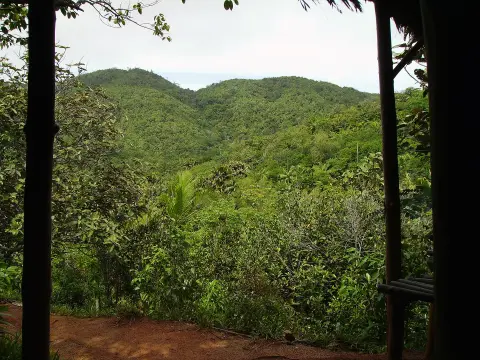
The reserve covers just 19.5 hectares, making it one of the smallest natural sites on the UNESCO World Heritage list. It lies in a valley in the centre of Praslin, with paths winding up and down through the forest. The canopy is dominated by coco de mer palms, which can grow more than 25 metres tall. This is the only place in Seychelles where all six endemic palm species grow together. Streams run through the valley floor, and the light is soft and green. The visitor centre and the first part of the forest are accessible to wheelchairs.
Why it matters
The Vallée de Mai protects one of the rarest forests on earth. The coco de mer grows naturally only on Praslin and Curieuse, and this is its largest stronghold. The Seychelles black parrot, the national bird, depends on it for food and nesting. A census in 2018 estimated around 1,382 birds in the wild. Your entrance fee helps fund the reserve and the work of the Seychelles Islands Foundation at Aldabra. Visiting is a direct way to help keep this forest alive.
Your walk-through
The stops a guide would take you to, in order.
-
1
The visitor centre
We start at the visitor centre. Here you buy your ticket and pick up a free leaflet with a map of the paths and a checklist of species. There is a small café and toilets. Several walking routes start here, from about 1.5 to 4 kilometres long. Choose the one that suits you. I will take us on a loop through the heart of the forest.
-
2
The first coco de mer
Look up at this tall palm, with its huge fan-shaped leaves. This is a coco de mer. Female trees carry the enormous double nuts, which take about five to six years to ripen and can weigh up to around twenty kilograms. Male trees carry long catkins. The trees may live for more than two hundred years. The nuts are protected by law, so please do not touch them.
-
3
Listening for the black parrot
Stop here and be quiet. Listen for a soft whistling call. That is the Seychelles black parrot, the national bird of Seychelles, found only on Praslin. It is actually dark brown-grey, not truly black. It loves to eat the fruits of native palms and nests in the dead trunks of coco de mer. If you spot one, stay still and enjoy the moment.
-
4
The six endemic palms
Look around you. All six palm species found only in Seychelles grow here together, the only place where this happens. Besides the coco de mer, look for the thief palm, the stilt palm with its roots like legs, and the palmiste. Each has its own leaf shape and texture. This mix of palms is what makes the valley so special.
-
5
The forest floor
Now look down. On the leaf litter and the trunks, you may spot the Seychelles bronze geckos, tree frogs and large snails. There are three species of bronze gecko here, including the giant bronze gecko. These small animals live their whole lives in the palms. Watch your step and stay on the path to protect them. Take a moment here before we move on.
-
6
Back to the valley entrance
As we finish, take one last look up into the canopy. In 1881, General Gordon thought this might be the Garden of Eden. Whatever you believe, it is hard not to feel a sense of wonder here. Thank you for walking gently. Your visit helps protect both this forest and the remote atoll of Aldabra. Take a moment here before we move on.
Things you might not know
- The reserve covers just 19.5 hectares, among the smallest natural UNESCO sites.
- It was listed as a UNESCO World Heritage Site in 1983.
- It is the only place in Seychelles where all six endemic palm species grow together.
Researched November 2026 from: en.wikipedia.org, sif.sc, whc.unesco.org. Fees and hours change, so check on the day.