⭐ Must-see · Castries, 11 km from central St Lucia
Cathedral Basilica of the Immaculate Conception
A grey stone shell with a heart full of colour
🎧 Listen to this guide · about 6 min
Pop your earphones in and we'll walk you round.
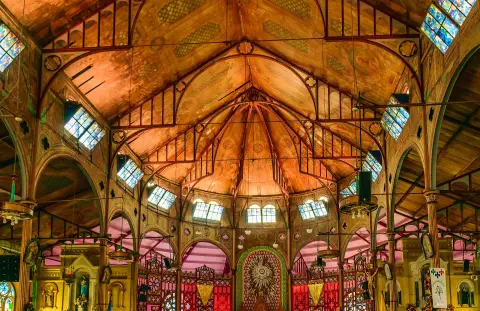
Welcome to the heart of Castries. Across the road is Derek Walcott Square, shaded by its great old tree, and in front of you stands the Cathedral Basilica of the Immaculate Conception. From outside it looks quite sober, grey stone and simple lines. Step through the doors and everything changes. The ceiling is wood, the light is soft, and the walls glow with colour. Saints and angels look down at you, and many of them have the faces of Saint Lucians. This is a working church, the mother church of the island's Catholics, so you may find people praying, a choir practising or a funeral in progress. Come in quietly, take a seat in a pew, and let your eyes adjust.
The story of Cathedral Basilica of the Immaculate Conception
There has been a church on this spot since the 18th century; an earlier church stood here from 1767. Castries was a French town for much of its early life, and Catholicism came with the French settlers. It stayed when the British took final control in the early 1800s, which is why most Saint Lucians are Catholic to this day.
The present building was designed by Father Scoles. Its foundation stone was laid in 1894 and the work was finished by 1897. It measures about 200 feet by 100 feet, and it is often described as one of the largest churches in the Caribbean. Castries burned badly several times, most famously in the great fire of June 1948, which destroyed much of the old town. The cathedral survived, and it remains one of the oldest major buildings in the city centre.
Two events gave the church its modern standing. On 7 July 1986, Pope John Paul II visited Castries and the cathedral. Then on 11 May 1999, during the centenary celebrations, the Vatican granted it the honorary title of Minor Basilica. Inside, the murals by the Saint Lucian painter Dunstan St. Omer, who also designed the national flag, turned a European-style church into something unmistakably Caribbean.
The setting
The cathedral sits at the corner of Laborie, Micoud and Peynier Streets, facing Derek Walcott Square. The exterior is stone and fairly plain, with tall windows and a modest tower. Inside, the space is wide and high, with a long nave, dark wooden roof timbers and slender iron columns. The real treasure is the colour. Dunstan St. Omer and his family painted bold murals across the walls and around the altar, in yellows, greens, reds and blues. Saints are shown with dark skin, in local settings. Stained glass adds more colour. Outside, Derek Walcott Square is a small, leafy park with benches, busts and a huge saman tree that spreads its branches over the paths.
Why it matters
The cathedral is the spiritual centre for most Saint Lucians, and big national moments, from state funerals to celebrations, often pass through its doors. Its murals matter far beyond religion. Dunstan St. Omer painted saints who looked like the people in the pews, at a time when church art across the region usually showed only European faces. That choice made the building a statement of Caribbean identity and pride. Facing it, Derek Walcott Square honours the island's two Nobel laureates, the poet Derek Walcott and the economist Sir Arthur Lewis. Together, church and square sum up much of what Saint Lucia values.
Your walk-through
The stops a guide would take you to, in order.
-
1
Derek Walcott Square
Start in the square across the road. It was once called Columbus Square, and was renamed to honour Derek Walcott, the Castries-born poet who won the Nobel Prize for Literature in 1992. Look for the busts of Walcott and of Sir Arthur Lewis, who won the Nobel Prize in economics in 1979. Two Nobel winners from an island this small is something Saint Lucians mention with real pride.
-
2
The saman tree
Now look up at the giant saman tree, its branches spreading wide over the square. Locals will tell you it is several hundred years old, and so the story goes, it was already old when the town was young. Whatever its true age, its shade has sheltered generations of office workers, schoolchildren and old men playing dominoes. Stand under it at noon and feel the temperature drop.
-
3
Cathedral facade
Cross over to the cathedral. Notice how plain the outside is, solid grey stone built in the 1890s to last in a town that burned again and again. The great fire of 1948 swept through Castries and took most of the wooden buildings. This church came through. Pause by the door, take off your hat, and step inside.
-
4
Nave and ceiling
Let your eyes adjust to the softer light. Look up at the dark wooden ceiling and the thin iron columns holding it up. The nave is long and wide, built for big congregations. On Sunday mornings it fills completely, and the singing carries out into the square. Sit for a moment in a pew and simply look at the colour around you.
-
5
Dunstan St. Omer murals
These murals are the work of Dunstan St. Omer, one of Saint Lucia's most loved artists, who also designed the national flag. Look closely at the faces. Saints, angels and the Holy Family are painted as Caribbean people, with dark skin and local features. For many Saint Lucians, seeing themselves on the walls of their own cathedral meant a great deal. Take your time here.
-
6
High altar
Walk quietly toward the altar, where the colours are strongest. This is where Pope John Paul II prayed during his visit in July 1986, and where, in 1999, the church was honoured as a Minor Basilica. If a service is under way, stay at the back and do not take photos. When you leave, notice how bright the street feels after the calm inside.
Things you might not know
- The cathedral measures about 200 by 100 feet and was finished in 1897.
- Pope John Paul II visited it on 7 July 1986.
- Its murals are by Dunstan St. Omer, who also designed Saint Lucia's national flag.
Researched November 2026 from: en.wikipedia.org, en.wikipedia.org, en.wikipedia.org. Fees and hours change, so check on the day.