💎 Hidden gem · Sydney Harbour, near Balmain, 5 km from central Sydney
Cockatoo Island
Prison, shipyard, and now an island you can roam
🎧 Listen to this guide · about 5 min
Pop your earphones in and we'll walk you round.
Step off the ferry onto Cockatoo Island. The first thing you notice is the scale. Enormous cranes, rusting sheds and cliffs of cut sandstone rise around you. This island has been a prison, a girls' reform school and one of the biggest shipyards in the southern hemisphere. Today it is quiet. The wind whistles through empty workshops, and seagulls wheel over the dry docks. You can wander almost anywhere you like, climb up to the old convict buildings, walk through a tunnel, and even camp the night. Few visitors know it exists. Let me show you an island with more stories than any other in the harbour.
The story of Cockatoo Island
The island's Aboriginal name is Wareamah, in the country of the Eora people. In 1839 the colony turned it into a prison for convicts who had reoffended in Australia. They lived in harsh conditions and quarried sandstone by hand. Some of their labour went into huge underground silos, cut into the rock to store grain.
Between 1847 and 1857 convicts also dug the Fitzroy Dock, a dry dock for repairing ships. The prison closed in 1869. The old buildings then became an industrial school for girls and a reformatory. For a time the island was even called Biloela.
The dockyard grew. A second, larger dock, the Sutherland Dock, was finished in 1890. In the twentieth century Cockatoo Island became the main shipyard of the Royal Australian Navy, building and repairing warships through both world wars. The dockyard closed in 1991. Since 2001 the Sydney Harbour Federation Trust has cared for the island. In 2010 its convict buildings were inscribed on the UNESCO World Heritage List as one of eleven Australian Convict Sites. Since then it has hosted art exhibitions, including the Biennale of Sydney, and become a place for camping and festivals.
The setting
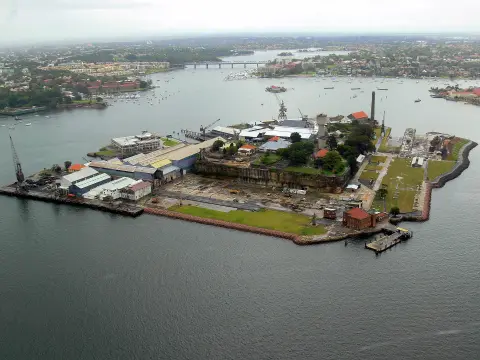
The island lies where the Parramatta and Lane Cove rivers meet the harbour, west of the Harbour Bridge. It covers about eighteen hectares. The upper island is a sandstone plateau with the convict prison buildings, the old military guardhouse and later residences. The lower island, built up with fill, holds the industrial area, the two dry docks, slipways, workshops and cranes. A long tunnel cuts right through the rock between the two sides. Ferry wharves lie at the eastern end.
Why it matters
Cockatoo Island tells the story of Australia's convict past and industrial growth in one place. UNESCO recognises it for showing how Britain used transportation and forced labour to build a colony. Its dockyard tells of the nation's naval and engineering history across more than a century. Today it shows how old industrial spaces can be reused for art, culture and recreation, while keeping their rough, honest character.
Your walk-through
The stops a guide would take you to, in order.
-
1
Ferry wharf and Visitor Centre
Land at the wharf and call in at the visitor centre for a map. You can also hire an audio guide. Look around at the slipways and cranes. This is the lower island, built up over the years to make room for industry. The noise of riveting and hammering once filled the air here, all day long.
-
2
Fitzroy Dock
Walk to Fitzroy Dock, cut by convicts and finished in 1857. Picture men with picks and wheelbarrows, digging into the sandstone below the waterline. Ships were floated in, the dock was drained, and workers repaired them in the dry. It was later lengthened. Stand at the edge and look down into its stepped walls.
-
3
The Turbine Shop and workshops
Wander through the huge sheds and workshops near the docks. Old machinery, rails and chains are left in place. Light streams in through broken windows. Artists love these spaces, and the Biennale of Sydney has filled them with installations. Even empty, they feel grand, like industrial cathedrals.
-
4
The Dog Leg Tunnel
Walk through the tunnel cut through the middle of the island. It was dug in the early twentieth century to move workers and materials from one side to the other. The air inside is cool, and footsteps echo. At the far end you come out on the island's western side, facing up the river.
-
5
Convict precinct, upper island
Climb the stairs to the top of the island. Here stand the convict prison buildings, built of the island's own sandstone. Look for the solitary cells and the remains of the grain silos cut into the rock. This is the UNESCO-listed part of the island. It is quiet now, but life here was hard and often cruel.
-
6
Biloela House and the clifftop views
End by the old residences on the upper island, near Biloela House. Look out across the harbour to the Harbour Bridge and the city. Imagine the girls of the reform school, who lived here in the late nineteenth century, looking at the same view. Then head back down to the wharf for the ferry.
Things you might not know
- Convicts dug the Fitzroy Dock by hand between 1847 and 1857.
- The island became part of the UNESCO-listed Australian Convict Sites in 2010.
- The dockyard operated until 1991, building and repairing ships for over a century.
Researched November 2026 from: cockatooisland.gov.au, en.wikipedia.org, whc.unesco.org. Fees and hours change, so check on the day.