⭐ Must-see · Farm Cove, Sydney CBD, 1 km from central Sydney
Royal Botanic Garden Sydney
Australia's oldest garden, on the shore where the colony first farmed
🎧 Listen to this guide · about 5 min
Pop your earphones in and we'll walk you round.
Step through the gates and the city noise drops away. Welcome to the Royal Botanic Garden. Thirty hectares of lawns, palms, roses and giant fig trees roll down to the water at Farm Cove. Ibis stalk across the grass. Cockatoos screech in the trees. Office workers eat lunch on the benches, and visitors from all over the world stop to photograph the Opera House through the leaves. This garden is free, open every day, and full of stories. It is also where European farming in Australia began. Today we will follow the harbour round to a rock seat carved for a governor's wife, with one of the best views in Sydney.
The story of Royal Botanic Garden Sydney
This shoreline is Gadigal country. The garden's Cadi Jam Ora area tells the story of the first encounters between the Gadigal and the newcomers in 1788.
Within months of arriving, Governor Arthur Phillip had a small farm planted on the shores of this cove. That is why it is called Farm Cove. The soil was poor and the farm failed, but the land has been cultivated ever since.
In 1816 Governor Lachlan Macquarie established a botanic garden here, making it Australia's oldest scientific institution. His wife, Elizabeth Macquarie, loved to walk out to the point at the eastern side of the cove. Convicts carved a bench into the sandstone for her, now known as Mrs Macquarie's Chair. Macquarie also had a road built around the headland. Over the nineteenth century, directors such as Charles Moore expanded the collections. Moore planted the Palm Grove, which still thrives. Government House, completed in the 1840s, rose on the high ground at the garden's western edge. In 2016 a new glasshouse and exhibition space, The Calyx, opened on the site of the old Pyramid glasshouse.
The setting
The garden curves around Farm Cove, between Bennelong Point with the Opera House to the west and Mrs Macquarie's Point to the east. Behind it lies The Domain, a large open park, and beyond that the city towers. A seawall path follows the waterline the whole way round. Inland, the garden is divided into themed areas: the Palm Grove, the Rose Garden, a succulent garden, an Australian native rainforest walk and the Oriental Garden. Ponds attract ducks and eels. The Calyx hosts changing plant displays under glass.
Why it matters
The Royal Botanic Garden is both a public park and a working science centre. Its herbarium holds over a million dried plant specimens and helps identify and protect Australian plants. It grows rare and endangered species, including the Wollemi pine, a tree known only from fossils until it was found alive in a remote gorge west of Sydney in 1994. For Sydneysiders it is simply a beloved green space, free for everyone, right next to the busiest part of the city.
Your walk-through
The stops a guide would take you to, in order.
-
1
Queen Elizabeth II Gate
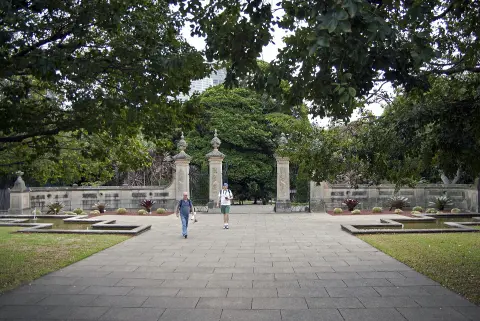
Enter by the gate near the Opera House forecourt. Straight away you are on the seawall path along Farm Cove. Look across the water. On calm days the reflections of the city towers shimmer in the cove. Keep the water on your left and walk slowly. Notice how big the old Moreton Bay figs are, with roots like buttresses.
-
2
Palm Grove
Turn inland toward the Palm Grove, one of the oldest plantings in the garden, started by Charles Moore in the nineteenth century. Tall palms from many countries rise above you, creating deep shade. For years a huge colony of flying foxes roosted here and damaged the trees. They were moved on, and the grove was restored. Listen for birdsong.
-
3
The Calyx
Nearby is The Calyx, a curved glasshouse opened in 2016. It holds seasonal displays, often a wall of living plants that changes through the year. Check what is on. Next to it, find the area called Cadi Jam Ora, which uses plants to tell of the Gadigal people and their first meeting with the British.
-
4
Wollemi pine and Australian natives
Look for the Wollemi pine, a strange tree with dark, ferny leaves. It belongs to a family once known only from fossils, and it was found alive in 1994 in Wollemi National Park. The wild trees are kept secret and protected. Garden plantings like this one help keep the species safe.
-
5
Farm Cove seawall
Head back to the water and follow the seawall east around Farm Cove. Here, in 1788, the colony's first farm was planted. Picture the rough fields, the convicts with hoes, the struggle with dry sandy soil. Now there are joggers and picnic blankets. Fig trees lean out over the water, and the Opera House sits across the cove.
-
6
Mrs Macquarie's Chair
End at Mrs Macquarie's Chair, a seat carved from the sandstone by convicts for Elizabeth Macquarie, the governor's wife. Sit where she sat. In front of you, the Opera House and Harbour Bridge line up in a single frame. It is one of the most photographed views in Australia, and best near sunrise or sunset.
Things you might not know
- The garden was founded in 1816 and is Australia's oldest scientific institution.
- Farm Cove takes its name from the colony's first farm, planted there in 1788.
- The Wollemi pine was known only from fossils until living trees were found in 1994.
Researched November 2026 from: botanicgardens.org.au, en.wikipedia.org, en.wikipedia.org. Fees and hours change, so check on the day.