💎 Hidden gem · Ahar, east Udaipur, 2 km from central Udaipur
Ahar Cenotaphs (Mahasatiya)
A quiet field of white domes for the rulers of Mewar
🎧 Listen to this guide · about 6 min
Pop your earphones in and we'll walk you round.
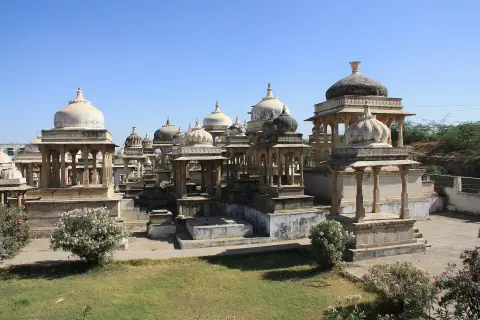
Welcome to Ahar, on the eastern edge of Udaipur. This is the royal cremation ground of the Mewar dynasty, known locally as Mahasatiya. Ahead of you stand more than 250 chhatris, domed pavilions raised as memorials. Some are small and plain. Others rise on high platforms, with rings of carved pillars beneath a dome. Please remember that this is a place of remembrance, still respected by the community, so we will walk quietly. The site is calm and open, and you will often have it almost to yourself. Next door is a small museum, built beside the mound of one of the oldest settlements in this region. Together, they take you back through centuries of Mewar's history in a single short visit.
The story of Ahar Cenotaphs (Mahasatiya)
Ahar is far older than Udaipur. The mound beside the museum, known as Dhulkot, was the site of a settlement that gave its name to the Ahar-Banas culture, a Chalcolithic farming culture of south-eastern Rajasthan. Excavations here in the mid-twentieth century found painted pottery, copper objects and house remains. The museum dates some of its pottery to around 1700 BCE. In the early medieval period, Ahar, then called Aghatpur, was an important town of the Guhila rulers, ancestors of the later Mewar dynasty.
After Udaipur became the capital in the 16th century, the Maharanas chose Ahar as their cremation ground. Memorials were raised where rulers and members of the royal family were cremated. Among the earliest and grandest is the cenotaph of Maharana Amar Singh I, who died in 1620. Around 19 major cenotaphs belong to Maharanas, and the rest to other members of the royal household.
The name Mahasatiya, or Mahasati, refers to the practice of sati, in which widows died on their husband's funeral pyre. Queens and other women of the court are recorded as having died here in this way. The practice was later outlawed in India. The site is now protected and maintained, and the next-door museum is run by the state archaeology department.
The setting
The cenotaphs stand on flat ground on the eastern side of the city, near the small Ayad river, also called the Ahar. The complex is enclosed by a wall, with paths running between rows of white and grey stone pavilions. Most chhatris follow the same plan: a raised platform, a ring of pillars, and a dome on top. The larger royal memorials have tiered bases and more elaborate carving, with friezes of figures and decorative brackets. Some are octagonal, while others are square. Many have small images of the ruler and of the women who died with him carved into stone slabs. Next door, the Ahar museum is a modest building, with the excavated mound of Dhulkot nearby.
Why it matters
Ahar is the main burial and memorial site of one of India's longest-ruling dynasties, and it records the succession of Mewar's rulers in stone. It also preserves a difficult chapter of history, the practice of sati, which visitors should understand clearly rather than romanticise. The neighbouring mound and museum show that people farmed and made fine pottery here thousands of years before the Rajput kingdoms. For Udaipur, Ahar connects the royal city to a much deeper past. For you, it is a quiet place to reflect, away from the crowds of the lakeside, and a chance to see some of the best memorial architecture in the city.
Your walk-through
The stops a guide would take you to, in order.
-
1
Entrance and first rows
As you enter, take in the scale. The domes stretch away in rows, white against the sky. Over 250 memorials stand here. Most mark members of the royal household, while around 19 belong to Maharanas. Walk slowly along the main path. Notice how similar the plan is, platform, pillars and dome, yet how each one differs in size and detail.
-
2
Cenotaph of Maharana Amar Singh I
This large memorial, on a broad terrace with a marble dome, is the cenotaph of Maharana Amar Singh I. He was the son of Maharana Pratap and died in 1620. It is among the earliest and most important here. Look at the carved pillars and the band of figures around the base. Its size reflects the standing of the ruler it honours.
-
3
Cenotaph of Maharana Sangram Singh II
Nearby is another of the grand memorials, for Maharana Sangram Singh II, who ruled in the early 18th century. Compare it with Amar Singh's. Styles changed over a century, with more complex bases and decoration. If you look closely at some memorial stones in this area, you will see carved figures representing the women who died here. Please do not climb on the platforms.
-
4
Smaller chhatris
Walk now among the smaller pavilions toward the back. These were raised for other members of the royal family and court. Some are simple, others have fine brackets and lotus carvings under the domes. The quiet here is part of the experience. Birds nest in the domes, and early in the morning the light falls softly between the pillars.
-
5
Ahar Museum and Dhulkot mound
Finish next door at the Ahar Museum. It is small, but it holds pottery from the ancient settlement on the Dhulkot mound, dated by the museum to around 1700 BCE, along with sculpture from the area, including a 10th-century metal image of the Buddha. Step outside and look at the mound itself. People lived here more than three thousand years before the first cenotaph was raised.
Things you might not know
- There are more than 250 cenotaphs at Ahar, around 19 of them for Maharanas of Mewar.
- The neighbouring mound gave its name to the Ahar-Banas culture, a Chalcolithic farming culture of the region.
- The cenotaph of Maharana Amar Singh I, who died in 1620, is among the earliest and grandest in the complex.
Researched November 2026 from: en.wikipedia.org, incredibleindia.gov.in, incredibleindia.gov.in. Fees and hours change, so check on the day.