🚗 Day trip · Chittorgarh, 115 km from central Udaipur
Chittorgarh Fort
The old capital of Mewar, its towers still standing guard
🎧 Listen to this guide · about 6 min
Pop your earphones in and we'll walk you round.
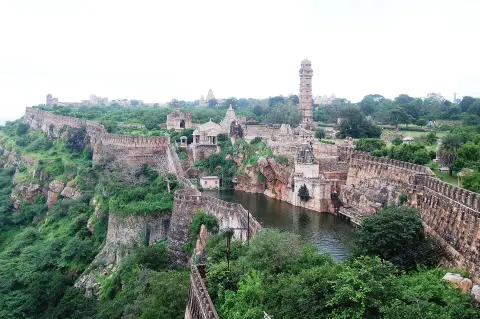
Welcome to Chittorgarh, the fort that was the capital of Mewar for centuries before Udaipur was founded. We stand on a long rocky plateau that rises about 180 metres above the plains, with walls running some 13 kilometres around its edge. Inside, there is space for a small city: palaces, temples, towers and great water tanks. This is a place of pride for Rajasthan, but also of loss. Three times in its history, the fort was besieged and taken, and those events are remembered here with deep respect. As we walk, look for the tall carved tower that marks a victory, and the quiet places that mark sacrifice. Both are part of Chittor's story.
The story of Chittorgarh Fort
Chittorgarh was a stronghold long before the Sisodias, and from the 8th century it was linked to the Guhila rulers, ancestors of the Mewar dynasty. It became the capital of Mewar and its most important fortress. In 1303 the Delhi sultan Alauddin Khalji captured the fort after a siege of about eight months. Later legend, especially the 16th-century poem Padmavat, tells of Queen Padmini and a jauhar, the mass self-immolation of women to avoid capture. Historians debate how much of this story is fact.
Mewar regained the fort, and under Rana Kumbha in the 15th century it was strengthened and adorned. He built the Vijay Stambha, the Tower of Victory, between 1458 and 1468, to mark his victory over Mahmud Khalji of Malwa in 1440. The fort was sacked again in 1535 by Bahadur Shah of Gujarat, and accounts say Rani Karnavati led a jauhar.
The last great siege came in 1567 and 1568, when the Mughal emperor Akbar surrounded the fort for about four months. The commander Jaimal was killed on 22 February 1568, and the fort fell, with heavy loss of life among defenders and civilians. By then, Maharana Udai Singh II had already moved his court toward Udaipur. Chittor was never again Mewar's capital. In 2013 it was inscribed by UNESCO as part of the Hill Forts of Rajasthan.
The setting
The fort covers about 280 hectares on a long, narrow plateau above the town of Chittorgarh and the Gambhiri river. A zigzag road climbs the western side through seven gates, ending at Ram Pol. On the plateau, monuments are spread over several kilometres, so most visitors move between them by vehicle. You will find the ruined Rana Kumbha Palace, the Kumbha Shyam and Meera temples, the Vijay Stambha, the Jain Kirti Stambha, Padmini's Palace beside a pool, and many water bodies, including the deep Gaumukh Kund fed by a spring. Many of the buildings are of stone with fine carving. From the edges, you look down over the town and the flat farmland around it.
Why it matters
Chittorgarh is central to the identity of Mewar and of Rajput history more broadly. Its sieges, and the resistance of its defenders, became symbols of honour and sacrifice, retold in poems, ballads and films. Its monuments, especially the Vijay Stambha, are among the finest examples of 15th-century architecture in India. As part of the UNESCO-listed Hill Forts of Rajasthan, it shows how Rajput states built powerful defences into the landscape. For you, it is the place to understand where Udaipur's story began, and why the rulers of Mewar chose to move their capital into the hills.
Your walk-through
The stops a guide would take you to, in order.
-
1
Ram Pol and the gates
We arrive through Ram Pol, the last of the seven gates on the climb. Near the gates, you will see small memorials marking warriors who died defending the fort, including Jaimal and Patta, who fell in the siege of 1568. Pause here for a moment. These are places of remembrance, and many local visitors stop to pay their respects.
-
2
Rana Kumbha Palace
Next is the ruined palace of Rana Kumbha, the oldest major palace on the plateau. Walk through its broken halls and courtyards. Tradition holds that the infant Udai Singh II lived here, before his nurse Panna Dai saved him by sacrificing her own son. Look for the stone balconies and the outline of rooms. Even in ruins, the scale is impressive.
-
3
Meera and Kumbha Shyam temples
Close by stand two temples in the same compound. The larger, Kumbha Shyam, is dedicated to Vishnu. The smaller is linked to Meera Bai, the 16th-century princess and poet who devoted her life to Krishna. Her songs are still sung across India. Look at the carvings on the outer walls and the tall spires rising above them.
-
4
Vijay Stambha
Here is the Vijay Stambha, the Tower of Victory. Rana Kumbha built it between 1458 and 1468 to celebrate his victory over the sultan of Malwa. It rises about 37 metres over nine storeys and is covered in carvings of Hindu gods and goddesses. Walk all the way around it. Nearby is the Mahasati area, where the jauhars are traditionally remembered. Please be quiet and respectful there.
-
5
Gaumukh Kund
A short walk brings you to Gaumukh Kund, a deep reservoir fed by a spring that flows from a carved cow's mouth, which is what gaumukh means. Water like this allowed the fort to survive long sieges. Look down at the steps and the cliffs around the pool. Fish gather in the water, and local visitors often feed them.
-
6
Padmini's Palace
Our next stop is Padmini's Palace, beside a pool. The building you see is a 19th-century reconstruction. It is linked with the story of Queen Padmini, retold in poetry since the 16th century. Historians still debate how much of that story is history and how much is legend. Look across the water at the small pavilion in the pool.
-
7
Kirti Stambha
Finish at the Kirti Stambha, the Tower of Fame. This slender tower, about 22 metres high, is older than the Tower of Victory, probably built in the 12th century by a Jain merchant. It is dedicated to Adinath, the first Jain Tirthankara, and covered with small carved figures. From here, look out over the edge of the plateau toward the plains below.
Things you might not know
- The fort covers about 280 hectares, with walls running roughly 13 kilometres around the plateau.
- The Vijay Stambha was built by Rana Kumbha between 1458 and 1468 and rises about 37 metres over nine storeys.
- Chittorgarh was inscribed by UNESCO in 2013 as part of the Hill Forts of Rajasthan.
Researched November 2026 from: en.wikipedia.org, whc.unesco.org, incredibleindia.gov.in, traveltriangle.com. Fees and hours change, so check on the day.