🚗 Day trip · Fort Langley, Township of Langley, 50 km from central Vancouver
Fort Langley National Historic Site
Where furs, salmon and a new colony came together
🎧 Listen to this guide · about 5 min
Pop your earphones in and we'll walk you round.
Welcome to Fort Langley, the place often called the birthplace of British Columbia. Behind these tall wooden palisades, the Hudson's Bay Company traded furs, salmon and goods for decades. You will see the big house where governors met, the storehouse piled with furs and blankets, and the workshops where barrels and tools were made. Interpreters in period clothes will show you how life worked here in the 1800s. Outside the gates lies the little village of Fort Langley, with its old houses, antique shops and cafés along the river. It is an easy day out from Vancouver, and a gentle one, full of stories.
The story of Fort Langley National Historic Site
The Fraser River has been home to the Kwantlen people, and other Stó:lō nations, for thousands of years. Salmon was at the heart of their lives. In 1827 the Hudson's Bay Company built a trading post a few kilometres downstream from here. The Kwantlen chose to move closer to the fort, and they became key partners in its trade.
In 1839 the company moved the fort to its current site. It burned in 1840 and was quickly rebuilt. Fort Langley became more than a fur post. It shipped salted salmon in barrels, ran large farms and supplied other company posts along the coast.
Then in 1858, gold was found on the Fraser River. Thousands of miners rushed in. To keep control, Britain created the new Crown Colony of British Columbia. On 19 November 1858 the colony was officially proclaimed here, in the fort's big house, and James Douglas was sworn in as its first governor. The company kept running a post here until 1886. Most of the fort you see today was rebuilt from the 1950s onward, but the storehouse survives from the company era. The site is now run by Parks Canada.
The setting
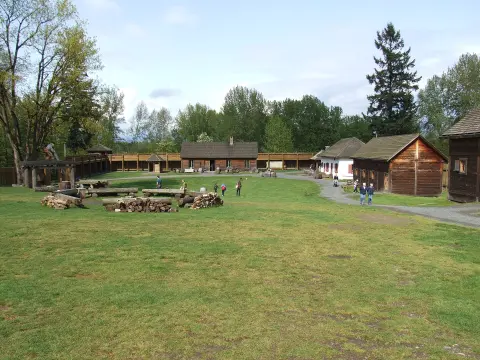
The fort stands on a gentle rise above the Fraser River, surrounded by a high log palisade with corner bastions. Inside is an open yard with several buildings: the Big House, the storehouse, the cooperage, a blacksmith's shop and servants' quarters. The style is simple and practical, timber and whitewash, built for work. Below the fort lies the river, broad and brown, with farmland on the far bank. Next door, the village of Fort Langley has tree-lined streets, heritage buildings and a riverside walk.
Why it matters
Fort Langley is where the story of British Columbia as a political place began. It is also a site where the history of trade between the Hudson's Bay Company and First Nations is told, including the impact on Indigenous communities. Parks Canada works with local nations to share those stories. For families, it is a lively, hands-on museum. For history lovers, it is one of the most important places in western Canada.
Your walk-through
The stops a guide would take you to, in order.
-
1
The Visitor Centre
Start in the Visitor Centre near the entrance. Watch the short film and look at the exhibits on the fur trade and the Kwantlen people. Pick up a map of the site and the day's programme. Interpreters often run talks and demonstrations, and you will want to know when they are happening. Then walk through the gate into the fort.
-
2
The storehouse
Head first for the storehouse. This long, timber building is the only one that survives from the Hudson's Bay Company era. Inside, look at the bundles of furs, the wool blankets, the tools and the trade goods. This was the heart of the business. Furs, especially beaver, were packed here before being shipped to London to make hats and clothing.
-
3
The cooperage
Now visit the cooperage, the barrel maker's workshop. Barrels were essential at Fort Langley. They held the salted salmon that the fort shipped across the Pacific, as far as Hawaii. Watch the interpreter shape staves and bind them with hoops. It is skilled, careful work, and the barrels had to be watertight to keep the fish from spoiling.
-
4
The Big House
Walk up to the Big House, the home of the chief trader and the most important building in the fort. On 19 November 1858, the colony of British Columbia was proclaimed here, and James Douglas took his oath as governor. Imagine the officials gathered on a wet November day, while gold miners crowded the river towns. Today, the rooms are furnished as they might have been then.
-
5
The village and riverside
Finish by walking out of the fort and down into the village of Fort Langley. Stroll Glover Road with its antique shops, bakeries and heritage houses. Then head to the river, where a walkway leads along the bank. Look out at the Fraser, which carried canoes, sternwheelers and fortune hunters past this spot. It is a peaceful end to a day in history.
Things you might not know
- The Crown Colony of British Columbia was proclaimed at Fort Langley on 19 November 1858.
- The fort shipped barrels of salted salmon to markets including Hawaii.
- Only the storehouse survives from the Hudson's Bay Company era; the other buildings are reconstructions.
Researched November 2026 from: parks.canada.ca, parks.canada.ca, pc.gc.ca, britannica.com. Fees and hours change, so check on the day.