⭐ Must-see · Granville Island, False Creek, 4 km from central Vancouver
Granville Island Public Market
Fresh fish, warm bread and the smell of salt water
🎧 Listen to this guide · about 5 min
Pop your earphones in and we'll walk you round.
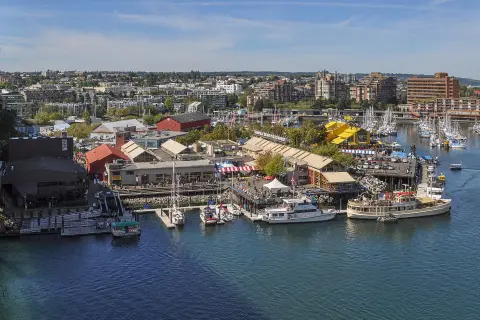
Come on in, and follow your nose. You are standing in the Granville Island Public Market, the place Vancouverites send every visitor first. Inside, the stalls are piled with Okanagan apples, smoked salmon, fat loaves and handmade fudge. Outside, little ferries the size of bathtubs putter across False Creek, and seagulls eye your lunch. Above you rumble the steel girders of the Granville Street Bridge. It is noisy, cheerful and a little chaotic, which is exactly the point. This is a place to graze rather than eat one big meal. Buy a little here, a little there, and find a seat on the dock outside.
The story of Granville Island Public Market
Granville Island was not always an island, and it was barely land at all. It began as a pair of sandbars in the shallow tidal flats of False Creek, where Musqueam, Squamish and Tsleil-Waututh people fished. From about 1915, engineers dredged the creek and dumped the fill onto the sandbars, building up a small island for industry.
For the next few decades it was all factories: sawmills, rope works, machine shops and foundries, served by rail and by boat. It was a smoky, grimy place. After the Second World War, industry began to move away, and by the 1960s much of the island was rundown and half empty.
In the 1970s the federal government took a bold step. Rather than clear the island, it kept the old tin sheds and turned them into a public space for food, arts and boating. The Public Market opened in 1979 in a former industrial building, and it was an instant hit. One working business stayed on: the concrete plant at the island's edge. Its six silos were painted as giant figures by the Brazilian artist twins OSGEMEOS in 2014.
The setting
The island sits under the south end of the Granville Street Bridge, joined to the mainland by a short causeway. Its streets are narrow, with old railway tracks still set in the road, and the buildings are mostly corrugated metal sheds painted in bright colours. The market hall itself is a long, open building with high ceilings, big doors facing the water and a maze of stalls inside. Around it you will find artists' studios, a theatre, a brewery, boat docks, a children's market and a busy little harbour. Everything is close together and easy to explore on foot.
Why it matters
Granville Island is studied by city planners around the world. It showed that old industrial land could be brought back to life without bulldozing its character. It is also a real working market. Many stalls are family businesses that have been here for decades, and local chefs still shop here. For visitors it is the easiest way to taste British Columbia in one place: wild salmon, local cheese, berries and the province's wines and craft drinks.
Your walk-through
The stops a guide would take you to, in order.
-
1
The Aquabus dock
Arrive the way locals love to, by tiny ferry across False Creek. The little rainbow-coloured Aquabus and the blue False Creek Ferries boats run back and forth all day. Step off at the market dock and look back at the towers of Yaletown and the West End. This short crossing is one of the cheapest and happiest boat rides in the city.
-
2
The seafood counters
Inside, head for the fish. Look for smoked salmon in many styles, from candied salmon nuggets to cold-smoked slices. Pacific salmon is the heart of the coastal food culture here, and it was central to First Nations life long before any market existed. Ask the staff which species are in season. Most are happy to explain the difference between sockeye, coho and spring salmon.
-
3
The bakeries and produce stalls
Now wander through the fruit and vegetable stalls. In late summer and autumn, the tables are heavy with apples, peaches and cherries from the Okanagan and Fraser valleys. In winter there are root vegetables, mushrooms and preserves. Pick up something warm from one of the bakeries. Then step out onto the waterfront deck to eat it, and guard it from the gulls.
-
4
Railspur Alley and the artisan studios
Leave the market and stroll toward Railspur Alley. Here old sheds have become small studios for potters, jewellers, weavers and glass makers. Many of them work in the open, so you can watch them at their craft. The rail tracks under your feet are a reminder that freight trains once rolled right through this island.
-
5
The Giants silos
Finish at the concrete plant at the east end. Look up at the six huge silos. In 2014 the Brazilian twin artists OSGEMEOS painted them as six giant figures in bright clothes, as part of the Vancouver Biennale. They wrap all the way around the round silos. It is one of the largest pieces of public art in the city, and the cement trucks still come and go beneath it.
Things you might not know
- Granville Island was built up from sandbars with fill dredged out of False Creek, starting around 1915.
- A working concrete plant still operates on the island beside the market.
- The island is owned by the federal government and managed by a Crown corporation.
Researched November 2026 from: granvilleisland.com, historyhit.com, destinationvancouver.com, en.wikipedia.org. Fees and hours change, so check on the day.