🚗 Day trip · Lübbenau, Spreewald, 95 km from central Berlin
Lübbenau and Lehde, Spreewald
By the Tralover editorial team · Fact-checked · How we research
Wooden boats, quiet channels and pickled gherkins
🎧 Listen to this guide · about 5 min
Pop your earphones in and we'll walk you round.
Welcome to Lübbenau, the gateway to the Spreewald. Here the River Spree splits into a web of small channels, woven through meadows and forests. For centuries, people here travelled mostly by boat. Today you'll do the same. We'll step into a long, flat wooden punt, and a boatman will push us along with a pole. There's no engine, just the gentle splash of water, birds in the trees and wooden houses along the banks. Our destination is the village of Lehde, where the canals are the main streets. Tuck a blanket around your knees, and let's glide.
The story of Lübbenau and Lehde, Spreewald
The Spreewald was formed at the end of the last Ice Age, when melting glaciers left behind a wide, flat valley. The River Spree spread out here into many arms, creating a wetland of islands and channels.
People settled here early. The Sorbs, or Wends, a Slavic people, have lived in this area for over a thousand years. Their language, customs and colourful costumes are still part of local life, and you'll see road signs in both German and Sorbian. For centuries farmers used the waterways to move hay, animals and harvests by punt. In some villages, the post was delivered by boat, a tradition that continues in parts of the Spreewald today.
Lübbenau grew as a market town and was ruled for centuries by the counts of Lynar, whose palace still stands in the town. In the nineteenth century, the railway brought visitors from Berlin, and tourism began. In 1991 UNESCO named the Spreewald a biosphere reserve, protecting both its nature and its traditional way of life. The region is also known for its pickled gherkins, Spreewälder Gurken, which have protected status in the European Union.
The setting
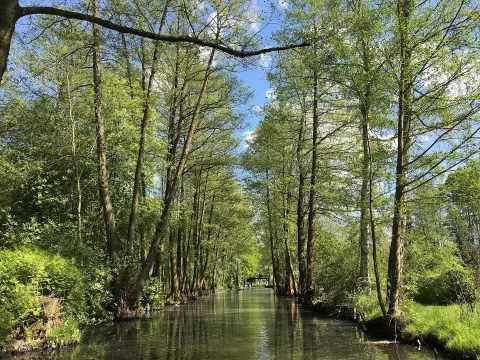
The Spreewald lies about 100 kilometres southeast of Berlin. Lübbenau sits on its edge, with a small old town, a palace and a busy harbour where the punts wait. Beyond the town, the land is flat and green, criss-crossed by channels, called Fliesse, lined with alder trees, reeds and meadows. Lehde is a short punt ride away, a village of thatched and wooden farmhouses, each on its own little island, linked by footbridges and water. In winter, mist often hangs over the channels and the trees stand bare and still. In summer, it's leafy and cool.
Why it matters
The Spreewald is a rare living cultural landscape, where people and nature have shaped each other for centuries. It's protected for its wildlife, including otters and kingfishers, and for its Sorbian heritage. For Berliners it's a classic escape, a place to slow down. For you, it's a chance to see a gentler, rural Germany, just over an hour from the capital's crowds and concrete.
Your walk-through
The stops a guide would take you to, in order.
-
1
The harbour at Lübbenau
Start at the main harbour. Rows of long wooden punts are tied up here, some with tables and benches down the middle. Choose a trip that suits you; many go to Lehde and back in two or three hours. In winter, look for boats with blankets and hot drinks. Before boarding, try a pickled gherkin from one of the stalls. They come in many flavours, from mild to spicy.
-
2
Gliding along the channels
Once you're aboard, sit back and listen. The boatman stands at the back and pushes the punt along with a long pole. Watch how easily he steers through the narrow bends. Look at the gardens running down to the water, the wooden boat sheds, the reeds. If you're lucky, you might see a heron standing still, or the bright blue flash of a kingfisher.
-
3
Arriving in Lehde
Here is Lehde. Houses stand on small islands, joined by humped wooden bridges. For generations, everything arrived here by boat: food, coal, even the post. Many of the old farmhouses are built of logs, with steep roofs. Step ashore and stretch your legs. It's tiny and charming, a world in miniature, and quiet in winter.
-
4
The Open-Air Museum
In Lehde you'll find the Spreewald Open-Air Museum, a small village of old farmhouses moved here and furnished as they were long ago. You can see how families lived, cooked and stored hay in the attic. Look for the traditional Sorbian costumes, with their wide, stiff headdresses. The museum usually opens from spring to autumn, so check before you go if you're visiting in winter.
-
5
Back to Lübbenau's old town
Ride back to Lübbenau and take a short stroll through the old town. Look at the white palace of the counts of Lynar, set in its park, and the baroque church of St Nicholas. In the weeks before Christmas, the town often holds a seasonal market, sometimes with boats carrying visitors to Lehde. End with a warm drink, and watch the punts glide home in the dusk.
Things you might not know
- UNESCO recognised the Spreewald as a biosphere reserve in 1991.
- In parts of the Spreewald, mail is still delivered by boat.
- Spreewald gherkins have protected geographical status in the European Union.
Researched November 2026 from: spreewald.de, spreewald.de, spreewald.de, en.wikipedia.org. Fees and hours change, so check on the day.