💎 Hidden gem · Tempelhof and Neukölln, 6 km from central Berlin
Tempelhofer Feld
By the Tralover editorial team · Fact-checked · How we research
Runways for walkers under Berlin's biggest sky
🎧 Listen to this guide · about 5 min
Pop your earphones in and we'll walk you round.
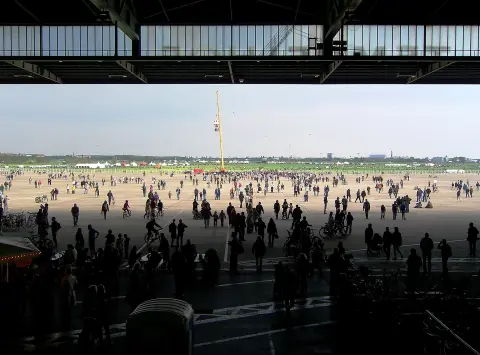
Welcome to Tempelhofer Feld. Close your eyes for a second and listen. No engines, no sirens. Just wind, a few skylarks in summer, and the hum of skateboard wheels on tarmac. Open them, and you're standing on an old airport. The runways are still here. So are the taxiways and the huge curved terminal on the edge of the field. But the planes left in 2008, and Berliners moved in. They fly kites, ride bikes, grow vegetables and picnic where pilots once touched down. It is a strange and wonderful place, and on a clear day the sky here feels bigger than anywhere else in the city. Let's go for a walk down the runway.
The story of Tempelhofer Feld
This land was a parade ground for the Prussian army long before it was an airport. Early aviators tested flying machines here, and in 1923 Tempelhof became an official airport. In the 1930s the Nazi regime ordered a vast new terminal, designed by architect Ernst Sagebiel. Work began in 1936, and the huge curving building was one of the largest structures in the world at the time.
The airport's finest hour came after the war. In June 1948 the Soviet Union blocked all roads and railways into West Berlin. The Western Allies answered with the Berlin Airlift. For nearly a year, planes landed at Tempelhof every few minutes, bringing food, coal and medicine. Some pilots dropped sweets on little parachutes for the children watching from the fences, and they became known as the Candy Bombers. The blockade ended in May 1949.
Tempelhof stayed in use for decades, but it was small and in the middle of town. The last flights left on 30 October 2008. In 2010 the airfield opened as a public park. In 2014 Berliners voted in a referendum to keep the field free of new building, and so it remains open.
The setting
The field is enormous, around three square kilometres, almost flat, and ringed by a fence with several entrances. Two long runways cross it from east to west, with a ring of taxiways around them. The grass in the middle is a meadow, partly fenced off in spring to protect nesting skylarks. On the western edge stands Sagebiel's terminal, a quarter-circle of pale stone more than a kilometre long. On the eastern side, towards Neukölln, there are community gardens built from wooden boxes and old pallets, barbecue areas and a dog field. There are few trees, so the wind blows freely and the sky stretches to the horizon.
Why it matters
Tempelhofer Feld is a Berlin story in itself: a place of military power, Nazi ambition and Cold War rescue, now handed back to the people. The 2014 referendum, in which voters chose open space over new flats, still shapes debates about how Berlin should grow. For locals it is a weekend ritual. For visitors it is the easiest way to feel Berlin's love of freedom and space, and to see the city's history written right into the ground beneath your feet.
Your walk-through
The stops a guide would take you to, in order.
-
1
Entrance at Columbiadamm or Tempelhofer Damm
Come in through one of the western gates near the old terminal. Pause by the signboards to look at the map. Notice how the field is laid out like a giant clock, with paths radiating from the centre. And notice the people: runners, families with prams, someone on a unicycle. This is what Berlin does with its spare airports.
-
2
The old terminal frontage
Look back at the terminal. Its great curved wall faces the field, with a long canopy that once sheltered planes from the rain while passengers boarded. Sagebiel designed it in the 1930s to impress. After 1945 the Americans used it as an air base. Guided tours sometimes go inside to the hangars and the roof; check the THF Berlin website if you'd like to join one.
-
3
The southern runway
Now walk out onto the runway itself. Feel how wide it is, how smooth. Kite-surfers on boards and skates zoom past when the wind is up. Imagine a Douglas C-47 or a C-54 roaring in, loaded with flour and coal, during the Airlift. In the busiest days, planes landed here around the clock. Today the only roar is from a kid on a scooter.
-
4
The skylark meadow
In the middle of the field, look at the long grass inside the low fences. This is a protected meadow, home to skylarks and other ground-nesting birds. In spring and summer you can hear them singing high overhead, often before you can see them. It's quite something to find wild birds breeding in the middle of a capital city. Please keep to the paths here.
-
5
Community gardens on the Neukölln side
Head east to the gardens. Raised beds built from crates, old bathtubs and wooden planks are full of herbs, sunflowers and tomatoes in summer. Neighbours run these plots themselves. In winter they look a little sleepy, but the hand-painted signs and odd sculptures are still fun to explore. From here you can leave through the Oderstrasse gate into Neukölln for coffee.
Things you might not know
- Flights at Tempelhof ended on 30 October 2008.
- In a 2014 referendum, Berliners voted to keep the former airfield free of development.
- During the 1948–49 Airlift, some pilots dropped sweets on tiny parachutes for watching children.
Researched November 2026 from: berlin.de, thf-berlin.de, visitberlin.de, en.wikipedia.org. Fees and hours change, so check on the day.