🚗 Day trip · Wicklow Mountains, County Wicklow, 55 km from central Dublin
Glendalough
By the Tralover editorial team · Fact-checked · How we research
A saint's valley of two lakes and a round tower
🎧 Listen to this guide · about 5 min
Pop your earphones in and we'll walk you round.
Welcome to Glendalough, the valley of the two lakes. We are in the Wicklow Mountains now, and it feels a long way from Dublin. Steep green slopes rise on either side. Mist often hangs over the water. In the sixth century, a holy man named Kevin came here looking for solitude. Others followed him, and a great monastery grew up in this valley. Its round tower still stands, tall and grey, among old gravestones and stone churches. Today we will walk among the ruins, then follow the lakeshore deeper into the valley. Breathe in the mountain air, listen to the water, and let the place slow you down.
The story of Glendalough
Glendalough was founded by Saint Kevin in the sixth century. He is said to have lived for a time as a hermit in a small cave above the Upper Lake, now called St Kevin's Bed. Tradition says he died around 618, and legend says he lived to be one hundred and twenty. The monastery that grew up around him became one of the most important religious centres in Ireland, a place of prayer, learning and pilgrimage.
Over the centuries the monastery was raided several times, including by Vikings, and damaged by fire. Even so, it flourished. In the twelfth century Laurence O'Toole, later Archbishop of Dublin and canonised as a saint, served as abbot here. After the Anglo Norman arrival, the diocese of Glendalough was united with Dublin in the early thirteenth century, and the monastery's power faded. English forces attacked it in 1398.
Pilgrims kept coming for centuries, especially on Saint Kevin's feast day, 3 June. In the nineteenth century the ruins were repaired by the Board of Works, and the site is now cared for by the Office of Public Works within the Wicklow Mountains National Park. Today, walkers and pilgrims share the same paths, and Saint Kevin's feast day is still marked in the valley.
The setting
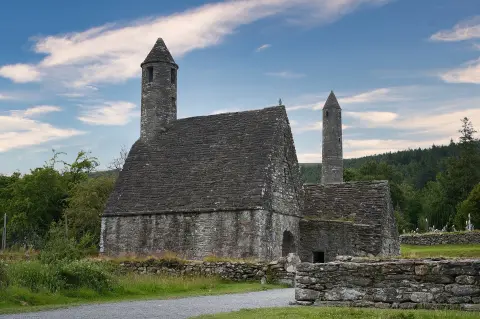
Glendalough is a glacial valley, carved by ice during the last Ice Age. The glaciers left two lakes, the smaller Lower Lake and the larger Upper Lake, connected by a stream. Steep wooded slopes rise around them. The main monastic site stands near the Lower Lake, entered through a rare stone gateway. Inside are the round tower, about thirty metres high, the roofless cathedral, the Priest's House, a graveyard with crosses, and St Kevin's Church, with its stone roof and small belfry. Further along the valley, near the Upper Lake, are more church ruins and the cave of St Kevin's Bed. Walking trails lead along the lakes and up into the hills.
Why it matters
Glendalough is one of the most important early Christian sites in Ireland. Its buildings show how monastic life worked in early medieval Ireland, when monasteries were also centres of farming, crafts and learning. Today it is a place of pilgrimage and quiet reflection, and the heart of the Wicklow Mountains National Park, which protects the landscape, the wildlife and the walking trails that thousands enjoy every year.
Your walk-through
The stops a guide would take you to, in order.
-
1
The monastic gateway
We begin at the gateway, the only surviving one of its kind at an early Irish monastic site. It has two granite arches. Look on the inside wall for a stone carved with a cross. This marked the edge of sanctuary. Anyone who passed through here and sought protection was meant to be safe within the monastic grounds.
-
2
The round tower
Here is the round tower, about thirty metres tall, built roughly a thousand years ago. Look at the doorway, high above the ground. Monks probably reached it with a ladder. Round towers were bell towers, and they may also have been used to store valuables or as lookouts. Its conical cap was rebuilt in the nineteenth century using the original stones.
-
3
The cathedral and graveyard
Walk into the roofless cathedral, the largest building in the valley. Its oldest parts date from the tenth century. Around you is the graveyard, with old stones and crosses. Look for St Kevin's Cross, a tall granite cross without the usual ring carved through. There is a tradition that if you can wrap your arms around it, your wish will come true.
-
4
St Kevin's Church
Down the slope you will see a small stone church with a steep stone roof and a tiny round belfry. It is often called St Kevin's Kitchen, because the belfry looks like a chimney. But it was a church, not a kitchen. Look at the stone roof. It has survived for many centuries without timber support.
-
5
The Upper Lake
Finally, follow the green road along the Lower Lake to the Upper Lake, about thirty minutes' walk. Here the valley opens and the cliffs rise steeply. On the far side, above the water, is the cave known as St Kevin's Bed. It is not safe to climb to it. Instead, find a rock by the shore and simply sit. This is the solitude Kevin came looking for.
Things you might not know
- The round tower at Glendalough is about 30 metres tall and roughly a thousand years old.
- Laurence O'Toole was abbot of Glendalough before becoming Archbishop of Dublin.
- The monastic gateway is the only surviving one of its kind at an early Irish monastic site.
Researched November 2026 from: heritageireland.ie, en.wikipedia.org, wicklowmountainsnationalpark.ie. Fees and hours change, so check on the day.