🚗 Day trip · Tlacolula Valley, 31 km from central Oaxaca
Teotitlán del Valle
By the Tralover editorial team · Fact-checked · How we research
Where Zapotec weavers turn wool into colour
🎧 Listen to this guide · about 6 min
Pop your earphones in and we'll walk you round.
Welcome to Teotitlán del Valle, a Zapotec village at the foot of the mountains, about half an hour east of Oaxaca City. Step out of the car and listen. In many homes you will hear the click and thud of wooden looms. You will hear Zapotec spoken in the streets. And you will see rugs everywhere, hanging in doorways and stacked in courtyards, full of zigzags, diamonds and deep natural colours. Teotitlán has been weaving for generations, and many families welcome visitors to their workshops. Come with curiosity and time. This is not a museum but a living village, and the best way to know it is to sit with the weavers.
The story of Teotitlán del Valle
Teotitlán is an old Zapotec community. Its name comes from Nahuatl and is often translated as land of the gods. According to local tradition, it was founded by Zapotec people in the fifteenth century, and the Spanish refounded it as a colonial village in 1527. The village kept its Zapotec language, customs and community organisation through the colonial period and beyond.
Weaving is central to its history. Before the Spanish arrived, people wove cotton and other fibres. The Spanish introduced sheep and the treadle loom, and Teotitlán's weavers began working in wool. Over the centuries they became famous for their rugs and blankets.
In 1581, the Spanish began building the Church of the Precious Blood of Christ on the site of a Zapotec temple, reusing its stones. In the twentieth century, as tourism grew, the village's textiles reached markets across Mexico and the world. Some weavers revived natural dyes like cochineal and indigo. In 1995, the community opened its own museum, Balaa Xtee Guech Gulal, to tell the town's history in its own words. Today weaving remains the main livelihood for many families, alongside farming.
The setting
Teotitlán lies in the foothills on the north side of the Tlacolula Valley, a few kilometres off the main highway. The village is laid out in a grid of streets, with adobe and brick houses built around courtyards. The church and its large atrium stand in the centre, near the market and the community museum. Above the village rises El Picacho, a sacred mountain with wide views of the valley. In family workshops, wooden looms stand in shaded rooms or courtyards, with skeins of dyed wool hanging nearby and pots for dyeing outside.
Why it matters
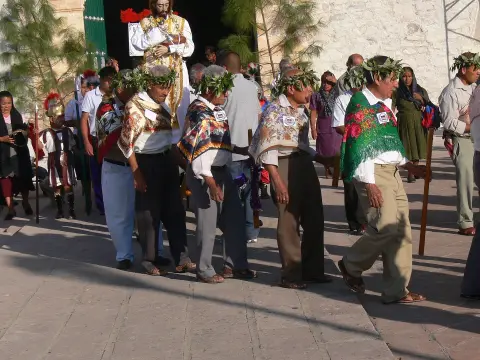
Teotitlán shows how a craft can sustain a community and its identity. Weaving supports many families, and the rugs carry patterns drawn from Zapotec designs, from nature and from modern art. The use of natural dyes connects the weavers to ancient knowledge of plants and insects. The village also keeps strong Zapotec traditions, such as the Feather Dance, the Danza de la Pluma, performed at its main festival in July. Visiting here, and buying directly from weavers, helps keep this living culture strong.
Your walk-through
The stops a guide would take you to, in order.
-
1
A family workshop
Begin at a family workshop. Many weavers welcome visitors and will show you the whole process. You may see raw wool being washed and carded, then spun into yarn on a wheel. Ask questions. How long does a rug take? Where does the design come from? Watch your hosts work the treadle loom, pushing the pedals and passing the yarn through by hand. Buying is never required, but it is appreciated.
-
2
Natural dye demonstration
In many workshops you can see a dye demonstration. Your host may crush a cochineal insect in the palm of their hand, producing a deep red. Then they add lime juice, and the red turns orange. Add a little ash or baking soda, and it turns purple. Indigo produces blues, and local plants produce yellows and greens. These dyes have been used in Oaxaca for centuries. It is chemistry, art and tradition in one moment.
-
3
Church of the Precious Blood of Christ
Walk to the church in the centre of the village. Its construction began in 1581 on the site of a Zapotec temple. Look closely at the walls, especially around the back and sides. You can see carved stones from the old temple, with Zapotec geometric patterns, set into the colonial walls. Inside, the church holds colonial statues of saints. Be respectful, as this is the heart of village life.
-
4
Community museum
Next to the church square you will find the community museum, Balaa Xtee Guech Gulal, opened in 1995. It displays archaeological finds from the area, weaving tools and exhibits about local customs, including traditional weddings. The museum was created by the community itself, so it tells the story of Teotitlán from the inside. It is small, but it gives depth to everything you see in the workshops.
-
5
The market
If you visit in the morning, stop at the municipal market near the centre. Women sell fresh tortillas, tamales, fruit and flowers, often speaking Zapotec. You may find local specialities like mole negro and tamales, which Teotitlán is known for. It is a good place for breakfast or a snack, and a chance to see daily village life far from the tourist trail.
-
6
View toward El Picacho
Before you leave, find a spot where you can see El Picacho, the sacred mountain above the village. Its peak is a place of pilgrimage and offerings for local people. Hikers can climb it with a local guide for wide views of the valley, but it is a long and steep walk. Even from the village, the mountain frames the scene, reminding you how closely the land and the culture are tied together here.
Things you might not know
- Teotitlán's Church of the Precious Blood of Christ, begun in 1581, reuses carved stones from a Zapotec temple.
- Cochineal, a tiny insect that lives on prickly pear cactus, produces red, orange and purple dyes.
- The community museum Balaa Xtee Guech Gulal opened in 1995.
Researched November 2026 from: en.wikipedia.org, mexicodesconocido.com.mx, whc.unesco.org. Fees and hours change, so check on the day.