💎 Hidden gem · Tlacolula Valley, 36 km from central Oaxaca
Yagul
By the Tralover editorial team · Fact-checked · How we research
A Zapotec stronghold among cactus and cliffs
🎧 Listen to this guide · about 6 min
Pop your earphones in and we'll walk you round.
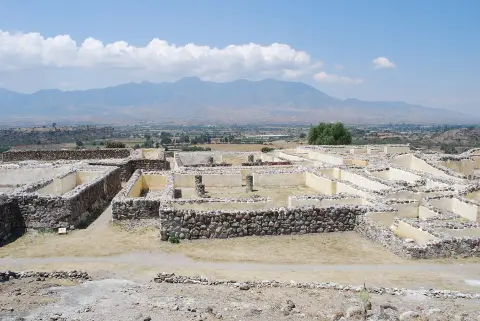
Welcome to Yagul. We are in the Tlacolula Valley, east of Oaxaca City, on a rocky hill dotted with tall cactus. Below us lie cornfields and agave plantations. Above us rise cliffs crowned by an ancient fortress. Between them stand the remains of a Zapotec city, with a great ball court, temple platforms and a labyrinth of palace rooms. Most tours rush past on their way to Mitla and Hierve el Agua. That leaves Yagul quiet and open. The only sounds may be birds, the wind in the cactus and your own footsteps on the stones. Take your time here. This place rewards those who linger.
The story of Yagul
People first settled at Yagul between around 500 and 100 BC. For many centuries it was a modest community. Its great period came much later, in the centuries before the Spanish conquest, from around 1250 to 1521, when it was the capital of a Zapotec city-state in the Tlacolula Valley. By the time the Spanish arrived, its population is thought to have been more than six thousand people.
Most of the buildings you see date from this later period, although the ball court is older. It was built between about AD 500 and 700, then widened between 700 and 900. The palace complex reflects the same architectural tradition as nearby Mitla, with rooms arranged around patios and decorated with stone fretwork.
In 2010, UNESCO inscribed the Prehistoric Caves of Yagul and Mitla as a World Heritage Site. The listing covers the caves and rock shelters in the hills around here. They hold evidence of some of the earliest steps toward plant domestication in North America, as well as rock paintings, showing that people have lived in this landscape for thousands of years. Yagul itself is also protected as a natural monument, for its cactus-covered hills and wildlife.
The setting
Yagul is built on a hill that rises from the valley floor. The lower part of the site holds the ceremonial and residential core. Here you find the ball court, the largest in the Valley of Oaxaca, about forty-seven metres long. Nearby are patios surrounded by platforms and the Palace of the Six Patios, a dense complex of rooms and courtyards. A path climbs above these ruins to the cliffs on the northeast, where the fortress sits, with lookout points over the valley. All around, the hillsides are covered in organ cactus, agave and thorny shrubs, framing the stone ruins in green.
Why it matters
Yagul helps tell the story of the Zapotec world after the decline of Monte Albán, when power was spread among smaller city-states. Its palace and ball court show how those city-states lived, ruled and celebrated. The surrounding landscape, with its caves and rock shelters, connects Yagul to the deep past of plant domestication, one of the great turning points in human history. For visitors, it offers a calm, uncrowded encounter with Zapotec ruins in a beautiful natural setting, and a better understanding of the valley that leads to Mitla.
Your walk-through
The stops a guide would take you to, in order.
-
1
Entrance and cactus slope
From the entrance, walk up the gentle slope toward the main ruins. Notice the vegetation around you. Tall organ cactus, prickly pear and agave cover the hillside. This is dry country, and the plants are well adapted to long months without rain. The site is protected as a natural monument as well as an archaeological zone, so the landscape here is part of what you came to see.
-
2
The great ball court
Soon you reach the ball court, shaped like a capital letter I. It is the largest in the Valley of Oaxaca, about forty-seven metres long. Walk along its central alley and look at the sloping side walls. It was built between about AD 500 and 700 and later widened. Imagine players moving the heavy rubber ball with their hips, and spectators watching from above. The game mixed sport, ritual and politics.
-
3
Patio 4 and the tombs
Nearby, look for the patio with platforms on its sides. Under one of these structures lies a tomb that archaeologists uncovered, decorated with stone carvings. Some tombs at Yagul show stone heads and fretwork patterns. Access to tombs may be restricted to protect them, so follow any signs and ropes. Even from outside, you can feel how closely the living and the dead were connected in Zapotec life.
-
4
Palace of the Six Patios
Next, explore the Palace of the Six Patios. It is a maze of narrow passages and rooms grouped around six courtyards, in three units of two patios each. It was probably the home of Yagul's ruling family. As you walk through, notice how the corridors twist and turn. You can see similarities with the palaces of Mitla, though the fretwork here is less preserved. It feels like a puzzle in stone.
-
5
Path to the fortress
Now take the path that climbs toward the cliffs. It is steep and rocky in places, so watch your step and bring water. As you climb, the valley opens up below you. Look back at the palace and ball court, which now look small. The fortress sits high on the rocks, and its position shows how important defence was in the troubled centuries before the Spanish arrived.
-
6
Fortress lookout
At the top, find a lookout point on the fortress. One is reached by a narrow bridge over a gap in the rock, so take care. From here you see across the Tlacolula Valley, with its fields, villages and mountains. In the hills around you lie the caves and rock shelters recognised by UNESCO. Stand still, listen to the wind, and feel how long people have lived in this valley.
Things you might not know
- Yagul's ball court, about 47 metres long, is the largest in the Valley of Oaxaca.
- The Prehistoric Caves of Yagul and Mitla became a UNESCO World Heritage Site in 2010.
- Yagul had more than 6,000 inhabitants just before the Spanish conquest.
Researched November 2026 from: en.wikipedia.org, whc.unesco.org, inah.gob.mx, lugares.inah.gob.mx. Fees and hours change, so check on the day.