⭐ Must-see · Entertainment District, 1 km from central Toronto
CN Tower
By the Tralover editorial team · Fact-checked · How we research
Toronto from the sky, with the lake at your feet
🎧 Listen to this guide · about 7 min
Pop your earphones in and we'll walk you round.
Welcome to the tower you have been seeing all day. From the airport road, from the islands, from the end of every downtown street, it is always there, a thin grey needle against the sky. Today you go up it. In about a minute, a glass-fronted elevator lifts you more than three hundred metres above the pavement. Your ears may pop. Then the doors open and Toronto spreads out below you like a map someone left on a table. The lake runs to the horizon. The islands curl in the harbour. On a clear day the view seems endless. Take your time up here. Find the glass floor, look down if you dare, and let the city introduce itself from above.
The story of CN Tower
In the late 1960s Toronto had a problem. New skyscrapers were going up downtown, and they were blocking television and radio signals. Broadcasters needed antennas higher than anything around them. Canadian National, the railway company, owned land by the tracks near the lake, and it wanted a project that would also show off Canadian industry. The answer was a tower.
Construction began on 6 February 1973. Concrete was poured around the clock, and the structure was topped out on 2 April 1975. The final antenna was lifted into place in 36 sections by a Sikorsky Skycrane helicopter nicknamed Olga, a job that took about three and a half weeks instead of the six months first planned. The tower opened to the public on 26 June 1976. It cost about 63 million Canadian dollars, and its own revenue paid that back within fifteen years.
For more than three decades it was the tallest free-standing structure in the world, from 1975 until the Burj Khalifa passed it in 2007. In 1995 the American Society of Civil Engineers named it one of the modern Seven Wonders of the World. That same year, when Canadian National was privatised, the tower passed to the Canada Lands Company. Officially it became Canada's National Tower, but everyone still calls it the CN Tower.
The setting
The tower rises from the old railway lands just south of Front Street, between the convention centre and the Rogers Centre stadium. Its core is a hollow hexagon of reinforced concrete, with three curved supports flaring out at the base like the legs of a tripod. Elevators run up the outside of the core in glass-lined shafts, so the city drops away as you rise. The main pod sits partway up. Inside it you have two observation levels, the Main level at 346 metres and the Lower level at 342 metres, where the glass floor is. Above that, at about 446 metres, is a smaller observation deck now called The Top. Higher still, the slim antenna mast carries the tower to its full 553.3 metres.
Why it matters
For Torontonians the tower is a compass. Lost downtown? Look up, find the tower, and you know where the lake is. It still does the job it was built for, carrying broadcast signals across the region. It is also the city's signature on every postcard and skyline photo. Its height record has gone, but it remains the tallest free-standing structure in the Western Hemisphere, and the views from its decks are the clearest way to understand how Toronto fits together: the grid of streets, the ravines, the islands and the long, flat shore of Lake Ontario.
Your walk-through
The stops a guide would take you to, in order.
-
1
The base and Roundhouse Park
Before you go in, step into Roundhouse Park next door and look straight up. From here you see the three flared legs and the hexagonal core rising out of them. This park sits on old railway land, and the curved brick roundhouse beside you once serviced steam locomotives. It is a good reminder of why the tower is here at all. A railway company built it, on its own railway yard, to solve a very modern problem of blocked signals.
-
2
The glass elevators
Now the ride. Try to stand near the glass. The elevators climb up the outside of the concrete core, so for the first few seconds you see rooftops, then office towers, then nothing but sky and lake. The trip to the observation levels takes about a minute. Watch the skyline flatten beneath you. Children squeal. Grown men grip the rail. It is one of the few elevator rides in the world people talk about afterwards.
-
3
Main Observation Level
Welcome to 346 metres. Walk the full circle slowly. To the south is Lake Ontario and the Toronto Islands, with the little island airport on the western tip. To the east, the harbour and the Port Lands. North, the towers of downtown give way to a carpet of trees and low houses that runs for miles. On a very clear day you may catch the spray of Niagara Falls far across the lake, though most days the haze hides it.
-
4
The Glass Floor
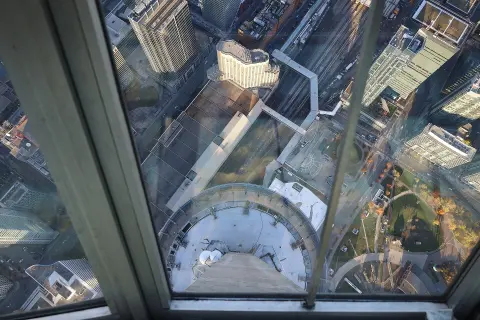
Take the stairs down to the Lower Observation Level at 342 metres and find the glass floor. It was installed in 1994, and it covers about 24 square metres. Each panel is thick thermal glass, built to hold far more weight than you will ever put on it. Still, your brain may refuse. Many people edge out on their toes. Some lie flat for a photo. Look down and you are staring at the base of the tower, more than three hundred metres below.
-
5
The Top
If you bought the higher ticket, a separate elevator takes you up to The Top, once called the SkyPod, at about 446 metres. It is a small, quiet space, closer to the antenna than to the crowds below. The tower operators call it the highest observation platform in the Western Hemisphere. Up here the city looks like a model. Cars are dots. The lake curves away, and you can feel how small even a big city is beside it.
-
6
EdgeWalk and 360 The Restaurant
Look out from the main pod and you may see people in orange suits walking around the outside, hands free, harnessed to a rail. That is EdgeWalk, opened in 2011, a hands-free walk around the roof of the main pod at 356 metres. If that is not your style, the 360 Restaurant sits inside the pod and turns a full circle every 72 minutes. Book a table at sunset and the whole city slowly rotates past your plate.
Things you might not know
- A Sikorsky Skycrane helicopter nicknamed Olga lifted the antenna into place in 36 sections in 1975.
- The tower held the record as the world's tallest free-standing structure from 1975 until 2007.
- The 360 Restaurant completes one full rotation every 72 minutes.
Researched November 2026 from: en.wikipedia.org, cntower.ca, cntower.ca. Fees and hours change, so check on the day.